

A Bridge-Centric Approach to Digital Delivery
Originally published as "Design Recentred" in the February 2026 issue of Bridge Design & Engineering magazine. Republished with permission.
Realising the Promise of Digital Delivery Calls for a Shift in Workflows
“Don’t get me started on digital delivery!” she said. “I just told them to stop all of it. I’m not paying for it. We don’t have time for it. They can update it all after the project is built.”
The frustration in these words contrasted sharply with the bluebird skies of the Melbourne morning on which they were said, as two colleagues, both structural engineers, sipped their morning coffee and discussed the joys and perils of digital delivery.
“We are in the middle of construction and every RFI (Request for Information) that we send is coming back with a price tag of at least $25,000,” she continued. “Even for the smallest of queries, the consultant is telling me, ‘It’s not as simple as just checking calculations or revising designs. We have to update digital models plus drawings, quality control it all, and publish the updates.’”
The frustration voiced by this engineering construction manager is shared by many, including the alarming price tag. The cost of change is real. The emotion in my colleague’s voice that morning made clear that we, as an industry, need to improve how we prepare for change and integrate changes into digital delivery.
As structural engineers and project managers, we can find ourselves on the fringe of digital delivery. After all, we’re responsible for the engineering design, not sorting out how to build the federated model. Yet, it’s not the how we should be worried about – the industry has figured that part out. We instead should be influencing when and why we’re delivering digital models, along with what is included in project deliverables.
Bridge-Centric Approach
The adoption of building information management (BIM) in the transport infrastructure space has added another tool for design consultants, constructors, and stakeholders to use in the pursuit of accelerated delivery, improved quality, and reduced cost. This innovation means it is becoming common for a project’s digital delivery scope to include development of a single federated model — a three-dimensional model incorporating design data from all relevant disciplines.
Successful inclusion of a federated model into a project’s scope requires a digital delivery plan that holistically captures the desired outcomes while granularly accounting for the effort, costs, and challenges that digital delivery adds to a project’s delivery. Developing this plan is the responsibility of project leaders from all involved parties, including design consultants, construction contractors, owners, and stakeholders.
A bridge-centric digital delivery approach prioritises progression of the bridge engineering and design above development of its digital model, while still respecting stakeholders’ interests in digital model development. It maintains the bridge engineer’s control of the design and the construction plan digital development, while encouraging interdisciplinary design coordination throughout a project. It seeks to maximise efficiency and to minimise the risk of rework by utilising a timeline for development of the digital model that enables maximum engineering to be completed ahead of digital modelling.
A Changing Profile of Development
Despite the shift toward digital delivery, the development milestones for project deliverables remain seemingly unchanged. Progression gates (30%, 60%, etc.) are paired with delivery of reports, construction drawings, and model submissions. Preparation and review of these deliverables require significant effort – and cost – to projects.
Traditionally, the effort required to prepare the drawings at each gate with 2D drafting has correlated with, or even trailed, the percent of design completion. However, the introduction of a 3D model for preparation of construction drawings can flip this, resulting in substantial up-front effort to develop a model suitable for extraction of details for concept and preliminary design drawings. The figure below shows a typical relationship between level of effort required for digital delivery methods relative to engineering design completion. It also indicates an assumption that 2D drafting level of effort typically matches level of completion of engineering design.
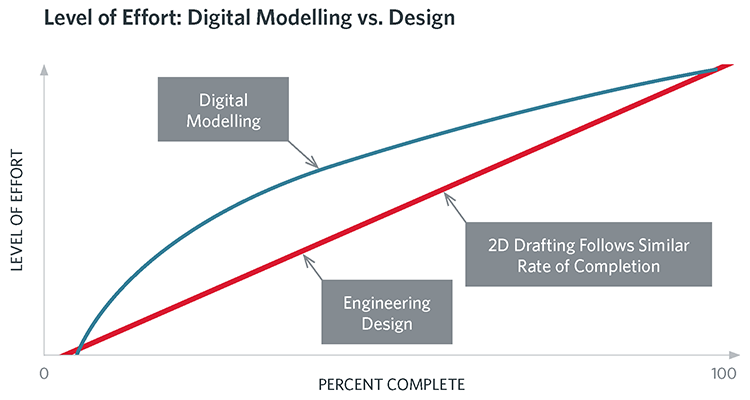
The non-linear rate of effort expended to complete construction drawings illustrates how the addition of a 3D bridge model as a project deliverable has disrupted the traditional flow of bridge design delivery. This is often caused by early project deliverables, such as concept design drawings, that have pre-dated expectations for presentation of details. This leads to early investment in modelling, which is done at risk since engineering design is less progressed.
Time expended creating early deliverables can be reduced through a strategic approach to inclusion of digital models to a project workflow. For example, prioritising model-based design reviews can provide more comprehensive visibility of a bridge in a federated landscape compared to drawings. It can also eliminate often unnecessary production of concept-level plan sets.
Particularly in a design-build environment, the risk (and cost) associated with rework can be amplified by the simultaneous development of multiple engineering disciplines. This risk can be visualised by the gap between the modelling level-of-effort and the engineering level of completion. This gap is affected by not only the design of the bridge but also design development of other engineering disciplines and input from stakeholders. As it accumulates over long design programs, where multiple changes can occur at various stages, rework risk associated with digital delivery becomes significant.
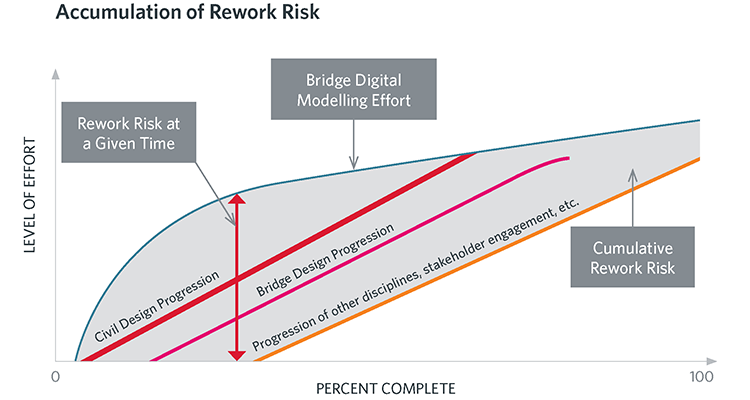
On bridge projects, rework risk can be mitigated by adjusting the level-of-model effort to mirror the engineering level of development as best possible. Achieving this required close collaboration between the design team, construction team, and owners is essential as well. By educating and including project partners in digital delivery planning, we can shape expectations and contract deliverables to better suit an optimised bridge-centric digital delivery plan.
Bridge-Centric Approach to Risk Mitigation
Closing the gap between model development and engineering progression will likely result in some divergence from common industry level-of-development (LOD) practices. This divergence can be overcome through discussions, strategic stopgaps, and negotiations with the client. In fact, an open-minded client is essential to re-shaping digital delivery strategy.
First and foremost, the purpose of the digital model must be central to the digital delivery plan for the bridge. The purpose is generated by collaboratively developing the digital delivery plan through engagement with the full project team.
With needs of others understood, opportunities for reduced LOD can be strategically implemented. For example, cross-braces could be represented as generic shapes with no connection details. While such an LOD divergence represents small savings, accumulation of small savings can significantly reduce effort. Further, when change occurs, there is reduced pressure and effort to make high-LOD updates.
To compensate for reduced model LOD, supplementary information can be provided in design reports or via annotations on drawings. Alternatively, drawings could be eliminated from various contractual submission gates, as federated models supplemented by design reports are generally of sufficient quality for preliminary design review by owners and contractors.
These proposed methods likely are not aligned with current practice and contractual requirements, so early client engagement and agreement is critical.
Innovative Tools
The bridge-centric approach can be complemented by adopting modelling methods that minimise rework risk or minimise the cost of the rework when it is necessary.
Automation and parametric modelling have become critical and is commonly used to rapidly generate digital bridge models. When change occurs, these tools reduce the cost of rework.
However, automation does not necessarily address a quality challenge that has been amplified by digital delivery, which is the creation of multiple sophisticated data sets. Software packages such as Autodesk Revit or Bentley Open Bridge Modeler are commonly used to create bridge models and represent one data set. Meanwhile, engineers are performing analysis using various finite element modelling software platforms, representing a second data set. This multi-data-set environment creates a potential for quality inconsistency and increased rework effort when changes occur.
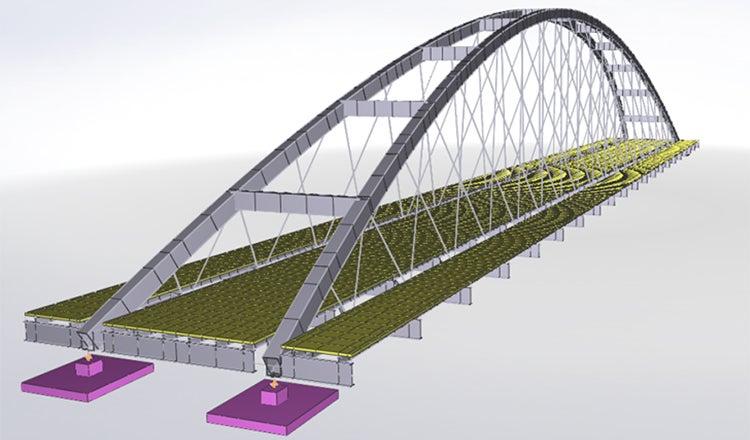
Design teams can resolve these risks by using a single data-set approach. The image below is an example of a complex bridge geometry that has been developed in the software package Rhinoceros 3D, complemented by the parametric modelling capabilities of Grasshopper. Once created in Rhino, the geometry is imported into the structural analysis software. This creates consistency between the digital bridge model and the structural analysis model, eliminating geometric errors in the analysis model and section definitions. When geometric changes are needed, only one data source needs to be manually updated. The software’s integrations also enhance optioneering efforts by facilitating rapid re-analysis when geometric changes or new structural configurations needed to be analysed. In this case, numerous versions of the bridge were evaluated with variable span lengths, arch bracing, arch transverse incline, networked/vertical cables, and arch heights.
Adapting to Change with Less Risk
Digital delivery is a great tool for infrastructure projects. Unfortunately, a project’s digital delivery plan typically focuses on how deliverables will be met and can lose sight of a model’s utility and its exposure to the inevitability of change on projects. This mindset exposes projects to an elevated cost-risk of rework due to the expanded scope that digital delivery has added to projects.
By implementing the ideals of a bridge-centric digital delivery plan, expensive modelling rework risks associated with design development are mitigated and bridge engineers are better placed to drive the completion of the bridge digital model. Through a strategic cooperation and a shift in digital delivery planning, we can increase the effectiveness and reduce risks and costs throughout industry.
With any luck, that will result in a little more to spend on morning coffees, and a little less spent on expensive RFIs.


