

Experts Talk: Safe System Approach to Improve Road Safety with Jay Aber and Olivia Polinsky-Rose
Experts Talk is an interview series with technical leaders from across our transportation program.
The Comprehensive Approach to Designing Roads for All Users and How It Can Become a Game Changer
The United States Department of Transportation has over the last several years committed to a goal of zero deaths on its transportation system and has embraced the Safe System Approach, also known as the SSA, as the means to achieve this goal. The SSA calls for the development and delivery of transportation infrastructure that recognises that people are vulnerable and will make mistakes, but the outcome of their mistake should not result in a serious injury or a fatality. The SSA can be used as a framework for considering safety throughout the life cycle of a transportation project.
Jay Aber, P.E., PTOE, a senior traffic engineer and planner, has two decades of experience improving road safety and increasing accessibility through better planning, design, policy and programming. He is a nationally recognised transportation safety expert, having led and assisted with dozens of comprehensive safety action plans and other related safety plans across the U.S. Traffic engineer Olivia Polinsky-Rose has supported the development and analysis of operations and safety projects throughout the country. She is passionate about implementing data-driven safety strategies that create a more accessible, equitable and efficient transportation system for users of all modes and abilities.
In this interview, they discuss the history of SSA, the difference from traditional roadway design and how it can become a game changer in the U.S.
Q. What is a Safe System Approach to design and how is it different from conventional roadway design approaches?
Aber: The Safe System Approach is a principles-based approach to transportation planning, policy, design, construction and maintenance that recognises:
- Death and serious injury are unacceptable
- Humans make mistakes
- Humans are vulnerable
- Responsibility is shared
- Safety is proactive
- Redundancy is crucial
Through these principles, the SSA acknowledges that all road users and system designers are human beings, and humans will inevitably make mistakes that may lead to crashes. The SSA acknowledges that people travel within the system that was created for them — a system that includes the cars they drive in, the sidewalks they walk on, and the emergency response that could save their life if they’re involved in a crash. While all users have a responsibility to conduct themselves in a safe manner, the goal of the SSA is to plan, develop and construct a transportation system that limits the likelihood of a crash occurring and that in the event of a crash, prevents fatalities. Transportation professionals have the privilege and responsibility of creating and maintaining this safety transportation system that keep ourselves and others safe on the roads.
The SSA provides a framework for explicitly considering safety in every stage of every road project. Throughout project development, the team should ask themselves “What can I do to remove severe conflicts, manage speeds to the surrounding context, separate modes (i.e., pedestrians, bicyclists and motorists) in time and space, and increase attentiveness and awareness of road users?” Traditionally, engineers would ask questions related to roadway capacity, congestion, travel speeds and other traffic operations performance measures. In the SSA, we are prioritising safety over those other transportation metrics.
Polinsky-Rose: Along with the six principles of the SSA, there are five complementary and holistic elements that must work together to achieve zero traffic deaths:
- Safer road users
- Safer vehicles
- Safer speeds
- Safer roads
- Post-crash care
The principles and elements of the approach provide a shift from conventional road safety practice. Rather than considering all crashes, including those with only minor property damage, the SSA shifts attention to life-altering crashes: fatalities and serious injuries. As transportation planners and traffic engineers using the SSA, we are refocusing the planning, design and operations of our transportation system to anticipate human mistakes and reduce impact forces to reduce the severity of a crash and save lives.
Q. Where did the Safe System Approach originate?
Polinsky-Rose: The SSA was originally developed in the 1990s, with Sweden and the Netherlands recognised as the earliest adopters of the approach. Between 1994 and 2015, following the adoption of the SSA into road projects, Sweden and the Netherlands saw a 50% reduction in traffic fatalities (pdf, page 21), compared to the U.S. reduction of 13%. Other early adopters of the SSA, like Norway, France, Australia and New Zealand have all experienced similar impressive reductions in traffic fatalities since adopting its principles. This isn’t a new approach and it’s been incredibly successful at improving road safety throughout the world. Our challenge is adapting these success stories to the American context and planning our transportation systems to save lives.
Q. What will it take to make this approach to road design more prevalent in our industry and our communities?
Aber: The most important piece of achieving the paradigm shift and proactively applying SSA concepts will be working within our agencies and with the public to understand why this is critical for our communities. Transportation agency leadership must commit to prioritising road user safety and empowering and supporting practitioners, such as engineers and planners, to focus on safe mobility for all.
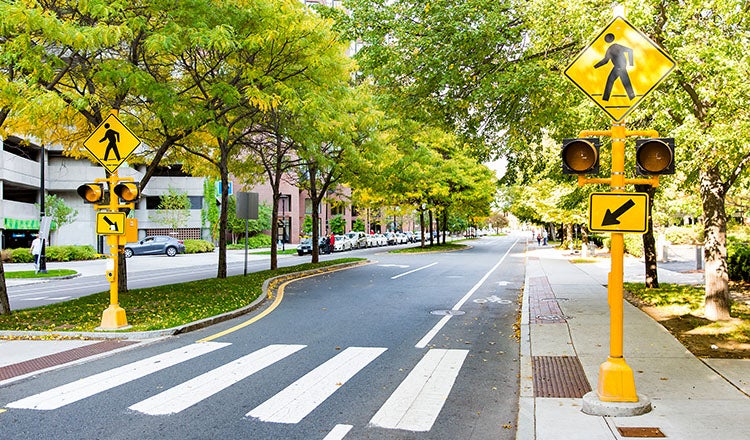
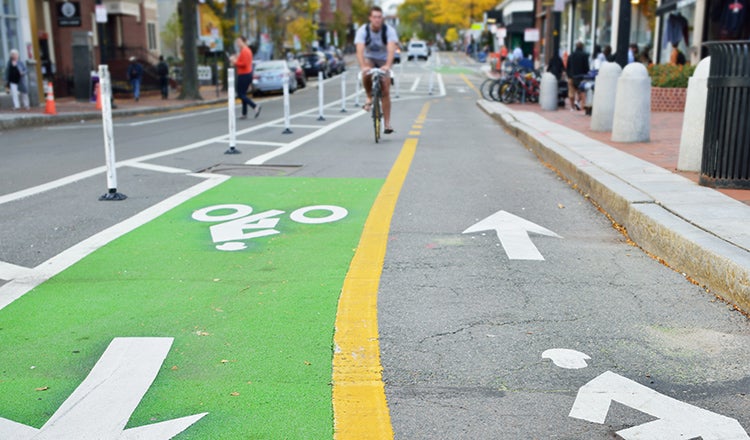
There will be difficult decisions to make that may need extensive public education and engagement to achieve buy-in; however, if we are truly committed to saving lives we will need to make these decisions and work with the public and elected officials to implement them. Leadership will need to focus on the importance of road safety, saving lives and reducing serious injuries at every opportunity. That dialogue creates a message that can successfully change minds and hearts that safety is important. This way, solutions that lead to fewer crashes — such as protected bike lanes, roundabouts, J-turns, medians and rumble strips — become the first choice of the public and planners and designers.
At the same time, practitioners involved with day-to-day projects need to be using the SSA framework of considering crash exposure, likelihood and severity, while communicating about options and integrating solutions meeting SSA principles.
Polinsky-Rose: There’s currently more funding available for transportation safety projects than ever before with the addition of the federal Safe Streets and Roads for All, or SS4A, program and continued funding of the Highway Safety Improvement Program. Those two programs alone fund billions of dollars annually for safety work in the U.S., and they’re the tip of the iceberg when it comes to funds designated for improving our transportation infrastructure. As our profession continues to invest in safer transportation infrastructure, using the SSA to do so will maximise the benefits of the investment.
Q. What are the challenges associated with implementing the SSA in transportation projects?
Polinsky-Rose: Adoption of the SSA requires a reframing of traffic safety culture and how transportation professionals approach engineering solutions. At a surface level, the approach shifts the focus of traffic safety from reduction of all crashes to the reduction of fatal and serious injury crashes. But deeper than that, the SSA requires all transportation professionals to consider and prioritise safety at every phase of a project. This shift will require our profession to integrate predictive road safety considerations at the beginning of alternatives development alongside traffic operations, design and environmental considerations rather than at the tail end of the design development process.
Aber: Our transportation system has been built up over the past 100+ years. Particularly since the 1970s, with the expansion of the suburbs and interstate highway system, the U.S. has constructed millions of miles of roadways, sidewalks, trails, transit networks, and bicycle facilities. Changing the transportation paradigm to focus on the SSA approach is a long-term proposition. Even as we develop the analytical tools to better prioritise and understand transportation safety, it will take many decades to achieve our vision of zero deaths. Building the coalitions, identifying and supporting the community champions, and maintaining momentum will be difficult when the public may not see immediate benefits from our efforts. This will require a lot of community engagement and partnering to start implementation, celebrate the small wins and milestones along the way, and continually track our efforts.
This is especially important with solutions such as roundabouts, reduced speed limits, J-turns, and lane reduction that may not be well understood or popular with the public on day one. Change is difficult anywhere, and managing the messaging and showing the benefits of these improvements is critical and has been successfully implemented in many communities. But it will take time and effort to continue to educate all transportation professionals, the public, and elected officials of the benefits of the SSA, implementation approaches, and best practices.
Q. What can agencies and practitioners start doing right now to better align their projects with the SSA?
Polinsky-Rose: Engagement and education are critical so that all stakeholders have a baseline understanding of what the SSA is, why the shift to the approach is important and how it’s different. Arguably, the most important piece to education and engagement about the approach is explaining how various stakeholders can and should implement the SSA in their day-to-day roles. For planning and engineering stakeholders, that likely means sharing available tools and resources, as well as relevant project examples that highlight where the SSA aligns with what they’re already doing.
For non-engineering stakeholders, implementation looks different and isn’t quite as simple as introducing updated engineering tools and guidance. For example, many law enforcement officers are unaware that their crash reporting data is not only used for insurance claims, but it’s also a crucial element of traffic safety analysis that is required to receive funding to construct safer infrastructure. In addition, law enforcement and emergency service responders can be included in concept development to understand needs related to responding to a crash or other significant road event. Engagement and education efforts with law enforcement will result in improved solutions development. This isn’t something that happens overnight and these engagement and education efforts take time, trial and error.
Aber: We also need to focus on educating leadership and practitioners that prioritising road safety is beneficial to our communities and that all users deserve services making it possible to safely walk, bike, take transit or drive to errands, work or recreation. A challenge here is that the safer decision may require sacrifices that may not be initially desirable to the general public. Staff will need the support of agency leaders and elected officials to convey the importance and priority of road safety.
Further, practitioners need to understand that we are not reinventing the wheel. The SSA gives us the framework to proactively consider safety for all modes on any project at any stage in project development and the framework to readily compare tradeoffs (e.g., safety, capacity and environmental impacts) between different transportation system choices. This approach enhances our toolkit.
Inspiration & Advice
Q: What sparked your interest in transportation planning and traffic engineering?
Polinsky-Rose: I had a construction surveying internship where I got exposure to the transportation world and immediately loved it. When I joined the HDR traffic team, I quickly gravitated toward safety work because it’s human-centric. Every single person relies on some form of transportation in their daily lives and deserves to get home safely every night. My purpose as a safety professional is driven by saving lives on our transportation system, which makes for a fulfilling career.
Aber: Growing up, I had friends killed and injured in car crashes. In college, I was hit by a car while bicycling. Now that I have children of my own, I want my girls to be able to walk and bike to school and their friends’ houses without having to worry about them being killed or injured on the road. And as they grow, I want to spare them from experiencing this loss of friends and family members to traffic crashes. The more I work with all of the dedicated and hardworking safety professionals throughout the industry, the more privileged and responsible I feel for the work.
Q: What advice do you have for traffic engineers who want to focus more of their career on developing safer solutions for road users?
Aber: Be a champion for safety. More than anything, safety needs champions in our industry. The more people who constantly push for integrating safety into all our decision-making, the more progress we will make. And the more momentum we have behind safety improvements, the more opportunities you will have to work on safety projects. Also, find a mentor and keep learning. Transportation safety is incredibly complex, and it takes the redundancy of every part of the system to eliminate severe crashes. I started my safety journey focusing on the roadway design elements of safety but have slowly transitioned to broadening my perspective into topics I never thought I would be engaged with, such as land use planning, poverty and homelessness, behavioral psychology and public messaging, substance abuse and rehabilitation programs, youth outreach, and more.
Polinsky-Rose: I’m still early in my career and trying to figure out the best way to do this myself. I would say the most important thing is to be a sponge and soak up as much knowledge from those who are recognised as safety leaders in our industry (like Jay). FHWA is continuing to publish more resources on the SSA and data-driven safety strategies that I’d encourage all transportation professionals to stay up to date on. I’d also encourage engineers to push themselves outside of our silo to engage and collaborate with other non-engineering safety stakeholders.
Each Experts Talk interview illuminates a different aspect of transportation infrastructure planning, design and delivery. Check back regularly to discover new insights from the specialised experts and thought leaders behind our award-winning, full service consulting practice.


