

Mass Timber’s Lasting Impact at Canadian Nuclear Laboratories
Revisiting a Mass Timber Institution
On the Canadian Nuclear Laboratories (CNL) campus in Chalk River, Ontario, sit three new mass timber buildings, drawing on the area’s logging heritage while establishing a forward-looking, low-carbon path for research facilities. In this setting, the design speaks for itself, with structure and material choices narrating a story of place, purpose and progress.
Just over two and a half years after the completion of the Science Collaboration Centre (SCC), four years since the Minwamon Building, and five years since the Support Facility, these buildings continue to inspire enthusiasm and awe among employees and visitors alike. To better understand how timber has shaped their daily experience, we spoke with the people who work inside these spaces every day. From improved acoustics and enhanced indoor comfort to a growing sense of admiration and ownership, their reflections reveal how thoughtful design can transform not only a campus, but its culture, fostering connection, pride and a sense of belonging.
Meet the CNL Employees
- Mark Bruce, Project Director, New Builds
- Nickie Deighton, Manager, Human Performance & Training
- Wes Hopkins, Supervisor, Materials Management
- Brett Leishman, Warehouse Operations Section Head
- Matthew McConnell, Manager of Maintenance Operations Zone
- Kaitlin McMillan, Program Coordinator
- Janice Pyke, Director, Site Planning & Property Management
- Deanna Shields, Project Manager, New Builds
Connecting People to Place
Biophilic elements, improved air quality, natural warmth — exposed mass timber brings forth a range of qualities that provide users with comfort and a sense of ease. At CNL, these benefits are not lost upon the employees. Between the flow of the connected wood beams in the Support Facility to the Science Collaboration Centre’s timber aesthetic that supports local Indigenous ideology of the power of biophilia, CNL employees regularly recognize and appreciate these exposed wood interiors that make their workplace unique.
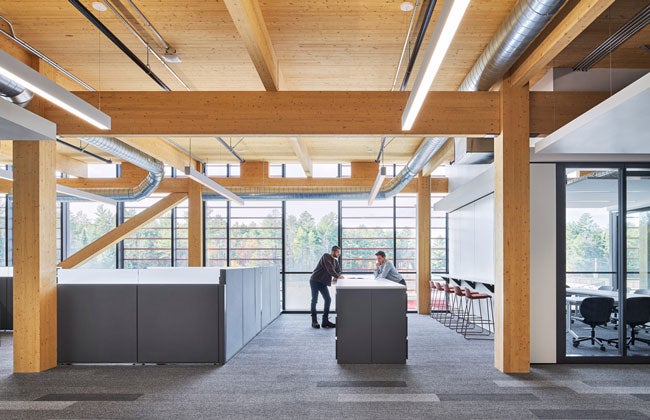
“It’s honestly beautiful,” McConnell said. “This could be all drywall — all boring office space. It has a natural aesthetic … you can see the beams going across the top; you can see all the boards, the braces. It’s beautiful.”
The building's appeal is strong enough that employees seek out opportunities to spend time there, even without a permanent workspace. “Even if I didn’t have a dedicated space in the building, I’d try and find excuses to be in the building,” Deighton said. “I have a team that is mostly remote, and we purposely schedule on-site meetings.”
For her, the attraction is as emotional as it is functional. “The light and the timber just warm up the space,” she said. "There’s an energy in the building. With the natural light, the collaborative spaces, and the opportunities to have larger group meetings, I genuinely enjoy working in this building. It really supports the overall wellness that CNL is aiming to create."
Referencing Indigenous teachings that emphasise the importance of connection to the natural world, McMillan reflected on how access to light and materiality shapes daily experiences. “Spending eight to ten hours at a desk where you can’t see the outdoors has a negative impact,” she said. “In these new buildings, particularly the SCC, almost every workspace offers natural light and the presence of wood, and I truly believe that improves how people feel.”
A Natural Comfort
With its natural insulation and sound-dampening qualities, mass timber offers significant advantages for both climate control and acoustics. While timber is not commonly used in warehouses, employees working in the Minwamon Building find that the exposed wood performs exceptionally well, helping to regulate fluctuating temperatures and reduce the constant background noise typically associated with steel structures.
The new warehouse not only introduced a more spacious and modern facility, but it also delivered an improvement in comfort. Leishman recalls a lack of temperature control in the previous warehouse. “It was a 50-year-old building where we couldn’t control the heat, and there was no air conditioning or ventilation,” he said. “We would either be sweating all the time or freezing — there was no climate control.”
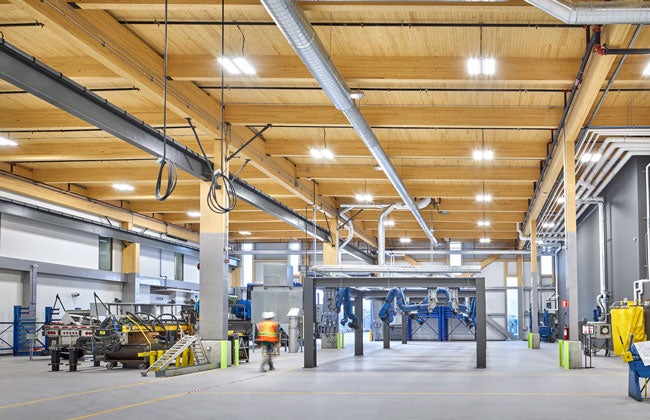
Because of its ability to absorb, store and gradually release heat, mass timber can establish stable indoor temperatures by moderating thermal fluctuations over time. When the employees moved into the new warehouse, they immediately spotted the difference. “When we came in here, it was like night and day,” Leishman said. “We can now maintain our materials a lot better, especially plastics.”
Beyond thermal stability, exposed mass timber offers another unexpected advantage in a warehouse setting: improved acoustics. In conventional steel warehouses, sound is reflected off hard surfaces, creating a sharp, reverberant environment filled with persistent background noise. Exposed timber, by contrast, absorbs excess sound and softens interior acoustics, resulting in a quieter, more comfortable workspace.
“In all steel warehouses, sound tends to bounce off hard surfaces, producing a tinny, echoing noise due to the lack of absorption,” explained Sue Croswell, HDR project delivery principal. “Exposed timber can absorb that excessive interior noise and create a much calmer environment.”
This difference stood out to McConnell in the Support Facility, where noise was no longer a dominant factor. “When someone was running a lathe or something like that, you knew it,” he said. “Now, it’s 100% nowhere near as loud; the acoustics are way down for sure.”
Spaces that Inspire Pride
Beyond the feel of the sun and the smell of timber, employees have collectively experienced another feeling: pride. An improved workplace environment designed to foster comfort, well-being and collaboration has generated a sense of ownership that connects employees to the space and CNL as an institution.
McConnell reflected on a reset in perspective. “A morale increase was actually the biggest part of this,” he said. “You give a spot like this to a group of people who have been here for 10 or 30 years, and you see the morale jump immensely. This was a huge boost for sure.”
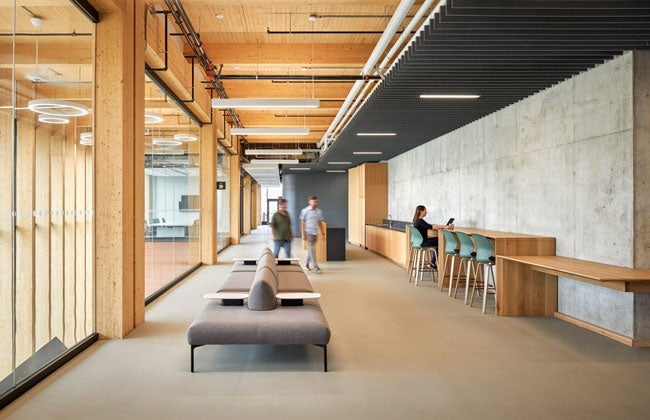
The initial excitement of moving into the new buildings has extended to keeping the spaces in prime condition. “Cleanliness is now everything,” Hopkins said. “Now, when people walk around and see something on the floor, they pick it up.”
Shields noticed a similar shift in diligence, taking note of the increased pride in maintaining a clean space. “To see employees giving tours and how proud and excited they are to be in that space is really exciting,” Shields said. “They even choose not to stick tacks in the walls; they look after it.”
A Culture Renewed Through Transformational Design
As the first point of arrival for visitors, the Minwamon Building stands as a powerful symbol of the campus’s transformation. Its distinctive façade and integrated forest-inspired artwork establish a strong visual connection to the surrounding landscape, making it a natural choice for the main visitor entrance. This role has proven to be an unexpected advantage.
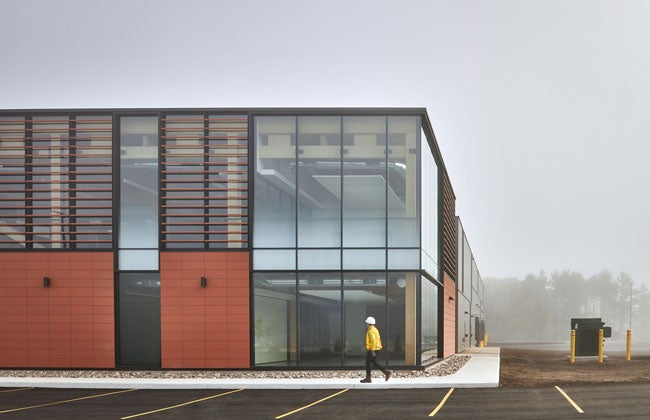
“The impact of locating our security desk in the Minwamon Building has created more value than we ever anticipated,” McMillan said. “Whether you’re a new employee, a visitor, or a contractor, this is where you go on your first day to receive your security badge. The fact that this is their first impression of us as a company is generating far more value than we could have imagined.”
Beyond improved acoustics and admired timber aesthetics, one theme resonated across every conversation: a sense of home. From the calm efficiency of a quiet warehouse to the warmth of a timber-lined meeting space, employees have developed deep connections to the buildings they occupy. In doing so, they have found not only comfort and respite, but a sense of ownership within an institution grounded in trust, well-being and connection to place.