
Bay Area Bridge Asset Management

Bay Area Bridge Asset Management
A Long-Term Plan to Preserve Vital San Francisco Bay Area Bridges
The seven state-owned bridges in the San Francisco Bay Area carry more than 200 million vehicle trips each year, connecting workers to jobs, residents to services, goods to markets and tourists to attractions. Maintaining the long-term reliability and viability of these assets is critical to the region’s economy and mobility.
HDR supported the Bay Area Toll Authority (BATA) and the California Department of Transportation (Caltrans) in advancing their bridge asset management program for these long-span bridges, including the San Francisco-Oakland Bay Bridge, Richmond-San Rafael Bridge, San Mateo-Hayward Bridge, Benicia-Martinez Bridge, Carquinez Bridge, Antioch Bridge and Dumbarton Bridge. These bridges range in age from 13 to nearly 90 years old and include multiple structure types — suspension, steel truss and concrete segmental. Together, they include more than 11 million square feet of bridge deck and over 22 million square feet of painted surfaces that must be maintained.
Comprehensive Life Cycle Planning
BATA needed a long-term plan to preserve these regional assets and an updated understanding of maintenance strategies that make economic sense. Looking at each of the bridges, our team focused on life cycle planning, optimized maintenance, and informed decision-making through scenario planning. The project also included support for asset management challenges specific to the Yerba Buena Island Tunnel, which connects the east and west spans of the San Francisco-Oakland Bay Bridge.
Our efforts resulted in comprehensive life cycle management plans and improved assessments of bridge systems. This information was incorporated in BATA’s first Toll Bridge Asset Management Plan, published by the Authority in January 2026. The Toll Bridge Asset Management Plan documents current bridge conditions, considers the impacts of different investment strategies, and provides asset performance measures to support BATA’s and Caltrans’ short- and long-term objectives.
Built on Careful Data Collection and Analysis
To create this plan, we gathered data about the bridges by reviewing as-builts, interviewing agency staff and conducting site visits. Our economics and engineering specialists then modeled deterioration and the performance of each of the BATA-operated bridges under various performance scenarios and planning for risk-based life cycle management. The modeling utilized element-level deterioration curves developed for the National Bridge Investment Analysis System (NBIAS) and adjusted for the local climate. These models employed a Markov chain approach to forecast the condition of bridge elements, enabling data-driven maintenance planning and resource optimization.
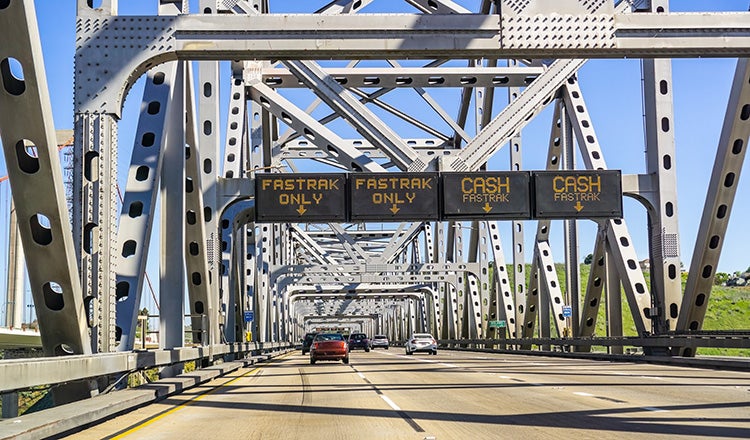
For example, one major focus of the completed asset management plan is preserving structural steel through proactive painting and corrosion protection. Steel painting alone accounts for more than a quarter of total investment needs over the next 50 years. The two spans of the San Francisco-Oakland Bay Bridge alone require more than 10 million square feet of paint.
We led several additional specialized studies that supported vessel collision risk analysis, fatigue analysis, and mechanical, electrical and piping (MEP) systems to provide consistent methodologies across the region's long-span bridges. The team also repurposed a Federal Highway Administration spreadsheet model, which uses concepts from National Cooperative Highway Research Project (NCHRP) Report 483, to analyze the impact of multiple scenarios on each bridge.
The asset management work allowed BATA and Caltrans to conclude that proactive maintenance significantly outperforms reactive strategies both economically and operationally. While central to BATA’s inaugural 2026 Toll Bridge Asset Management Plan, the adaptable framework can serve as a practical, scalable tool for other agencies managing complex, long-span bridges. BATA intends to incorporate the asset management planning into its next Capital Improvement Plan and then work on asset management enhancements before its next Toll Bridge Asset Management Plan.


