

Grant Summary: USDOT FY 2026 INFRA (Nationally Significant Multimodal Freight & Highway Projects)
U.S. Department of Transportation Discretionary Grant Opportunity
Program Overview
The Fiscal Year (FY) 2026 INFRA program provides competitive funding for multimodal freight and highway projects of national or regional significance.
The program is intended to:
- Improve the safety, efficiency and reliability of freight and passenger movement
- Strengthen national supply chains and economic competitiveness
- Modernize aging infrastructure and expand system capacity
- Address the national shortage of commercial motor vehicle (CMV) parking
The program offers two tracks of funding:
- Track 1: Freight and highway infrastructure projects
- Track 2: Commercial motor vehicle parking projects
There is a strong emphasis on truck parking, supply chain performance and large-scale investment. Successful applications will demonstrate clear freight benefits, strong financial leverage and project readiness aligned with USDOT priorities.
This article provides a summary of the Notice of Funding Opportunity (NOFO) issued by USDOT on June 2, 2026.
Key Dates & Submission
- Application Opens: June 2, 2026
- Track 1 Deadline: July 1, 2026
- Track 2 Deadline: July 15, 2026
Applicants may submit only one application.
Key Changes for FY 2026
This INFRA opportunity is significantly different from the previous FY 2021 to FY 2026 NOFOs:
- Removes references to rescinded Executive Orders
- Aligns the NOFO with new Executive Orders and updates to the outcome criteria rating rubric
- Changes “Technical Capacity Review” to “Applicant Capacity” and “Environmental Risk Review” to “Project Risk Review” under the Project Readiness review
- Application Review Information has been updated to clarify how INFRA applications will be assessed
- Includes $200 million in dedicated funding for CMV parking
Funding Availability
A total of $626.7 million in INFRA funding is available, allocated as follows:
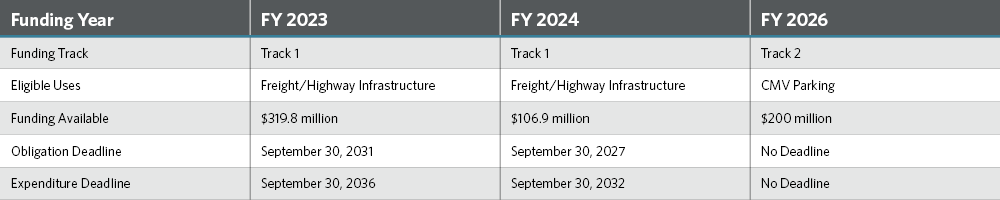
FY 2023 and FY 2024 both fall under Track 1 and support freight and highway infrastructure projects, with FY 2023 offering $319.8 million and FY 2024 offering $106.9 million. FY 2026 shifts to Track 2 and focuses on commercial motor vehicle parking, with $200 million available. The table also highlights varying timelines: FY 2023 funds must be obligated by September 30, 2031, and spent by September 30, 2036, while FY 2024 funds have earlier deadlines of September 30, 2027, and September 30, 2032. FY 2026 funding has no obligation or expenditure deadlines listed.
Key Funding Notes
- Strong emphasis on freight corridor performance and bottleneck reduction
- Preference for projects with:
- Significant non-federal leverage
- Advanced project readiness (NEPA, design, ROW)
- Funds allocated to:
- Small projects (generally less than $100 million in costs, with some exceptions)
- Rural projects (especially under Track 2)
Award Size & Cost Share
For both tracks, projects that exceed $100 million must request a minimum award of $25 million, while projects costing less than $100 million must request a minimum award of $5 million.
In Track 1, projects over $100 million may receive up to a 60% grant cost share and up to an 80% federal share. Smaller Track 1 projects may also receive up to a 60% grant cost share, but their maximum federal share is limited to 60%.
In Track 2, both large and small projects may receive up to a 60% grant cost share and up to an 80% federal share, regardless of project size.

*7 States have a different, lower threshold for large vs. small between $66 million and $91 million (INFRA). Consult Section B.3.c of the NOFO
**11 States have a higher, sliding scale max federal share between 80% and 95% (INFRA)
***The FY 2026 appropriation language explicitly caps the “Federal share of the cost of a project” at 60% for large truck parking projects and 80% for small truck parking projects. This supersedes the standard INFRA rules that allow other Federal funds to stack up to 80% for large projects.
Strategic Insights
- Freight benefit is essential: Projects must clearly demonstrate impacts on national/regional freight movement
- Truck parking is a key opportunity in FY26
- Leverage is critical: Higher non-federal matches improve competitiveness
- Readiness drives selection: Clear timelines for obligation and construction are required
- Scale matters: Large, corridor-level projects are prioritized
Eligible Applicants
- States and groups of states
- MPOs (urbanized areas > 200,000 population)
- Local governments and political subdivisions
- Special districts/public authorities (e.g., ports)
- Tribal governments or consortia
- Federal land management agencies (with state partner)
- Multistate or multijurisdictional entities
Eligible Projects
Track 1: Standard INFRA Project Types
- Highway freight and corridor projects (NHFN)
- Highway and bridge projects (NHS)
- Freight rail, port and intermodal improvements
- Highway-rail grade crossings or separations
- Wildlife crossings
- Border crossing and trade corridor projects
- Marine highway projects
Track 2: Development and expansion of commercial motor vehicle parking facilities
Eligible Activities
- Planning and pre-construction
- Design and environmental review
- Construction and reconstruction
- Equipment and operational improvements
Evaluation Criteria
Projects are evaluated based on:
- Safety
- Economic Competitiveness & Freight Movement
- State of Good Repair
- Innovation
Application Requirements
- Standard Forms
- Project Information Form
- Project Narrative
- Project Location File
- Project Budget
- Funding Commitment Documentation
- Benefit-Cost Analysis Narrative (Calculations)
- Letters of Support (Optional)
