
Don Young Port of Alaska Modernization Program

Don Young Port of Alaska Modernization Program
Navigating a Highly Dynamic Environment and Complex Permitting to Repair an Integral Port
The Port of Alaska is a key intermodal transport hub essential to freight movement across the state. It efficiently links marine, road, rail, pipeline and air cargo systems to connect communities, military bases and other destinations. However, the port’s condition has become critical. Pipe piles have corroded and begun to split, and while steel sleeves have been installed as temporary jackets around corroded piles to maintain operational capacity, they have limited benefit and do not address seismic concerns. An earthquake in 2018 exacerbated existing structural damage.
If these issues are not addressed, load capacities at the existing docks will continue to be reduced. A failure of any port facility before replacement would create insurmountable transportation challenges, as no other facility in South Central Alaska has similar capability or capacity. Because the port cannot be economically replaced elsewhere, its modernisation is vital to Alaska’s economy.
Serving deep-draft vessels that operate year-round, the port allows faster, more reliable and cost-efficient cargo transport than any other methods. It is Alaska’s only National Strategic Seaport and critical to national defence. It is also the primary entry point for fuel and cement into Alaska, important goods for the transportation and construction sectors of the Alaska economy.
Jacobs and HDR have teamed together to provide program management for the five-phase modernisation program, an approximately $1.9 billion program to replace most existing port infrastructure. Our role includes procurement, environmental services and permitting, and construction administration services.
In 2022, construction was completed on Phase 1, a new Petroleum and Cement Terminal to the south of the existing cargo docks.
Phase 2 includes modernisation through two major components:
- 2A delivered a new port administration building in 2024 and reconstruction of the North Extension Stabilisation 1 Project, completed in 2025 to stabilise a previously installed cargo handling and storage area.
- 2B involves building two new cargo terminals. Construction on Terminal 1, procured as a design-build contract, is scheduled to begin in 2026. This phase includes demolishing two existing cargo terminals and an older petroleum terminal.
Phases 3 through 5 will replace a second petroleum terminal, complete the North Extension Stabilisation 2 Project and demolish the third older terminal.
We prepared cost-benefit analysis that helped secure two grants totalling $45 million for Phase 1, accelerating funding momentum.
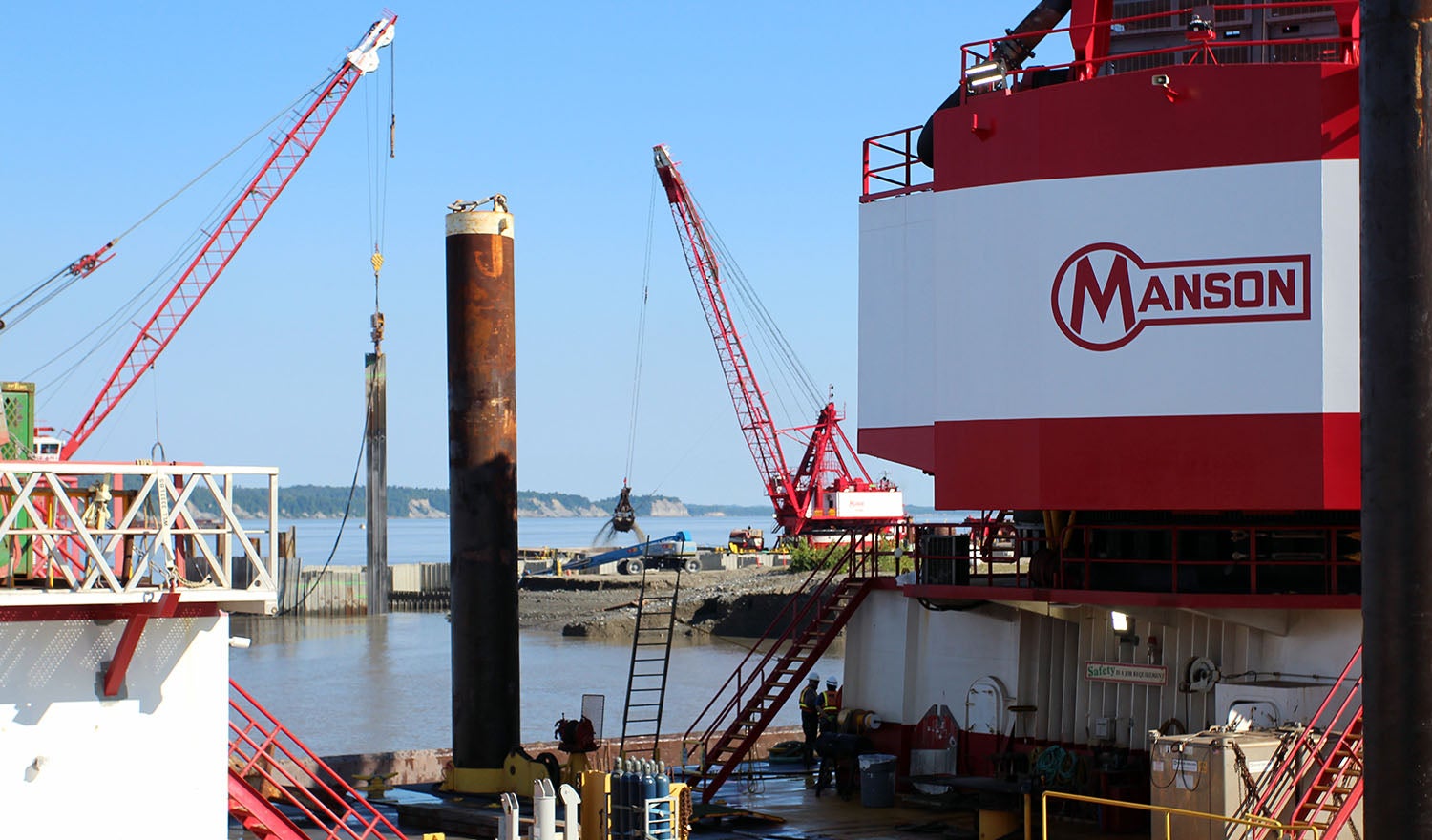
Procurement With a Focus on Alternative Delivery
With a complex series of projects, each with their own unique challenges, there’s no one-size-fits-all delivery method.
Instead, our team has let contracts with a variety of alternative delivery methods. Just in the first two phases, the program has used four delivery models: construction manager/general contractor, progressive design-build, conventional design-bid-build and design-build.
Each procurement method was strategically selected to meet individual project circumstances.
A stabilisation on the north extension had some safety complexities, and a progressive design-build contract allowed the owner to be more involved in the contract during the design phase and decision making. After a delay and reconfiguration of the contract, the contract moved forward as a design-build.
The new administration building was also delivered through a design-build contracting method, while the new cargo terminals will be design-bid-build contracts.
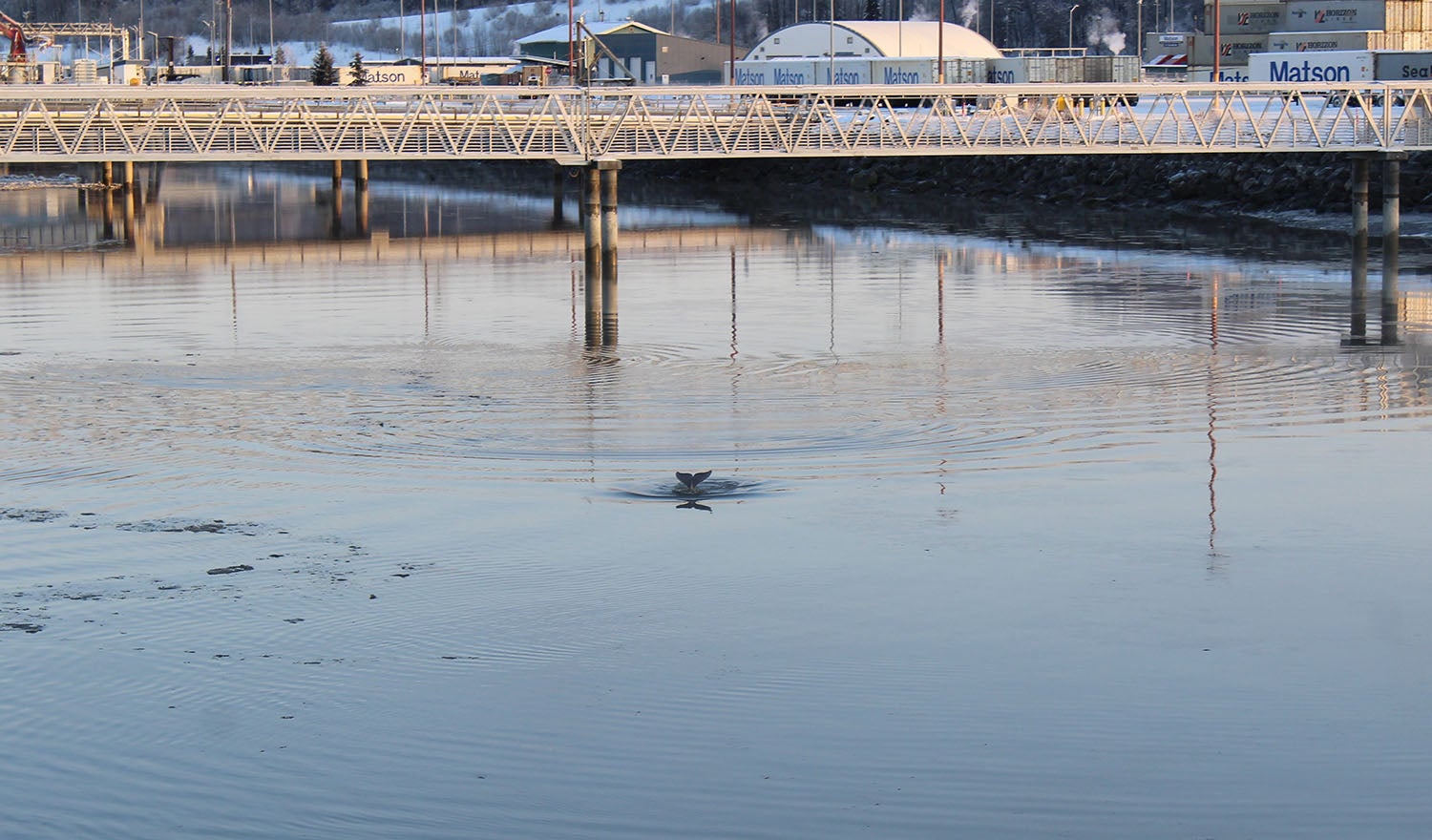
Building the Port While Protecting a Highly Endangered Whale
The port is in Knik Arm on the shores of Cook Inlet, home of the Cook Inlet beluga whale, a highly endangered and genetically distinct population from other beluga whales in the state. With only about 331 remaining, protecting these whales from disturbance, especially sounds from pile driving, is essential to successfully constructing the new port facilities.
The sensitive setting makes permitting for construction of each terminal or project highly complex. The port must go through a multi-year process with the National Marine Fisheries Service to receive authorisation under the Endangered Species Act and the Marine Mammal Protection Act to incidentally expose marine mammals to elevated sound levels, known as a “take.” Pile driving required for new infrastructure produces sound levels that can disturb marine mammals, and the port is authorised a limited number of takes each construction season. Exceeding those takes could require shutting down construction for the season, risking costly delays.
Avoiding this involves a coordinated monitoring approach. During in-water pile driving, 11 marine mammal observers are set up at four monitoring stations, scanning with high-powered binoculars. If beluga whales or other protected mammals are spotted approaching work zones, construction is briefly halted, allowing them to freely swim into or out of Knik Arm.
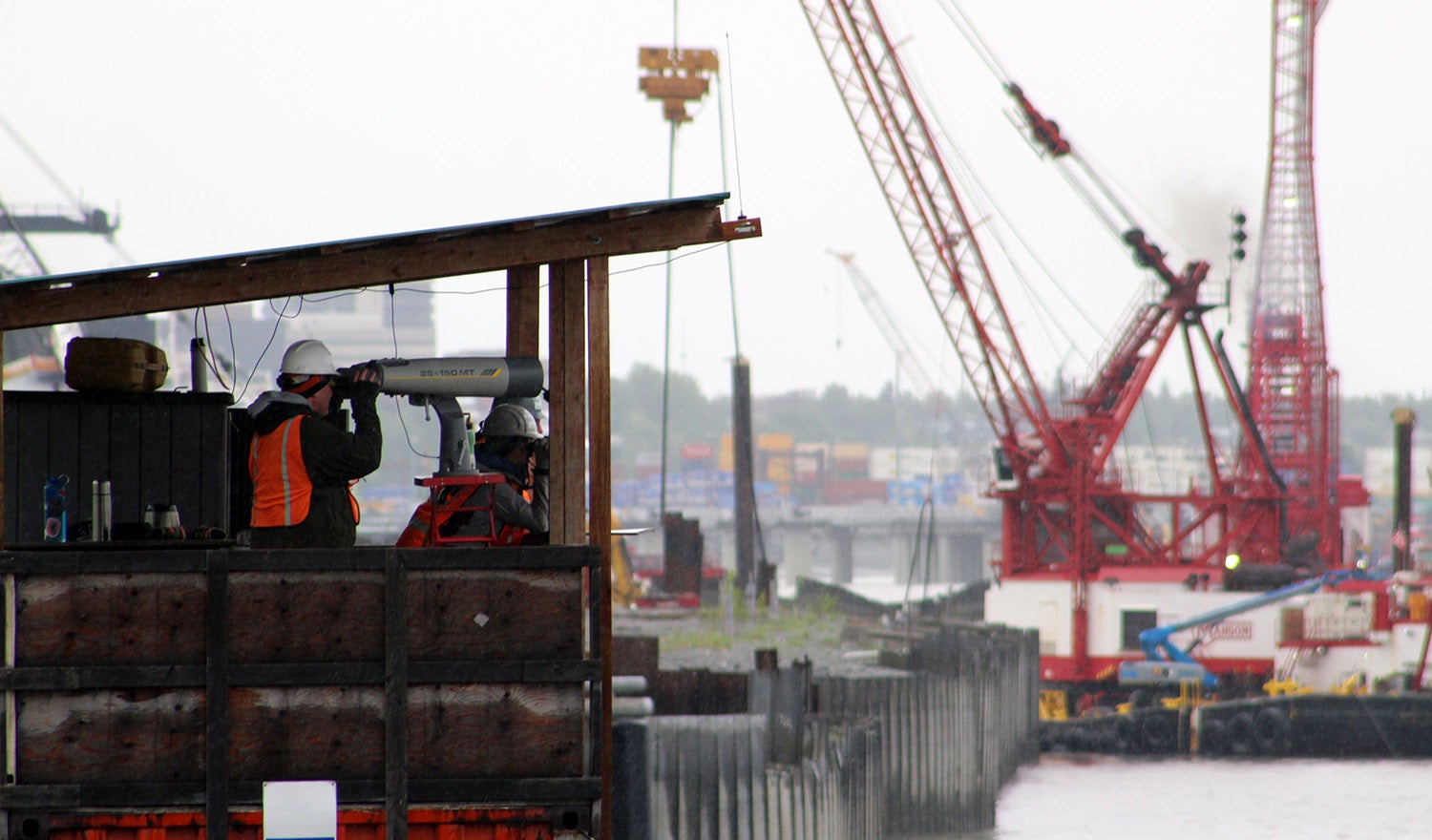
This robust program has proven to be highly successful. Every year, the port has used only a fraction of the authorised takes for any species, including beluga. This success has allowed for construction of critical facilities to continue. The program has now been successfully implemented across multiple construction seasons, providing security for Alaskans during other phases of construction.
Overseeing Complex Construction Conditions
The HDR construction administration team managed challenging conditions throughout Phase 1 of the project. In 2020, we oversaw the installation of 71 48-inch-diameter piles for the new Petroleum and Cement Terminal foundations and approaches. In 2021, nine 144-inch-diameter mooring and breasting dolphin piles were installed, weighing 255 to 311 tons each. This work was completed in an environment with around 30-foot tides twice daily — the fourth largest in the world. These tides impacted pile installation, generated extreme currents and affected the elevation of work barges. The superstructure of the terminal was assembled using precast concrete blocks connected with massive cast-in-place concrete pours. Both the piling and the superstructure were supported by templates and falsework to support these permanent works.
Our team processed over 600 RFIs during the two Phase 1 contracts. Each required a clear understanding of the questions asked, design intent and a timely response to avoid construction schedule impacts. We also managed dozens of change orders for scoping, cost reviews, and documentation and execution.
Several complexities encountered in Phase 1 continue to complicate the project team, including:
- Icy conditions limiting in-water work to six months per year, requiring seven-day work weeks and daily shifts of more than 12 hours.
- Maintaining port operations during construction, including freight and fuel deliveries and ongoing dredging. Our team works with port staff and stakeholders to minimise construction disruptions.
- Federal grant funding requirements mandating the use of American products and materials. Attaining compliance requires proper documentation and verification in a globalised material environment.


