
EPA Announces First-Ever Limits on PFAS in Drinking Water
Let's Break it Down
The U.S. Environmental Protection Agency announced the Final National Primary Drinking Water Regulation for six PFAS (Final PFAS Rule). This comes nearly 4 months later than expected. The delay was met with uncertainty and a flood of rumors — lower MCLs, higher MCLs, new PFAS added, select PFAS removed. None of these threads led to where we landed. The final regulation is largely unchanged from what was originally proposed — six MCLs, including five for individual compounds (PFOA, PFOS, PFNA, GenX, and PFHxS) and a Hazard Index MCL for PFNA, GenX, PFHxS, and PFBS to be regulated as a group. PFOA and PFOS have MCLGs of zero. The bottom line is that water utilities around the country must begin their compliance strategies to meet all regulatory requirements.
That isn’t to say there were no changes to the Proposed PFAS Rule. Indeed, one could argue that these modest modifications are a silver lining to an otherwise burdensome regulation. The requirements for reduced monitoring and the calculation to establish the Hazard Index were both (ever so slightly) relaxed. More importantly, utilities now have three years, until 2027, before the annual notifications and information in the CCR begins and five years, until 2029, before MCL violations require Tier 2 (30-day) notification. The EPA also acknowledged an opportunity for an extension on MCL compliance for those that qualify. The good news is that we have more clarity on the rule and more time to comply. The bad news: the clock is now ticking, and the overall lift has not changed.
Be the First to Know
Subscribe to receive our Water Insights
A big question — how much will this cost? The American Water Works Association estimates nearly $4 billion a year. The EPA estimates rule compliance will cost approximately $1.5 billion a year. Utilities have to understand the true costs of testing, monitoring, and treatment with market volatility and supply/chain fluctuations. Now is the time to get your estimates.
Practical Steps Towards PFAS Compliance
Water utilities are just receivers of PFAS, though they are now placed on the front line for minimizing our exposure. Federal funding is available, though limited. The public is aware and concerned. How should utilities plan and respond? How should they communicate with their customers?
Consider Developing a Roadmap
We believe your PFAS roadmap should consider this practical framework for effective PFAS compliance. Notice that stakeholder outreach should be involved in all four steps. Though not discussed in detail, outreach typically involves a website, listed FAQs and a stakeholder map to help keep the public informed.
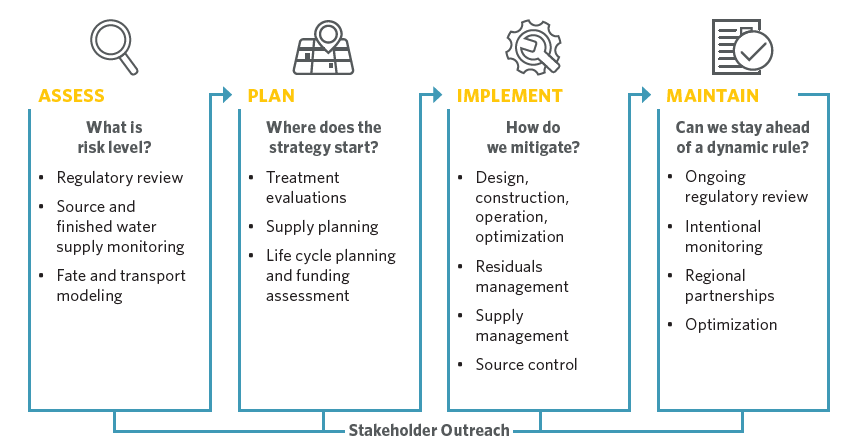
Assess: Assessment establishes the extent of drinking water PFAS contamination and the overall risk posed to utilities and the communities they serve. This phase includes a comprehensive regulatory review of the Final PFAS Rule, along with any local, state, and other jurisdictional policies that may influence compliance requirements. A thorough characterization of the presence and speciation of PFAS in source and finished waters will then provide key insights into identifying best management approaches. Furthermore, PFAS “fingerprinting” and fate-and-transport modeling may identify potential dischargers and other sources to the watershed, opening management and partnership opportunities. Transparency and collaboration during this phase may provide cost-share opportunities for mitigation strategies and reduce or eliminate future PFAS discharges to sources of supply.
Plan: Planning identifies viable alternatives for an overall PFAS compliance strategy. USEPA’s all-of-agency approach to PFAS regulation will eventually drive a host of compliance activities that encompass all water sectors and beyond. Manufacturers, dischargers, farmers, and other receivers of PFAS will all have a role to play in mitigating this issue. Primacy agencies must also act quickly to develop their own policies, either creating or adapting PFAS primacy regulations that address the new rule. As a community-wide challenge, PFAS provides an unprecedented opportunity for collaboration. Whether utilities are considering supply augmentation, watershed monitoring programs, source control, pre-treatment programs, or common-sense policymaking — planning for effective PFAS compliance may identify opportunities to provide more holistic, sustainable solutions by reducing environmental discharges and facilitating cost-sharing discussions. Regardless of strategy, this rule will tax the already limited resources of drinking water utilities. Planning should consider compliance needs comprehensively and identify how and when they will be met, whether they are financial, staffing, analytical, or material/equipment.
Implement: Implementation puts into practice the best strategies identified during the planning process. This phase may include the design, construction and operation of necessary capital improvements. Management strategies for PFAS-laden treatment residuals would be established, as necessary. We do have an opportunity to remove PFAS completely from the water cycle when we consider destruction technologies. In addition, supply management, source control programs, and policy updates (if applicable) are other means to reduce PFAS loads to water supplies and further reduce long-term contamination risks. Successful implementation results in satisfied regulatory requirements and community expectations.
Maintain: The Final PFAS Rule, a growing public awareness of these contaminants, and an ever-increasing list of PFAS that pose (or may pose) health risks to drinking water customers present a dynamic challenge to utilities. Those hoping to maintain long-term PFAS compliance will benefit from an ongoing regulatory and policy review, sustained monitoring of water supplies, continued development of regional partnerships, and an intentional practice of strategy reassessment and optimization.
I’m a big proponent of this framework. It outlines a practical plan for effective PFAS compliance and strategic communication.
Ultimately, I still believe our best strategies for this complex challenge are those we develop together. These contaminants are persistent and ubiquitous, and pose public health concerns at part per trillion levels. The long-term life cycle costs for compliance may be significantly reduced if we incorporate holistic approaches to minimize PFAS in the environment. It's profoundly logical — we decrease PFAS coming into our sources of supply and, over time, we may be able to decrease the effort we need to remove it. This embodies a One Water mindset and has the potential to connect all of us in the search for sustainable PFAS solutions.
Terminology
- CCR - consumer confidence report
- GenX - trade name for chemical hexafluoropropylene oxide dimer acid (HFPO-DA) and its ammonium salt
- MCL - maximum contaminant level
- MCLG - maximum contaminant level goal
- PFAS- perfluoroalkyl and polyfluoroalkyl substances
- PFBS - perfluorobutane sulfonate
- PFHxS - perfluorohexane sulfonate
- PFNA - perfluorononanoic acid
- PFOA - perfluorooctanoic acid
- PFOS - perfluorooctane sulfonic acid
