

Experts Talk: AI-Enhanced Bridge Management With Maryam Bostani
Experts Talk is an interview series with technical leaders from across our transportation program.
Smarter Planning, Clearer Priorities and the Shift to Data-Driven Decision-Making
Nearly half of the bridges in the United States are over 50 years old. As these critical assets continue to age, an increasing number will require major rehabilitation or full replacement in the years ahead. According to the American Society of Civil Engineers (ASCE) 2025 Report Card for America’s Infrastructure, more than 42,000 highway bridges are already in poor condition, and bridge-related rehabilitation needs are estimated at $191 billion.
Meeting this challenge requires smarter preservation strategies, clearer prioritization and stronger long-term planning, particularly amid limited public funding. For many agencies, that means aligning bridge management more closely with broader asset management practices by connecting condition, risk, performance and investment decisions across the portfolio. This is where artificial intelligence (AI) can be transformative.
Maryam Bostani, Ph.D., serves as our AI practice lead for bridges and structures, with 16 years of combined research and industry experience in applying AI to complex engineering challenges. A registered professional engineer in Canada, her work has focused on developing AI-based bridge management systems that enhance life-cycle planning and support data-informed investment decisions. She has served as an adjunct professor at Brown University and contributed to research under the National Cooperative Highway Research Program (NCHRP). She is also active in AI-related committees within the Transportation Research Board (TRB), the Transportation Association of Canada (TAC), and the Association of Consulting Engineering Companies (ACEC).
In this interview, she explains how AI-powered bridge management systems can move agencies from reactive repair cycles to proactive, evidence-based planning and how this shift can help infrastructure owners reduce life-cycle costs while maintaining safe, reliable bridges for the communities that depend on them every day.
Q. Why would transportation agencies and infrastructure owners need an AI-powered bridge management system?
A. Transportation agencies are managing aging bridge networks under growing financial pressure. Agencies already collect extensive inspection and performance data. The difficulty lies in transforming that data into clear, defensible, long-term decisions.
By integrating AI into bridge management through tools like the forecasting system that we have developed, agencies can better leverage the data they already collect and convert it into actionable insights. Rather than relying primarily on reactive repairs or fixed intervention cycles, owners can shift toward proactive, evidence-based planning. Data can be analyzed to forecast future conditions, evaluate preservation strategies and prioritize investments.
Importantly, AI does not replace engineering judgment; it enhances it. It improves transparency in prioritization, connects information across systems and provides defensible insight into how investment decisions influence performance and risk.
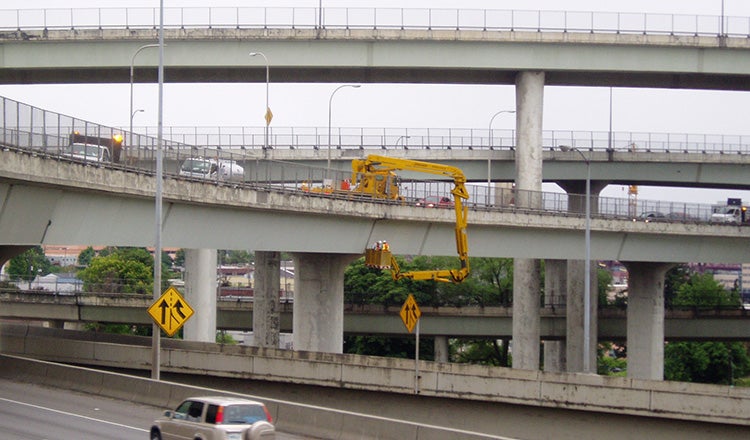
Q. What’s meant by AI-powered bridge management? How does this differ from the generative AI that is becoming common?
A. Today, many people associate “AI” with chatbots and content-generation tools. But when we talk about AI-powered bridge management, we are referring to machine learning and deep learning models that analyze engineering data and support infrastructure decisions. The AI used in bridge management refers to analytical models that have been applied in engineering research and practice for decades. These models identify patterns, forecast future performance and support technical decision-making.
These systems can optimize decisions, helping agencies determine which projects to advance now, which strategies will extend service life most effectively, and how to allocate limited budgets across an entire network for maximum impact.
Q. How is this sort of bridge management system being implemented?
A. We have developed a tool that operates at both the individual bridge level and the overall network level.
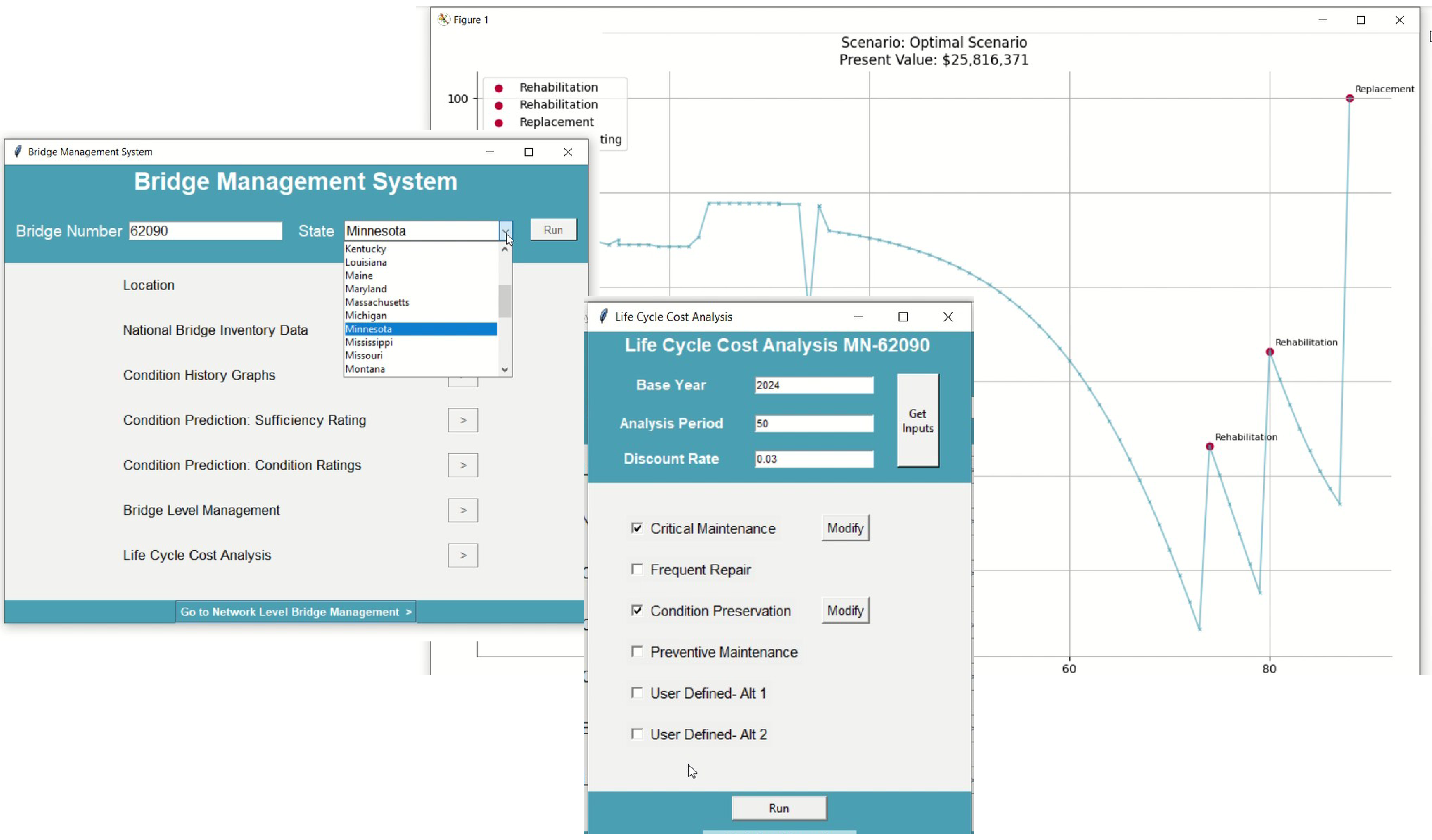
At the bridge level, the system analyzes inspection history and performance data for a specific structure and forecasts how its condition is likely to change over time. Users can evaluate different intervention strategies, such as repair, rehabilitation, widening, replacement or other user-defined options, and compare the long-term impacts of each scenario. The results include predicting the future condition of the bridge and estimating the associated life-cycle cost for each scenario, then identifying the optimized option that minimizes life-cycle cost while ensuring the bridge remains in an acceptable condition. This supports informed decision-making at the project level.
At the network level, the system evaluates selected bridges within a geographic region. It allows users to define constraints, such as required actions for specific bridges or minimum condition thresholds, and then it optimizes project selection within the available budget. This enables agencies to adjust funding levels or performance targets and immediately see the trade-offs between cost, risk and overall network condition.
Q. Why does it matter that bridge expertise was involved in creation of this approach?
A. It matters because an AI model can be mathematically optimal and still be practically unusable. A data-driven system may generate the “best” solution from a statistical perspective, but if that solution does not reflect how bridges actually deteriorate, how maintenance is performed in the field, or what agencies can realistically implement, it will not succeed.
Engineering expertise establishes that the outputs are technically sound. Engineers understand which maintenance actions are feasible for bridges in a given condition, what sequence of interventions makes structural sense and how decisions today affect long-term performance.
This is also where HDR’s integrated bridge teams make a difference. Our bridge inspection, design and asset management teams collaborate closely, allowing the AI framework to reflect how projects are actually delivered. Recommendations are reviewed by professionals who design, inspect and manage these assets. That cross-disciplinary feedback loop creates results that are implementable.
Q. How does this bridge management approach fit with agency budgets?
A. This approach is designed to operate within real budget constraints. Agencies enter their projected funding levels by year or by program, and the system develops a recommended plan that stays within those limits.
At the individual bridge level, the tool we have developed evaluates feasible maintenance and repair options, estimates their life-cycle costs, and projects how each alternative will affect future condition and risk. At the network level, those bridge-level decisions are combined into a program that fits within the total available budget and aligns with agency requirements.
The system also supports “what-if” analysis. Agencies can adjust funding levels, performance targets, or policy constraints and immediately see how those changes influence long-term condition trends and overall program outcomes. This allows leadership to understand the consequences of budget decisions before they are made.
The result is a financially grounded program supported by clear, traceable logic.
What’s next for bridge owners and engineers when it comes to AI and bridge management?
A. The next phase is moving from AI as a planning support tool to a system that directly informs program and project delivery. As agencies gain confidence in the forecasts and recommendations, network-level insights can be translated into concrete actions, bundling similar work, advancing rehabilitations and replacements at the right time, and coordinating investments across multiple years.
As adoption matures, these systems will become more tailored to individual agencies. Models will increasingly reflect local policies, risk tolerance, treatment strategies, cost structures and performance targets. AI should not operate as a one-size-fits-all solution; it should align with how each agency defines priorities and manages its network.
The quality of insight will also continue to improve as data becomes richer. Integrating element-level information, structural health monitoring from sensors, and AI-assisted inspections, including drone imagery, will strengthen forecasts at the component level. This reduces reliance on subjective assessments and improves the timing and selection of maintenance and rehabilitation actions.
Inspiration and Advice
Q. How did you become interested and involved in the intersection of AI and bridge design?
A. My interest in AI began 16 years ago during my graduate studies, when I was introduced to machine learning and neural networks. What captured my attention was not just the mathematics, but the idea that these models could learn from data and uncover patterns that are difficult to detect using traditional approaches. At the same time, my academic and professional focus was rooted in structural engineering and infrastructure systems.
Bringing those two worlds together felt natural. Bridges are long-life assets with complex deterioration patterns, large amounts of historical data and significant financial implications. I began exploring how AI could help forecast condition changes, prioritize maintenance and support long-term planning. During my doctoral research, I applied these methods to predictive modeling in bridge management, which solidified my interest in combining engineering judgment with advanced analytics.
Since joining HDR, I have continued building in that space, applying AI in practical ways, advancing the work through research and internal innovation programs, and collaborating with inspection, design and asset management teams. For me, the intersection of AI and bridge engineering is not about replacing traditional expertise; it is about strengthening it. It is about using data more intelligently to support safer, more strategic infrastructure decisions.
Q. What advice do you have for other engineers who may be interested in incorporating AI into their bridge careers?
A. The first step is to build a strong foundation in engineering practice. AI is most powerful when it is applied to real problems. For bridge engineers, that means understanding how bridges deteriorate, how inspections are performed, how maintenance decisions are made, and where uncertainty exists in the process. The stronger your engineering foundation, the more effectively you can apply AI in a meaningful way.
At the same time, don’t be intimidated by the term “AI.” You don’t need to become a data scientist overnight. Begin by learning the fundamentals of data analysis and machine learning, and think about how they connect to the challenges you already face in your work. The goal is not to replace engineering judgment, but to enhance it.
Most importantly, stay curious and collaborative. Ask questions, experiment thoughtfully and focus on solving practical problems. The future of bridge engineering will increasingly combine domain expertise with data-driven tools, and those who understand both will be well positioned to lead.
Each Experts Talk interview illuminates a different aspect of transportation infrastructure planning, design and delivery. Check back for new insights from the specialized experts and thought leaders behind our award-winning, full service consulting practice.


