

Experts Talk: Using Pedestrian Simulation to Design Better Facilities With William Lin
Experts Talk is an interview series with technical leaders from across our transportation program.
Planning for the Future By Understanding How People Move
Whether it’s an airport terminal, rail station or event venue, the way people move through a space has a significant impact on safety, accessibility and the overall user experience. While planners and designers have long used calculations to estimate capacity, pedestrian simulation provides a more detailed understanding of how people interact with a pedestrian facility and with one another.
In this interview, William Lin, P.Eng., discusses how computer-based modeling helps project teams identify operational challenges before construction begins and test future scenarios such as a change in people’s behaviour or a delayed flight in an airport terminal.
William is a rail and systems engineer on our Canada-based pedestrian simulation team. He has worked with transit, aviation and institutional clients across North America to create facilities that work better for the people who use them every day.
Q. What is pedestrian simulation and why is it a helpful tool? Why would someone want to consider it for their facility?
A. Historically, capacity assessment for railway stations, airports and other transportation facilities relied on per-square-foot calculations to determine whether a space could accommodate the expected passenger volumes. Those calculations are useful, but they don’t fully capture the dynamics of how people interact with the environment around them.
Pedestrian simulation uses computer-based models to forecast how individuals will move through an environment under different operating conditions or hypothetical scenarios. Since these simulation models replicate human behaviour, they create a digital representation of a real world piece of infrastructure, which can be used to test how that facility performs before it’s built or modified.
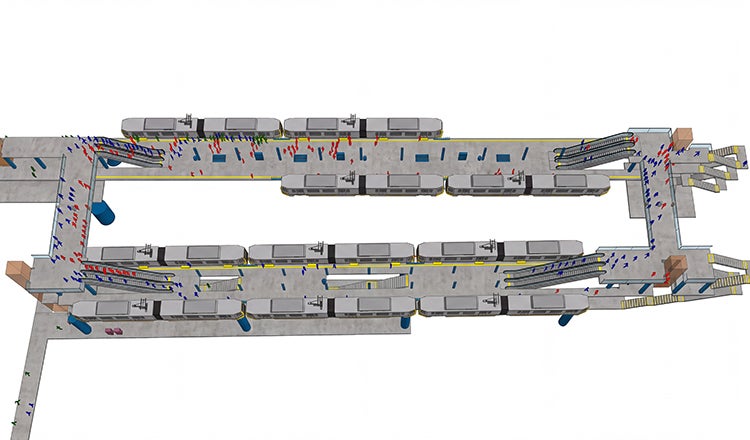
For example, rather than estimating whether a platform, corridor or waiting area has adequate static capacity in spreadsheets, simulation can help identify where congestion occurs, how bottlenecks form and how design changes affect the user experience.
Beyond capacity and customer experience, pedestrian simulation is also a valuable tool for safety and security planning. It helps planners understand how crowds behave during periods of high demand, disruptions or incidents, identify areas where crowding or conflicting movements may create safety concerns, and assess whether proposed operating procedures and response strategies will effectively manage those risks.
Perhaps most importantly, simulation provides a clear and intuitive way to visualize issues and compare different scenarios in a way that traditional calculations cannot. It also helps planners, operators and decision-makers to clearly see the benefits and trade-offs of proposed infrastructure investments and operational improvements before they are implemented.
Q. At what stage of design is pedestrian simulation most helpful?
A. Pedestrian simulation can be applied throughout the full cycle of infrastructure projects, starting with the planning and conceptual design stage. If you’re space programming a new airport terminal, you want the building to provide an intuitive journey for users. After calculating the size requirements of the facilities, simulations can show how people are likely to move between them, identify preferred walking paths, estimate travel times between key processes and highlight potential bottlenecks.
During detailed design, pedestrian simulation can become a powerful tool for evaluating specific design decisions and trade-offs. At this point, the overall layout may have been established, but many details can still significantly influence user experience and facility performance. Let’s say a client is considering reducing the number of escalators to lower capital and O&M costs, replacing some with stairs. Simulation can help quantify the system-wide impact of that decision, such as walk times, queue lengths, accessibility and crowding levels throughout the facility. Rather than relying on assumptions, stakeholders can make evidence-based decisions with a clear understanding of the benefits and consequences.
We can also test future operational changes at a facility even after it’s built. For example, how would a subway station perform if a larger proportion of riders adopted mobile payment rather than using ticket vending machines? Or how would passenger circulation and terminal crowding be affected if an airport introduced a new international route served by a wide-body aircraft that significantly increases peak passenger volumes?
Q. Do you have any examples of where simulation revealed an issue during the design stage that might have been otherwise missed?
A. Recently, we were using pedestrian simulation to test the design for a new station along a light rail transit line. The original concept had a single entrance connecting the concourse level to the platform below. On paper, it appeared the number of stairs and elevators would be able to handle the projected passenger volumes.
The simulation helped us discover a potential issue. The station's stairs and elevators were positioned near the centre of the narrow platform. As passengers exited trains, many needed to make a sharp 180-degree turn to reach the stairs and elevators. That movement slowed pedestrian flow, increased conflicts between passengers moving in different directions, and created localized crowding during peak periods. As a result, passengers also had less space and time to exit the train efficiently, making it more difficult to clear the train within the allotted dwell time. We tested an additional concept of adding another entrance with additional stairs at the end of the platform and that improved pedestrian flow significantly. We are now in the process of fine-tuning the optimized design.
Q. Once the infrastructure is built, how can pedestrian simulation plan for future expansion?
A. Pedestrian simulation can help clients evaluate expansion and renovation opportunities. For example, we worked with an airport authority in the U.S. to develop a vision plan for the future of one of their terminals, which was built in the 1960s. Our team proposed expanding the currently segmented ticketing hall into one continuous and welcoming space, consolidating existing security checkpoints to streamline operations, and introducing more self-service options and advanced security screening technologies. To show how this design would work compared to the existing layout, we developed a pedestrian simulation model to showcase a typical day at this airport 10 and 20 years in the future.
Another project example for a transit client includes evaluating a streetcar route adjacent to a new Major League Baseball stadium. An influx of thousands of people is going to make stop platforms significantly more crowded, and you might need additional vehicles to transport people back and forth to the stadium. Pedestrian simulation can help demonstrate how additional people will affect transit operations, identify potential capacity deficiencies, if additional service is needed or other operational adjustments that will be needed to keep the system running efficiently.
Q. How does pedestrian simulation differ from traffic simulation?
A. Traffic simulation and pedestrian simulation both require an understanding of how people and vehicles behave within a specific environment. In many ways, you can think of pedestrian simulation as traffic simulation, but for people rather than vehicles.
The key difference is that people are far less predictable than vehicles. Vehicles typically follow defined lanes and established rules. Pedestrians, on the other hand, have much greater freedom in how they move, make decisions, interact with others and respond to their surroundings.
Over several decades, researchers have studied how people move through different environments, developing extensive datasets that describe their behaviour. These studies establish characteristics such as walking speeds, personal space preferences, route choices and how different groups interact with the environment. Modern pedestrian simulation software incorporates these findings to create realistic models of crowd movement.
For example, a commuter rushing through a busy train station behaves differently from leisure travellers with luggage, a family with young children or someone using a wheelchair. Cultural and regional factors also play an important role. For instance, commuters in large metropolitan areas may be more comfortable walking in close proximity to others or standing in densely packed queues than people in less crowded environments such as airports. Ultimately, all these things matter when designing infrastructure that best serves the people who will use it.
Inspiration & Advice
Q. How did you get involved in pedestrian simulation?
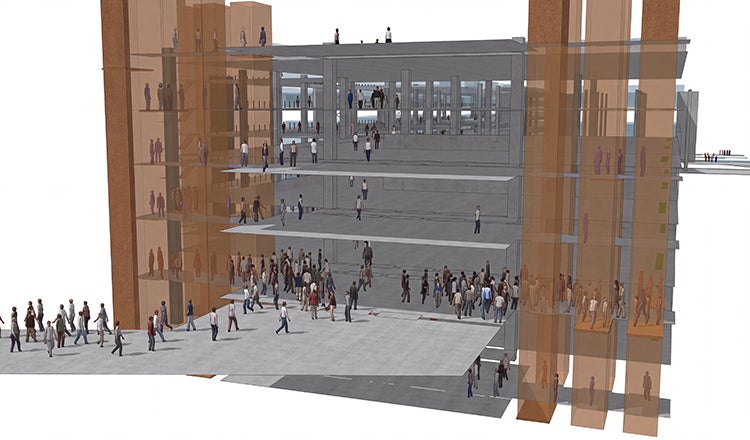
A. It all started with a transit expansion project in Toronto. We were designing a multi-level railway terminal station and decided to use pedestrian simulation models to study how well people moved through the stations and connected to adjacent pedestrian networks. As a member of the traffic engineering and transit planning team, I was brought onto the project. I was really fascinated by the software capabilities of predicting flow patterns through complicated building structures. I knew I wanted to work in this space.
Q. What advice do you have for people interested in pedestrian simulation?
A. If you already have a background in traffic engineering, the transition to pedestrian simulation can feel like a natural fit. There are many similar principles that would feel familiar.
If you are coming from a different background, don’t worry. The most important thing is to stay curious and be willing to learn. Reach out to other people who do pedestrian simulation. Even if you haven’t had a chance to work on any simulation projects yourself, conversations with experienced practitioners will help you understand what this service is, its applications and potential opportunities. It's also important to let your supervisor or mentor know if you're interested in exploring this area. Like myself, many people find their way into pedestrian simulation through projects that arise unexpectedly, and expressing your interest can help put those opportunities on your radar.
Finally, spend time in the real world. Visit train stations, airports, stadiums, shopping centres and pay attention to how people move through spaces. Watch where they hesitate, change routes, or run into each other. Field observation can teach you things that a software manual never will.
Each Experts Talk interview illuminates a different aspect of transportation infrastructure planning, design and delivery. Check back regularly for new insights from the specialized experts and thought leaders behind our award-winning, full service consulting practice.


