

Federal Transit Policy & Funding Update
On April 3, 2026, the U.S. administration released its funding request for fiscal year (FY) 2027. The administration’s request formally kicks off the FY 2027 funding cycle, placing the request before appropriations subcommittees to begin their FY 2027 deliberations. While the Administration’s budget proposal outlines funding levels recommended by the executive branch, ultimately Congress will introduce and approve annual appropriations that set federal spending levels that often differ from the executive branch’s request, as it did in FY 2026.
The FY 2027 funding request represents the first-year appropriation request after the Infrastructure Investment and Jobs Act (IIJA). A surface transportation reauthorization act must be enacted by October 1, 2026 or extension(s) to the existing IIJA will be necessary until a new act is approved. As of this writing, neither the House nor the Senate has introduced its draft reauthorization bills. The House Transportation and Infrastructure Committee has scheduled an initial markup of its draft reauthorization bill on April 29.
This update will focus on the 2027 funding request levels for the Federal Transit Administration (FTA) with an emphasis on the Capital Investment Grants (CIG) Program as well as the Federal Railroad Administration (FRA). It will summarize notable recommendations for other transportation programs. Given the absence of an approved reauthorization for FY 2027, the Administration is recommending zeroing out all the advanced appropriations set aside for public transit (-$4.25 billion) and passenger rail (-$13.2 billion) in the IIJA. These will be detailed in the discussion below.
FTA FY 2027 Budget Request
The administration is requesting $16.3 billion, a $4.8 billion (-23%) decrease for public transit from the FY 2026 enacted level. This request includes $15 billion from the Mass Transit Account and $1.3 billion from the General Fund. There was some discussion in Washington last year to consider eliminating the Mass Transit Account along with the transit formula funding it provides. This elimination is not included in the administration’s request.
The Mass Transit Account is forecasted to go negative in FY 2027. A key discussion point with reauthorization will be whether Congress transfers General Fund over to the Mass Transit Account to keep it solvent as they have with the Highway Trust Fund since 2008.
The administration requested $15 billion from the Mass Transit Account for formula, state of good repair, bus and bus facilities, low or no emission bus competitive grant funding along with other programs but did not quantify funding for any of these long-standing programs. In years past, 57% of the funding was for urban and rural formula grants and 26%t for state of good repair grants.
Historically, the CIG Program has been FTA’s largest discretionary grant program, and it continues to be. During IIJA, multiple new discretionary grant programs funded with advanced appropriations were introduced. Some of the largest include the Fixed Guideway State of Good Repair, Low or No Emission Bus, Rail Vehicle Replacement Program, All Stations Accessibility Program and Rural Communities Essential Ferry Service programs. All these named discretionary programs except for the CIG Program are zeroed out in the public transit funding request.
CIG FY 2027 Funding Request
The CIG FY 2027 funding request is $1.2 billion, a $2.1 billion (-63%) decrease from the FY 2026 enacted level. This reduction is comprised of $1.6 billion due to no advanced appropriation and $0.5 billion reduction from the General Fund. The FTA CIG pipeline currently includes 46 eligible projects consisting of two Core Capacity, 12 New Starts and 32 Small Starts projects, with total CIG funding requests exceeding $28 billion, or 24 times the requested funding level. View the CIG Dashboard.
On April 16, 2026, FTA released their CIG reporting instructions for the FY 2028 Annual Report to project sponsors. Sponsors seeking an updated rating in the upcoming Annual Report must submit a complete package by August 21, 2026. View instructions to apply.
The CIG 2027 Annual Report did not prescribe funding allocations by project. Three projects with existing Full Funding Grant Agreements (FFGA) include Hudson Tunnel Project, Second Avenue Subway Phase 2 and Chicago Red Line Extension. Their CIG funding schedules total $1.357 billion in FY 2027, which exceeds the total administration request of $1.2 billion.
The table below shows the 2027 CIG requested funding levels and changes from 2026 enacted levels. With 2026 funding levels approved in February 2026, it was hoped FTA would begin to approve a few projects into New Starts and Core Capacity Engineering that had applied during 2025 and begin to approve grant agreements for projects that demonstrate their readiness. As of this update, no projects have been approved to advance into engineering and no projects have received an FFGA during this administration.

Passenger Rail FY 2027 Budget Request
For FY 2027, the administration is requesting $2.8 billion from the General Fund, a decrease of $13 billion (-82%) for FRA over the enacted FY 2026 level. Compared with FY 2026 funding, including the $13.2 billion advanced appropriation, the FY 2027 passenger and freight rail funding request of $2.8 billion is $26.2 billion (-90%) lower than the FY 2026 enacted level. The table below summarizes major passenger rail funding changes from FY 2026 enacted, including advanced appropriation to FY 2027 funding request, which does not include advanced appropriations.
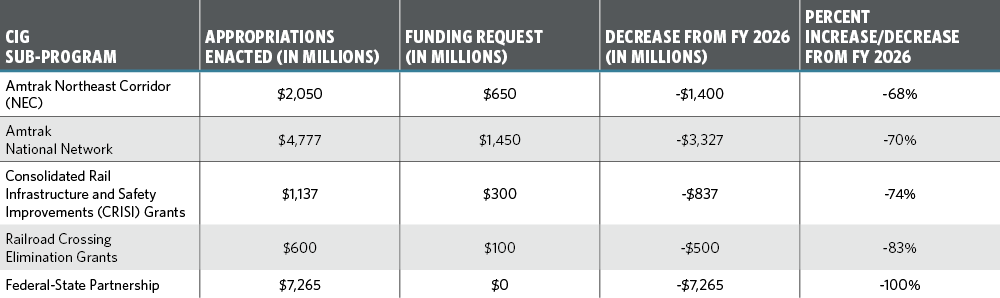
Advanced appropriation programs funded during IIJA, including Amtrak NEC, Amtrak National Network, CRISI, Railroad Crossing Elimination Grants and Federal-State Partnership for Intercity Passenger Rail, totaling $13.2 billion, are eliminated in FY 2027. The budget request of $2.8 billion includes some funding for Amtrak NEC and Amtrak National Network, as well as $300 million for CRISI and Railroad Crossing Elimination grants, as summarized in the table above.
Other Transportation Programs
The request proposes eliminating several discretionary programs, including Better Utilizing Investments to Leverage Development (BUILD) grants, the Mega Grant Program and Congressionally Directed Spending (earmark) accounts.
Requested funding for other major programs includes:
- $770 million for the Infrastructure for Rebuilding America (INFRA) Grant Program
- $713.7 million for the Bridge Formula Program
- $500 million for the Port Infrastructure Development Program (PIDP)
- $2.4 billion for MARAD, including the formation of a Maritime Security Trust Fund
- Raises Highway Trust Fund contract authority obligation limitations by 1% above FY 2026 levels
- Cancels approximately $4.2 billion in unobligated balances from the National Electric Vehicle Infrastructure (NEVI) Formula Program and Charging and Fueling Infrastructure Grants Program
Summary
The administration’s FY 2027 funding request begins the transition from the IIJA surface transportation authorization to the next authorization. The president’s request does not include $17.45 billion of advanced appropriations for public transit and passenger rail that IIJA authorized for each of its five years. Advanced appropriations were a critical tool for the industry, enabling more effective planning of large-scale and long-range capital investments by providing funding certainty, rather than relying on the annual appropriations process from the General Fund.
Congress now has about six months to deliberate and negotiate FY 2027 appropriations. Since 1996, annual appropriations have not been completed by October 1, instead relying on continuing resolutions to keep the government funded and avoid a shutdown. Further complicating timely funding approval is the midterm 2026 election cycle. Incumbent members running for reelection will have one eye on Washington and one eye on their home district. There will be a significant turnover of membership in the next Congress with 57 representatives and 11 senators opting to not run for reelection.
The current Congress can begin its FY 2027 budget hearings and deliberations, aiming to complete during the current session by the end of the year. If not successful, FY 2027 appropriations will roll over to the new Congress in January with many new members needing to learn the process and issues to approve the Transportation Housing and Urban Development Appropriations bill.
