

Experts Talk: Major Bridge Design Innovation With Mike Lamont
Experts Talk is an interview series with technical leaders from across our transportation program.
Creativity and Core Engineering Principles Combine on Transportation’s Most Complex Structures
Designing a major bridge is rarely just about crossing a river or a roadway. These projects bring together engineering judgment, construction strategy, aesthetic ambition and stakeholder alignment in ways that typical structures do not. For owners, they are often once-in-a-career undertakings. For designers, they demand a different level of rigor and creativity.
Mike Lamont, HDR’s major bridges technical director, knows all this as well as anybody. He’s spent more than 35 years in the bridge industry, and his work includes leadership roles on cable-stayed, arch and segmental bridges across North America, including the Port Mann Bridge in British Columbia and the I-395 Signature Bridge in Miami. A registered professional engineer in more than a dozen U.S. states as well as Canada, he is an industry-recognized leader in balancing aesthetic features and signature architecture with cost and constructability.
In this interview, Mike discusses some of the recent trends in complex bridge design, explains the role of creativity in bridge engineering and shares the importance of collaboration with both contractors and architects on major bridge projects.
Q. How have design trends in structure type changed in recent decades?
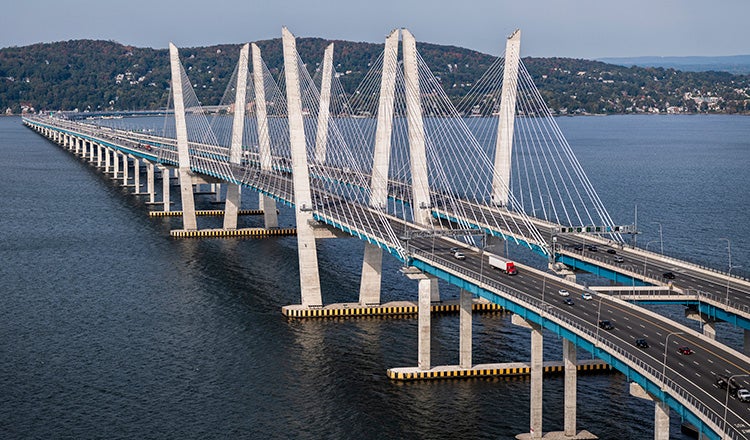
A. A lot of the older famous bridges in North America — Golden Gate, Brooklyn, Mackinac — are suspension bridges. But we're not building many new suspension bridges anymore, mostly due to cost and complexity. Instead, as cable-stayed technology has matured, span lengths have increased, and more contractors have gained familiarity with cable-stayed construction methods. Now cable-stayed bridges are a more common long-span choice.
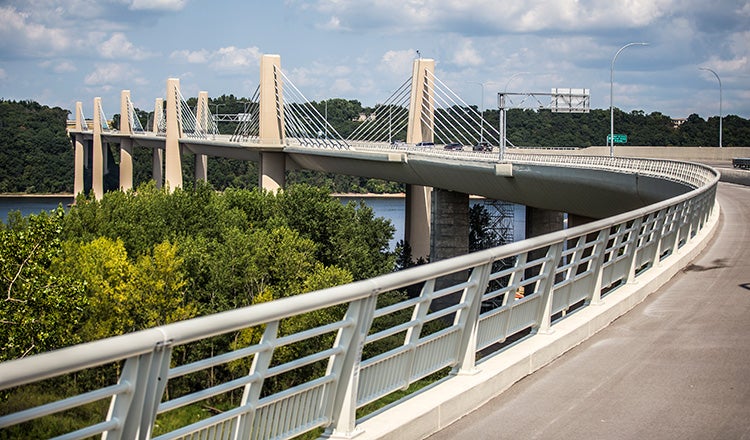
We are also seeing a significant rise in tied-arch bridges, particularly for medium-to-long river crossings. Many older truss bridges in the 500-800-foot span range are being replaced, driven by functional obsolescence or safety concerns related to structural redundancy, and tied arches are well suited for that application. And on a river crossing, you can build the tied arch offsite, float it in on a barge and lift it into place. That limits the interruption for river navigation, making tied arch bridges a viable solution at these span lengths.
So if you look at the market today, cable-stayed bridges tend to dominate the longer span range, while tied arches have become increasingly common for replacing legacy truss structures.
Q. What’s the role of innovation and creativity on major bridges?
A. Given the rarity of major bridges, design codes are not written with these structures in mind, and codes may not strictly apply because they're outside the realm of a typical bridge. We definitely still need to follow the intent of the codes, and they're still applied, but engineering judgment begins to play a much bigger part of the design process. That shift can be a learning process for a lot of owners. For example, standard design code provisions for deflections and redundancy are written for typical bridges and don’t strictly apply to cable-supported bridges, but we need to demonstrate that we are addressing the intent of these codes when designing complex bridges.
Major bridges often don’t look like the rest of a typical inventory. But when we break down the design, first principles still apply. As a designer of a major or complex bridge, we have to be confident in our understanding of basic engineering principles and then be able to communicate how we are applying them and why.
In interpreting design codes for these unique bridges, there's often a lot of questions about how they are being applied. The natural inclination when an owner or reviewer is outside their comfort zone is to push for more conservatism. There’s a tension between creativity and a tendency to think “we’ve always done it this way.” That really is difficult when we’re trying to be innovative and trying to design something that hasn't been done before. If the team lets it, it can really stifle creativity and innovation. That’s where communication and collaboration show their value.
An important part of my job these days is being able to communicate to multiple parties how a bridge is being designed, why it’s designed in a certain way and how it applies design codes that are not necessarily written for these type of bridges — bringing everyone along as a team as the design evolves.
It used to be that the engineer was king, and whoever was stamping the drawings made all the decisions. That is certainly not the case anymore, and it's probably a healthy adjustment in the industry. Now the owner often has their own consultants reviewing designs, with independent peer review or other checking. There may also be federal or external stakeholders involved. That environment requires engineers to not only develop sound solutions but also clearly explain and defend them.
Q. How do trends in project delivery methods impact the design of major bridges?
A. Design-bid-build used to be the standard way things were done. In the last 20 or so years, however, design-build has gained favour because of the acceleration of the design and construction time. We can often save time from project start to project end by going design-build. That said, there’s been a lot of litigation with design-build, so recently progressive design-build or construction manager/general contractor (CM/GC) are gaining popularity in response.
In those methods, the owner, the contractor and the engineer work more collaboratively instead of having a hard bid early in design, so there's a better understanding of the risk before the bid price is established. The trade-off can be less contractor competition and relatively higher construction costs, but hopefully less litigation.
We're doing a lot of preliminary designs for owners where we take something to a 20% to 30% design level and then have discussions about what the appropriate procurement method would be. Once the concept is established, it’s important to understand what the ultimate delivery method is going to be, because contractor input is an important part of the long-span bridge design process, and how we go about getting this input varies depending on the procurement model.
Q. Sounds like communication with contractors can be valuable. How important is it for engineers and designers to have a strong grasp of constructability?
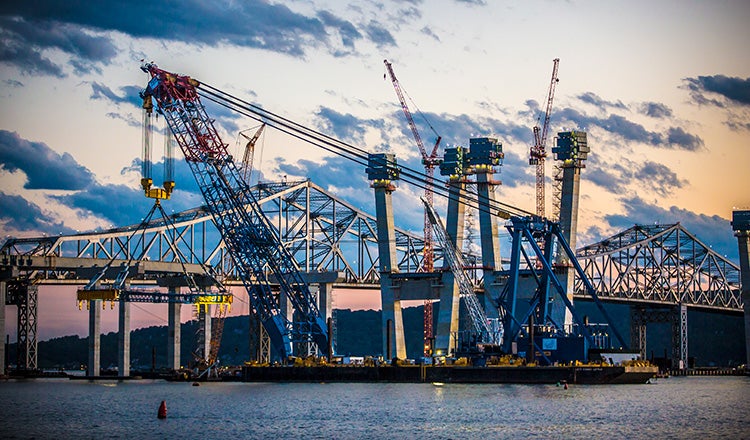
A. Constructability has a big influence, particularly with major bridges and long-span bridges. As a designer, we have to consider how the structure will be built because that changes the loads that are locked into the structure. Having a feasible construction method in mind as you're designing it is a requirement.
Earlier in my career, I did a lot of construction engineering for contractors, particularly on cable-stayed bridges but also segmental and tied arch bridges. Having that background has really helped me in design and in advising owners on design issues and construction issues.
I understand what an erection engineer needs to do when they are designing a cable-stayed bridge and the pros and cons of different construction methods. And a lot of that is site dependent: What is the access? Are they able to use barges to bring in material or equipment? What are the constraints on the site? And does that push the design toward one method versus another?
That all impacts not only how a bridge is constructed but also construction duration. And the success of a project is often determined by how easy it is to build it, with both cost and schedule impacted by that.
Q. How do you collaborate with architects to balance constructability with aesthetic aspirations?
A. I remember when I was in school the general rule was: If it's a building, the architect is in charge, and if it's a bridge, the engineer's in charge. But nothing is that simple.
Architects are creative, and as they're coming up with the designs, they want to create something unique, something that's never been done before. The thing is, typically, there's a reason something hasn't been done before. I've certainly seen some concepts that really catch your eye and make you say “wow,” but it doesn't mean that they work structurally.
There needs to be close coordination between the architect and the engineer. And the earlier the better, because what we see sometimes is that an architect will come up with something, perhaps independent of the engineer altogether. And then someone falls in love with that architectural concept; it’s shown to the owner or even to the public. But then reality sets in when we start looking at its structural behaviour and, just as importantly, its cost. As engineers, we can make something work. It's just how much it will cost.
An approach we recently took on a new design in Portland, Oregon, included a structural vetting exercise in parallel with the development of aesthetic options. That was a CM/GC project where the contractor was contributing to the constructability and cost implications. Within about 6 to 8 weeks, we took the different architectural concepts, vetted them structurally, came up with rough quantities, had the contractor price the options, and then we determined which of the aesthetic options were really practical when considering the project budget, constructability and the structural design.
That sort of collaboration, including the owner, engineer, architect and contractor, was a valuable exercise and it resulted in a good balance between cost and aesthetics.
Q. How did your career lead you to focus on major bridge design?
A. My first job out of school was for Caltrans, the California state transportation agency. And the first project I worked on was as a construction inspector on the Bay Bridge in San Francisco. They were doing a seismic retrofit on it after it partially collapsed in the Loma Prieta earthquake in 1989. From there I got into design with Caltrans and did a lot of seismic design work. I really caught the bug for bridge design.
When I left Caltrans I moved up to Olympia, Washington, to work for Arvid Grant, who was a pioneer of cable-stayed bridges in the U.S., and then David Goodyear, one of the best at long-span bridge design and construction engineering. And I’ve been doing it since, focusing on cable-stayed bridges, segmental bridges and complex bridges. I found my niche.
Q. What advice do you have for bridge designers earlier in their career?
A. No matter what task you're working on — even if it doesn’t seem exciting — there’s something applicable you can take from that experience. You may be doing a task that you're not that jazzed about, but learn as much as you can from what you're doing. Understand what you're doing and why.
Don’t just follow an example without understanding why you are doing certain things. Squeeze all the knowledge you can out of the experience that you get, because gaining a solid “first principles” understanding of various aspects of engineering is going to pay off down the road.
Each Experts Talk interview illuminates a different aspect of transportation infrastructure planning, design and delivery. Check back regularly for new insights from the specialized experts and thought leaders behind our award-winning, full service consulting practice.


