

Experts Talk: Integrated Technology Systems for Major Transportation Infrastructure With Michael Whalen
Experts Talk is an interview series with technical leaders from across our transportation program.
Harnessing Technology to Boost Public Safety, Improve Operational Efficiency and Lower Ownership Costs
Owners of major transportation infrastructure have an opportunity today to leverage emerging technology in ways that were just a dream a few years ago. Integrated systems allow engineers on their projects to design infrastructure that enhances public safety while also easing operation and maintenance.
Michael Whalen, P.E., LEED AP, serves as a project delivery manager in our White Plains, New York, office. Using his background in mechanical engineering, he has managed transportation system designs for the New New York Bridge/Governor Mario M. Cuomo Bridge project (replacing the Tappan Zee Bridge), the I-395 Signature Bridge Project in Miami and the Los Angeles World Airports Automated People Mover project. These projects included intelligent transportation systems (ITS), structural health monitoring (SHM), lighting, security, tolling, mechanical and electrical design work. His experience also includes similar roles on the Bayonne Bridge Navigational Clearance Project and the New York City Transit Authority’s Enhanced Station Initiative Project.
We asked him five questions about how the advanced technologies used in today’s transportation infrastructure projects are being applied to benefit both the public and owner-operators.
Q. What types of integrated systems are found on major transportation infrastructure today and how do these systems provide a return on investment in terms of energy and operational efficiency?
A. Just a decade or two ago, a major bridge or highway project may only have involved structural or highway design. However, with the evolution of technology there are many different design applications that can improve the performance and management of a transportation project.
Almost all new major infrastructure projects are built with technologically advanced systems to help owners and operators operate more efficiently and maintain their structures. A great example is the Gov. Mario M. Cuomo Bridge, where we have integrated ITS, intuitive LED lighting, structural health monitoring and security systems into its design. Each system provides the owner with a return on investment by increasing public safety, decreasing energy costs and providing information to improve operator and maintenance decision-making regarding future maintenance and rehabilitation programs.
Q. How can these types of systems improve mobility and safety as well as help owners operate and maintain their transportation assets more efficiently?
A. Typical systems implemented on transportation infrastructure projects may include dynamic message signage for lane control and variable speed limits, traffic surveillance cameras, weigh-in-motion vehicle scales, travel-time sensors, highway advisory radio and roadway weather information systems. Such systems help owners operate and maintain their transportation assets more efficiently.
For example, they provide feedback to the owner and information to the traveling public to relieve congestion and provide real-time travel updates. Technology informs motorists of crashes and directs them away from closed lanes; this helps drivers avoid last-second lane shifts, thus reducing the potential for other incidents. ITS serves as a valuable communication tool among the operators, law enforcement, first responders and tow truck operators. By alerting emergency personnel as quickly as possible, the impact of lane closures and crashes can be minimized.
In terms of maintenance, the structural health monitoring system on the Gov. Mario M. Cuomo Bridge is the largest and most complex of its kind in the United States. This SHM system consists of over 300 sensors giving real-time feedback and monitoring of the structure’s performance.
The SHM system works in tandem with other subsystems on the project and it is smart enough to know when a trigger event is occurring, such as a seismic event or ship impact. When they occur, an immediate alert to the operator is generated via email. The operator then can compare data from various sensors along the length of the bridge to gauge how different sensors and structural components react during different trigger events, at the same time as performing a post-event assessment of the structure.
Along with providing sensor information during trigger-event periods, the system lets the operator compare the bridge’s performance criteria on a yearly basis to assist maintenance planning, and condition assessment of bridge components such as bearing and expansion joints.
Managing lighting assets can be a huge undertaking on large infrastructure projects, whether it be a long span bridge or a miles-long highway. On recent projects, we have been adding a wireless repeater node to the top of each roadway light fixture to help streamline the communications process for maintenance monitoring. This node allows all roadway lights to “talk” to each adjacent fixture and send real-time signals back to a remote operator’s console. Typical signals sent include fixture status, fixture light output, maintenance required, end-of-life estimate and schedule. This system allows operators to remotely program the lights, schedule maintenance activities and show real-time energy usage trends.
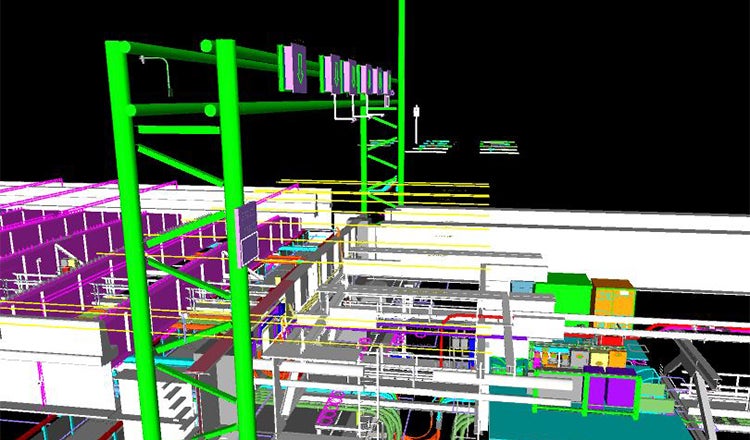
Q. How have Building Information Modeling systems been used to minimize risk in the process of bridge design, construction, operations and maintenance?
A. BIM is a valuable 3D modeling tool to minimize risk, and we use it extensively on our major infrastructure projects. It helps the engineer, contractor and operator make decisions during the project lifecycle, from design through operation and end of life. It easily allows engineers to insert, update or modify information received via shop drawings, field changes, etc., into the model and improve coordination with all disciplines and trades involved.
Contractors can use BIM to integrate construction activities and costs into the model as well as store up-to-date shop drawings, quantity take-offs and bills of materials. Bridge owners and operators appreciate BIM models because they serve as databases for inspection data, operational data, performance data and photos.
Q. How advanced are today’s asset management services in regard to evaluating bridges’ structural integrity, and what role do such services play in an integrated bridge system?
A. BIM models used as asset management systems can integrate with SHM to assist in condition assessment and decision making related to maintenance activities. Risk management is the primary reason to maintain a proper asset management database. Having a reliable asset management system and being able to make informed decisions relies heavily on obtaining high-quality and reliable data through systems such as ITS and SHM.
New web-based tools like AI-powered bridge management systems and the System for Inspection and Management of Structural Assets, or SIMSA, that we developed with the Colorado Department of Transportation to manage the structural components of its system, are moving operators from a reactive stance to being proactive. By closely monitoring the structure’s key performance characteristics, operators can identify potential risks to serviceability, perform assessments, estimate remaining service life and make informed decisions on near- and long-term maintenance plans to maintain safe, reliable infrastructure for the communities that depend on these systems.
Q. How are integrated transportation technology systems being designed to encompass future growth and industry advances in technology?
A. As with all areas of technology, changes and advancements in transportation systems technology increase exponentially year after year. The growth in vehicle automation, Bluetooth and wireless technology have made advancements in connected vehicle technologies and automated vehicles inevitable.
We can design these structures with future growth in mind by investing in and designing enough spare capacity for bandwidth on the fiber optic network; by including standard-compliant equipment such as National Transportation Communications for Intelligent Transportation Systems Protocol; and by ensuring that spare conduit capacity is included.
For example, space required for future equipment should be factored into the design so that controller cabinets, radios and power equipment can be installed without retrofits to the structure. Upgrading network security protocols may be required to manage the large influx of data to be collected and transmitted on a connected vehicle network. However, it can be challenging to integrate and design for future technological growth on these large-scale projects due to the fast-changing technology; near-term implementations should be delivered with the future in mind to maximize the long-term value of these tools.
Inspiration & Advice
Q. What inspired you to focus your career on systems engineering?
A. When I was growing up, we would actually drive over the old Tappan Zee Bridge quite often to visit relatives. I remember looking at all the truss work and thinking how neat it was and wondering how such things could stand up. So from that time, I always had a passion for bridges — but with a degree in mechanical engineering, the opportunities to work on such projects were extremely limited. I enjoy following the latest trends in technology, so focusing on these transportation technology systems lets me leverage my experience to work on the types of structures that inspire me as well as use my engineering background and interests in new technologies.
Q. What advice would you offer to new professionals in the transportation industry who will work with transportation technology systems out in the field?
A. Don’t be afraid to ask questions! Integrated systems engineering for these types of projects isn’t something that has been around for decades with masses of books written on the topic. These integrated systems require out-of-the-box thinking with an end focus on operator and public efficiencies. Each new project and past case studies can teach you something new about how to successfully deliver integrated systems to your clients.
Each Experts Talk interview illuminates a different aspect of transportation infrastructure planning, design and delivery. Check back regularly to see new insights from the specialized experts and thought leaders behind our award-winning, full service consulting practice.


