

Genesis and the Future of Discovery: Aligning Research Environments With the DOE's Mission
A New Beginning
The United States Department of Energy's (DOE) mission is to protect America's security and prosperity by addressing energy, environmental and nuclear challenges through transformative science and technology solutions.
To advance that mission, the DOE launched the Genesis Mission, an initiative designed to unite national laboratories, academia and industry around a shared goal: harnessing artificial intelligence (AI) to accelerate discovery science, strengthen national security and drive energy innovation. Through our vast portfolio across the country and our longstanding DOE relationship, we are leveraging our expertise to contribute to the mission’s success.
Genesis Mission Initiative
Build Collaborative Partnerships
The Genesis Mission recognizes that accelerating discovery requires bringing together diverse expertise, perspectives and capabilities. It plans to achieve this goal through building collaborative partnerships, both between national labs and external institutions and companies.
Over the past 30 years, we have partnered with 14 of the DOE's 17 national laboratories, helping create the facilities and infrastructure that enable collaboration, discovery and technological advancement. Our teams have worked alongside DOE national laboratories, leading research universities and private-sector innovators to create environments that support collaboration and knowledge sharing.
This blend of relationships and expertise positions us to support the type of partnerships Genesis seeks to expand. From user facilities that welcome researchers from around the world to multidisciplinary laboratories where scientists, engineers and computational researchers work side by side, our projects reflect the collaborative model that is central to the DOE's vision for the future.
Accelerating Discovery Science
By applying AI to molecular science, chemistry and data generated from large-scale research facilities, the DOE aims to shorten the path from observation to breakthrough. The mission also recognizes the growing potential of quantum computing and applied mathematics to solve increasingly complex scientific challenges. We have extensive experience creating the environments that support this work, partnering with DOE laboratories, universities and industry leaders to design advanced research facilities where computation, experimentation and collaboration come together to accelerate discovery.
At Brookhaven National Laboratory, we are supporting the design of the Electron-Ion Collider, a landmark federal science project that will generate unprecedented data about the internal structure of protons and atomic nuclei. Designed as the most advanced collider of its kind, the facility will provide researchers with powerful new tools to investigate some of science's most fundamental questions while supporting future scientific exploration through adaptable infrastructure and long-term flexibility.
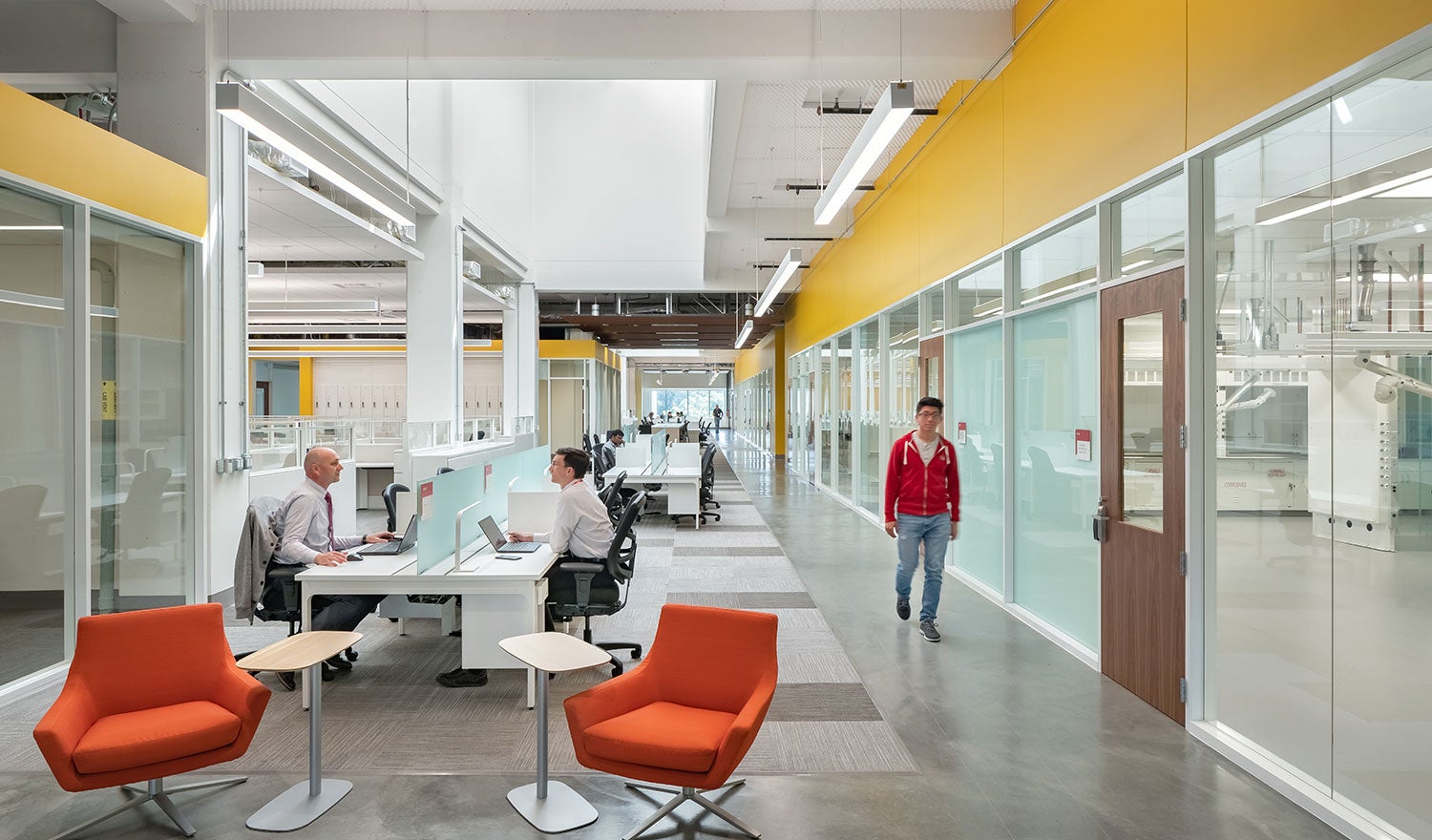
Our work at SLAC National Accelerator Laboratory reflects a similar commitment to discovery. The Photon Science Laboratory was designed as a multidisciplinary research environment supporting synthesis, characterization, simulation, theory and modeling. Today, researchers from SLAC and Stanford University are using its laboratories to support AI-driven research focused on advancing battery storage technologies.
Strengthening Materials Security
Artificial intelligence is creating new opportunities to accelerate the discovery and characterization of materials while helping researchers identify solutions that reduce dependence on foreign supply chains and support critical industries. We have extensive experience supporting materials science research environments, including nanotechnology, materials characterization and advanced manufacturing facilities.
One example is Brookhaven National Laboratory's National Synchrotron Light Source II, one of the world's most advanced synchrotron facilities. The facility provides researchers from academia, private industry and national laboratories with sophisticated tools to study material properties at the micro- and nanoscale, supporting discoveries with implications for manufacturing, energy technologies, medicine and national security.
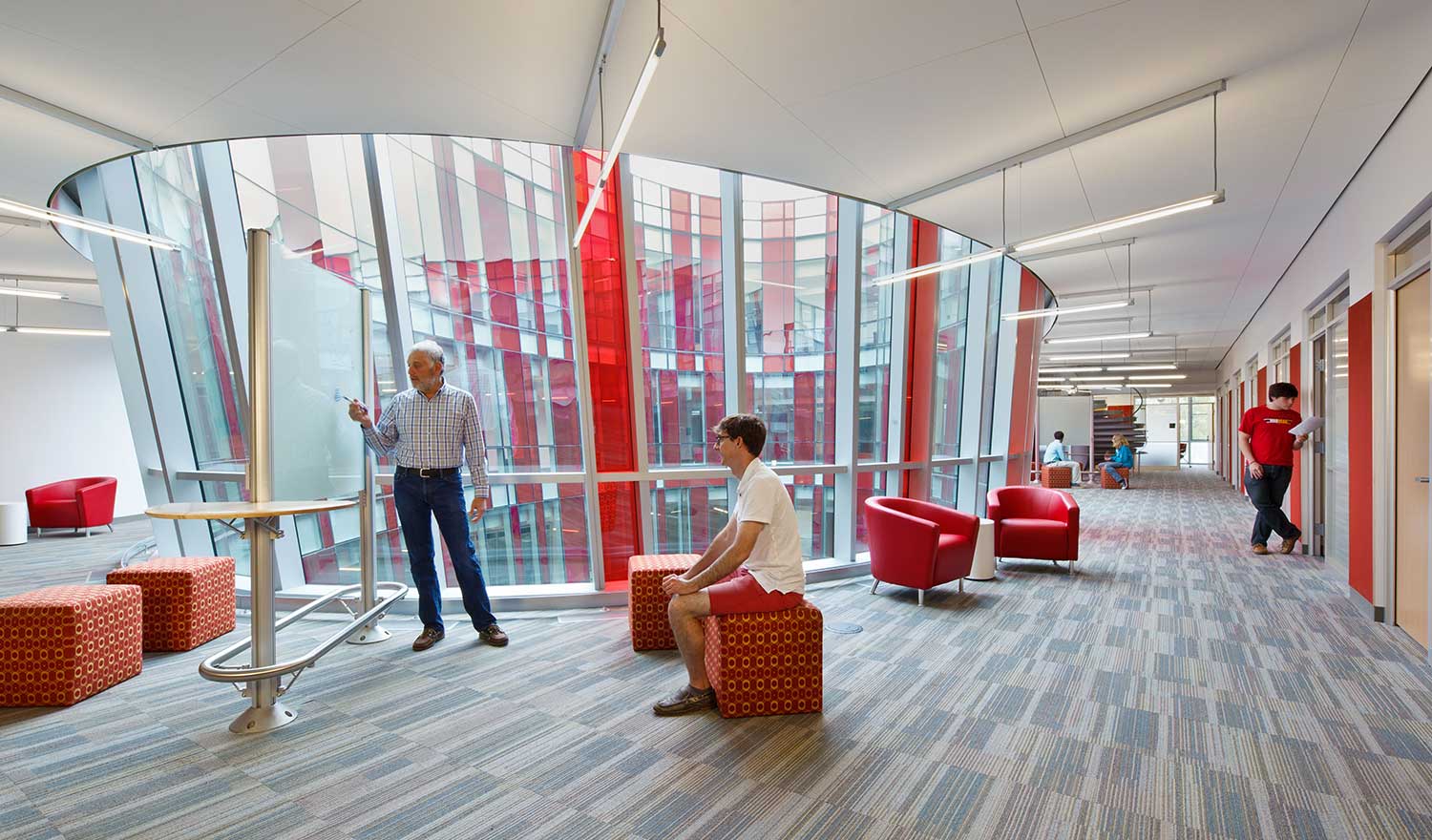
Our experience extends into quantum science and the advanced material sciences. The University of Maryland Physical Sciences Complex provides 160,000 square feet of space for collaborative efforts with nearby federal institutions, including the Joint Quantum Institute, National Institute of Standards and Technology, the NASA Goddard Space Flight Center, and a growing collaboration between the Institute for Physical Science and Technology and the National Institutes of Health. The building is organized around a central "cone" that allows for a mixture of theoretical and applied scientists to come together into a central and uplifting space.
Driving Energy Innovation
Achieving the nation's long-term energy goals will require breakthroughs across multiple disciplines, from materials science and manufacturing to advanced computing and engineering. The initiative is pushing for the stabilization of fusion power to create an affordable and abundant power supply, designing a new generation of optimized nuclear reactors and modernizing the nation’s power grid using AI-enabled simulation technology. Research environments must support that convergence while creating pathways from discovery to implementation.
Argonne National Laboratory's Energy Sciences Building reflects this approach. Designed as a premier interdisciplinary physical sciences laboratory, the facility encourages collaboration among researchers working to understand how the world produces, consumes and conserves energy. Its design supports the exchange of ideas across disciplines while helping position the campus for the future of energy research.

We are also supporting next-generation energy technologies through its work with Commonwealth Fusion Systems and MIT's Plasma Science and Fusion Center on SPARC. Designed to become the first net-energy fusion device that produces more energy than it consumes, SPARC represents a significant step toward the long-term pursuit of carbon-free commercial fusion power. The project brings together advances in physics, engineering, materials science and computing, reflecting the type of multidisciplinary innovation the Genesis Mission seeks to accelerate.
Building the Foundation for What's Next
By bringing together national laboratories, academia and industry, the initiative seeks to accelerate discovery and unlock new possibilities in science, national security and energy innovation. Success will depend not only on emerging technologies such as artificial intelligence and quantum computing, but also on the environments that enable collaboration, experimentation and innovation.
