
Electron-Ion Collider

Electron-Ion Collider
Designing the Most Advanced Particle Collider of its Kind
The Electron-Ion Collider (EIC) is a flagship U.S. Department of Energy (DOE) science facility being built at Brookhaven National Laboratory (BNL) in partnership with Thomas Jefferson National Accelerator Facility (Jefferson Lab) and is part of a multibillion-dollar federal investment in next-generation accelerator-based research infrastructure. Designed to enable unprecedented investigation into the structure of protons and nuclei, the EIC integrates complex accelerator systems with purpose-built infrastructure and conventional facilities, allowing the collider to operate at the limits of power density, thermal performance, reliability, and precision. With deep expertise in accelerator and high-energy physics infrastructure, HDR is designing integrated architectural and engineering solutions to provide the infrastructure supporting one of the most advanced colliders ever constructed.
Infrastructure Design for an Evolving Science
The EIC is a highly specialized, distributed research complex in which facility design must advance in parallel with a rapidly evolving accelerator program. HDR provided planning and detailed design of the infrastructure facilities that support the collider systems, while maintaining flexibility to respond to changing scientific requirements. The design development was executed in close coordination with accelerator physicists, cryogenic and radiofrequency (RF) engineers, facility operations personnel, and other stakeholders. This collaborative approach allowed the team to anticipate technical uncertainty, accommodate evolving equipment loads, and resolve interface conditions between accelerator components and building systems. The resulting facilities are engineered to support long service life, phased construction, and future system upgrades.
The project designers closely coordinated the accelerator systems’ requirements and developed the infrastructure by emphasizing scalable utilities, electrical, and thermal systems. The close collaborations between designers of high, medium, and low voltage power distribution; cooling water systems; cryogenic facilities; and controls infrastructure yielded an integrated project that is modular and redundant, while remaining economically feasible. The project includes features such as maintaining the physical clearances to support future equipment configurations, higher operational loads, and advancements in accelerator technology.
Key Technical Design Attributes
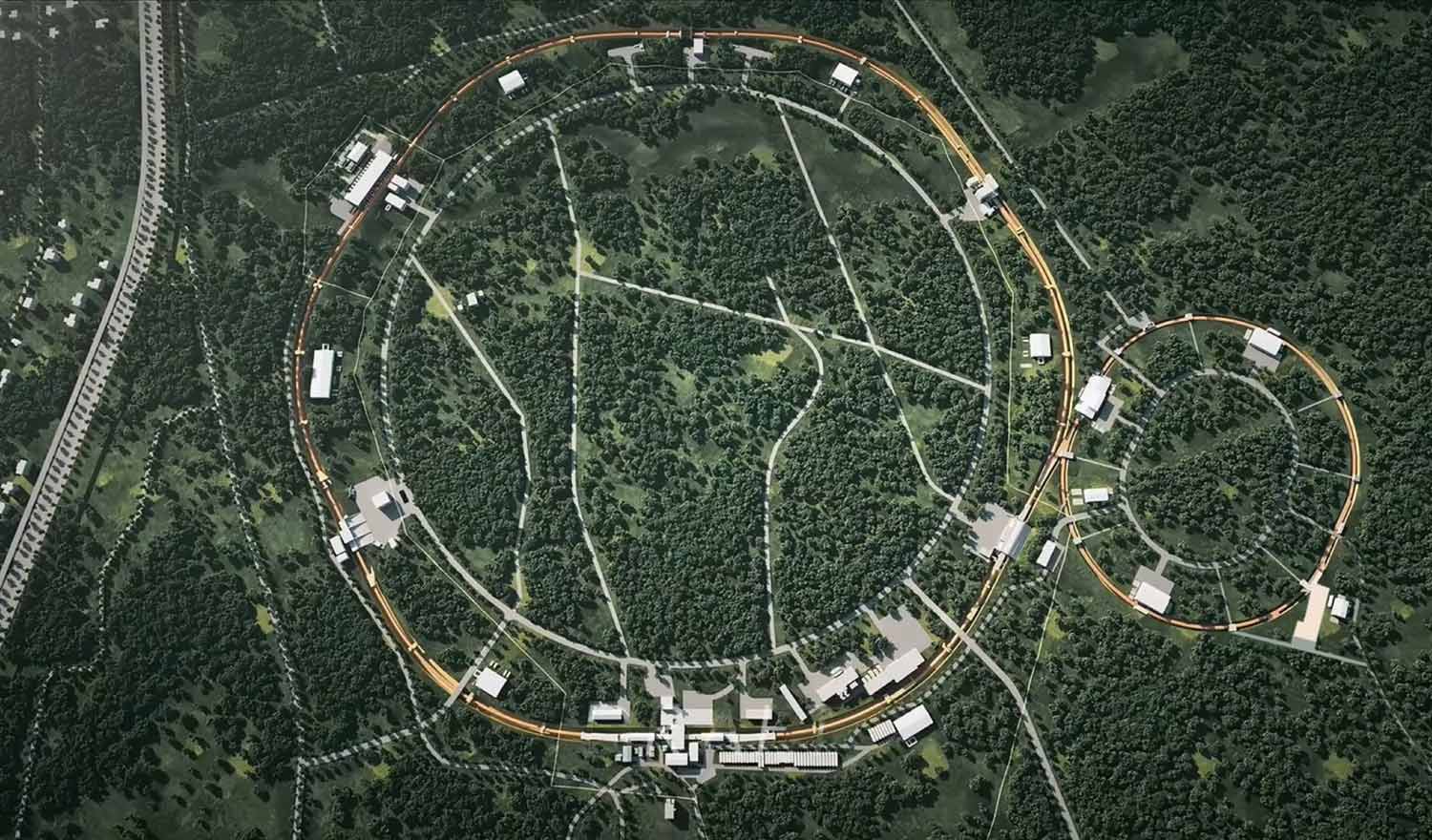
- Adaptation of Existing Accelerator Assets: Strategic reuse and modification of the existing 2.4-mile circumference tunnel and associated structures previously used by the Relativistic Heavy Ion Collider (RHIC) support new collider functions, while meeting upgraded structural, HVAC, and shielding requirements.
- High Reliability Power Infrastructure: Electrical power design includes two 50 megawatt transformers connected to a 66,000-volt transmission line where voltage is reduced to 13,800 volts. A campus-wide medium voltage distribution and dedicated unit substations are designed to accommodate the projected total peak demand of 70 megavolt-amperes (MVA) or roughly 3000 amps at the 13.8 kilovolt (kV) level supporting the high-density RF, magnet, and kicker loads. The EIC power design provides provisions for redundancy, future expansion, and life safety power continuity. Additionally, careful considerations were given to electrical unit substations with long lead procurement timelines which were procured early and delivered to the site.
- Integrated Thermal and Cryogenic Systems: Coordinated chilled water, closed-loop deionized cooling, cooling tower, and cryogenic plant infrastructure distributed across multiple support buildings and optimized for operational efficiency, maintainability, and scalability. HDR engineers collaborated closely with BNL and Jefferson Lab designers on the development of cryogenic facilities supporting the accelerators.
- Highly Coordinated Multi-Facility Planning: Careful considerations were given to the detailed interface management across dozens of technically specialized support buildings, pump houses, RF power facilities, cryogenic plants, and utility yards to ensure seamless integration of mechanical, electrical, structural, and control systems.
- Electron Injector (eIN) Complex: HDR worked closely with the accelerator team to develop the early conceptual designs of the infrastructure and site utilities supporting the electron source for the EIC project. The components making up the eIN include a Linear Accelerator (LINAC), a Beam/Bunch Accumulator Ring (BAR), a Rapid Cycling Synchrotron (RCS) tunnel, in addition to berm top enclosures, RF, and cryogenics facilities. These eIN components act sequentially to generate, stack, and accelerate high-intensity polarized electron bunches before injecting them into the primary Electron Storage Ring (ESR) in the EIC tunnel.
Building a Foundation for the Future of Physics
The EIC will position the U.S. DOE and a host of international collaborators at the forefront of global physics research. Our work enables over 1,500 scientific collaborators from 294 institutions in 40 countries to pursue discoveries at BNL that will shape generations of researchers while demonstrating how adaptable infrastructure design can support the evolving requirements and future needs of large-scale science facilities.


