

Driving Continuous Improvement After Project Management Information System Go-Live
This is the final segment in a four-part series on successful Project Management Information System (PMIS) selection and use. The first segment, How to Optimize Your Program’s Project Management Information System (PMIS), discussed the importance of assessing your program's needs by defining requirements and prioritizing tool categories before selecting a PMIS. Next, Selecting the Right Project Management Information System Tool walked through the different categories of tools based on identified program needs such as speed of implementation, total cost of ownership, integrations and customizations. The third segment, Using Essential Features to Launch Your PMIS, explored the concept of a minimum viable product (MVP), a focused approach that prioritizes essential features to accelerate implementation and reduce risk.
PMIS Go-Live Isn’t the Finish Line, It’s the Starting Point
PMIS go-live is the starting point in unlocking the full potential of a PMIS. The real value emerges through continuous improvement and optimization once the system is operational.
Why PMIS Continuous Improvement Matters
When launching a PMIS, the focus is typically on core functionalities to meet immediate program needs with many requirements identified during planning deferred for later phases. Post-implementation offers an opportunity to add these enhancements.
Continuous improvement is not just about adapting to new program needs, it’s about adding features that were intentionally postponed during MVP development and driving user adoption, allowing the system to increase its value over time. This phase moves the PMIS from basic functionality to strategic advantage.
A system that evolves in tandem with a program enables better decision-making, stronger governance and measurable return-on-investment (ROI) progression. Frame it as growth: Your PMIS should mature along with your program.
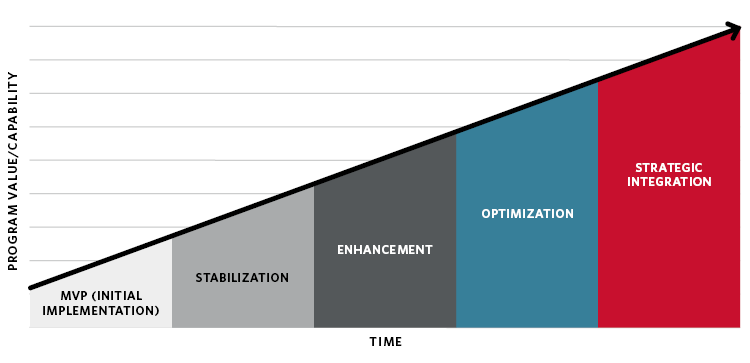
Once a PMIS moves beyond initial implementation and stabilization, ongoing attention to user engagement, system optimization, governance and data integrity enables continued enhancements that add value and optimize strategic integration. Without these efforts, even the best-designed system can fall short of expectations.
Four Tips for Long-Term PMIS Success
Following best practices for PMIS integration establishes an approach designed for future success.
Prioritize User Adoption and Engagement
A PMIS only delivers value when the program team uses it effectively. Training should not stop after rollout. Proactively deliver training and refreshers through a push-based training method rather than a passive pull-based method. Regular refresher sessions, self-service training videos, and open office hours help maintain confidence and reduce friction. Adoption is closely tied to feedback loops. Capturing usability issues and enhancement requests verifies that changes and optimizations reflect program needs and user experience.
If the PMIS is accessed by external users, such as contractors and consultants, consider adding contract language outlining expectations for its use as you onboard them to support your program. Provide them with ongoing training and support as required for their role.
Training opportunities and support can include the following:
- Micro-learning opportunities with bite-sized modules focused on key tasks such as uploading, naming and transmitting documents, completing, submitting and understanding workflow forms such as RFIs and change orders.
- Self-service training and job aids.
- Role-based training that explains the “why.”
- Continuous onboarding for new staff and contractors.
- Quick and responsive super users or champions for real-time support.
Establish Governance and Organizational Change Management
Form a PMIS governance group to oversee enhancements and maintain standards. Define clear decision authority levels so requests don’t get “stuck” with too many stakeholder inputs. Communicate regularly with program leadership through check-ins that cover priorities, implementation status and roadblocks or issues. This transparency builds trust and keeps the PMIS aligned with program objectives.
Focus on System Optimization
As your feedback loop gathers information from program users, confirm that workflows and configurations align with current processes. Analyze feature utilization to identify underused capabilities and promote their adoption. Flexible integration options can help onboard teams struggling with adoption. Integration with other enterprise systems can further streamline operations and reduce duplication. Maintain a sandbox environment for configuration testing before changes go live.
Maintain Data Quality and Reporting Excellence
Inaccurate and irrelevant data are common reasons for poor user adoption. Continuous validation of data verifies integrity, while refining dashboards and reporting tools keeps insights relevant and actionable. Align reporting improvements with evolving program objectives to optimize impact and retain buy-in.
Programs that succeed in the long run often adopt a structured approach. Ongoing health checks monitor adoption, data quality and system performance. Maintaining an enhancement backlog and prioritizing based on business impact encourages strategic improvements rather than reactive ones. Analytics can track user engagement and highlight areas for improvement, while roadmap reviews keep the PMIS aligned with program goals.
Sustain PMIS Momentum With Practical Steps
Continuous improvement depends on communication and alignment. Establish feedback loops with end users, invest in ongoing training, and increase enhancements to continuously support program objectives. Treat your PMIS as a living system — one that requires care, attention and evolution to deliver sustained value.
Go-live is not the end of the journey. It’s the beginning of a new phase where your PMIS can truly transform program management. Organizations that embrace continuous improvement will see higher adoption, stronger governance and a system that grows with their needs. The hard work after implementation is what turns a functional tool into a strategic asset.

