

Experts Talk: The Economics of Sustainability and Resilience With Pamela Yonkin
Experts Talk is an interview series with technical leaders from across our transportation program.
Why to Approach Every Project With a Sustainability and Resilience Lens
The risks, costs and expectations facing infrastructure today have fundamentally changed. With limited budgets and an uncertain economy, transportation infrastructure owners must make smarter, more defensible decisions that consider the consequences of not planning for long-term shocks and stresses — they have simply become too great to ignore. Sustainable, resilient projects last longer, can save money in the long term and can help mitigate uncertainty. Resilience and sustainability planning make good financial sense — just ask an economist.
Economist Pamela Yonkin heads our resilience and sustainability practice, and she is an expert in helping clients use data to make decisions related to resilience and sustainability. Yonkin, ENV SP, has decades of experience performing economic analyses of built infrastructure projects and many of her projects have involved the issues of sustainability and resilience.
Q. What is the difference between sustainability and resilience?
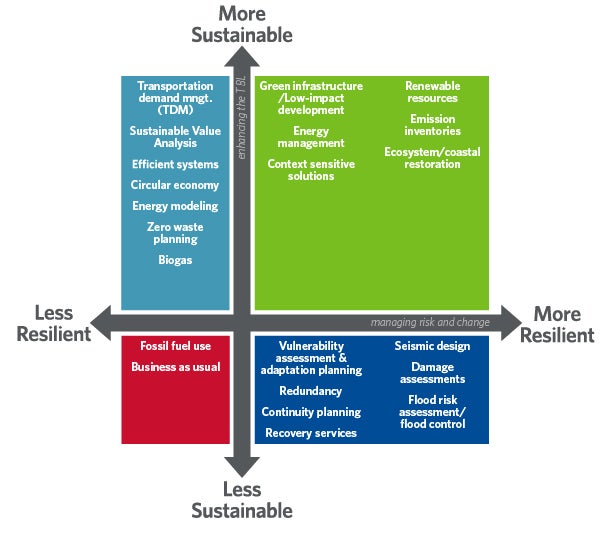
A. Sustainability is the practice of meeting the needs of the present without compromising the ability of future generations to meet their own needs. It is accomplished when, for example, we reduce or eliminate environmental impacts, improve quality of life for communities, and do so in a way that can be maintained economically. Resilience is the practice of designing things to endure physical, social and economic shocks and stresses. Ideally, resilient infrastructure endures, rapidly responds and prospers, despite these unexpected impacts. The two concepts complement each other when we create dynamic, adaptive systems that will protect human health, economic security and environmental wellbeing. If you build something that’s both sustainable and resilient, it lasts longer and it bounces back more easily from shocks.
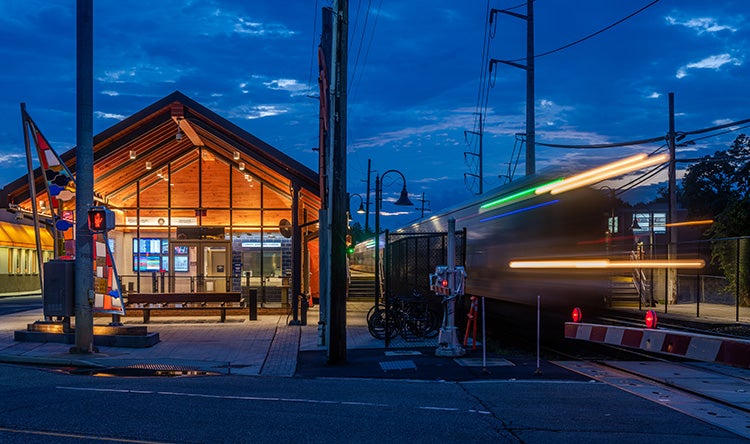
For example, if you build a sustainable transit station, you'd want something that improves the community’s quality of life. Possibly, it includes active transportation elements and better lighting, which better connect the neighborhood to transit and improve station safety. These improvements may also encourage someone to take the bus, bicycle or walk on a safe sidewalk, resulting in reduced emissions. The building could have solar panels, saving on utility costs and reducing emissions even more. To be resilient, the station could be built outside the floodplain and resistant to local hazards. In that way, it’s the whole package: damage-resistant, long-lasting and quality-of-life improving.
Q. What does economics have to do with sustainability and resilience?
A. Both in our personal and professional lives, we continually weigh the benefits and costs associated with different decisions. Incorporating economics into decisions related to sustainability and resilience is a very natural extension of this. It can lead to a pretty persuasive argument for building a “greener” building or one that withstands natural disasters better. For example, it might be more expensive in the near-term to build a project with sustainability and resilience features, but there may be the potential to save a lot of money in the long term on utility costs and emergency repair bills due to those same features. There are also approaches for putting dollar values on things like public safety, journey quality, and cleaner air, reflecting even greater value for designs that incorporate features that support these triple bottom line sustainability and resilience.
Most transit agencies, municipalities and transportation authorities also have more potential projects than they have funding, and they need ways to prioritize their investments. Decision-making with an economic basis can support this effort. We all know it’s really important to provide a pragmatic, feasible solution rather than just identify the problems. Economics can help with the process of reasonable decision-making related to infrastructure investment, and we have approaches for measuring the value of projects that are more sustainable and resilient.

Q. Why should community and transportation leaders invest limited dollars in resilience and sustainability?
A. In short, it can reduce project costs long-term. Failing to consider sustainability and resilience reflects the “penny-wise, pound-foolish” idiom perfectly. If we think about sustainability from a triple bottom line perspective, we consider the environmental and social elements of a project, but also whether it is economically sustainable. The whole point is designing infrastructure that uses limited funding wisely by being holistic in terms of its impact, understanding the full value of the infrastructure investment over its life cycle, and supporting long-term economic sustainability. Sometimes those investments are more expensive on the front end, but the project’s long-term value should outweigh its short-term costs, making it more sustainable over time.
What happens when owners do not consider whether the infrastructure they build is resilient? Those owners may wind up experiencing an unexpected shock, with associated emergency repairs likely at a premium and the possibility that the “fix” is short term. If a similar event happens again, they will incur those same costs or more because the infrastructure is likely still inadequate. Considering resilience in planning and design means mitigating the costs associated with different risks. It also means considering other factors, such as the impact of the loss of critical infrastructure or the ability of critical personnel to get to and perform their jobs. HDR has many tools at our disposal to work with our client programs to understand which assets are most critical or most vulnerable, the risks of an event occurring, and the potential impact, cost and other consequences, if something does happen. That gives us an understanding of when to invest in more resilient designs. Incorporating resilience thinking into decision-making is the best approach when investing limited dollars in infrastructure that is, in many cases, likely to outlive us.
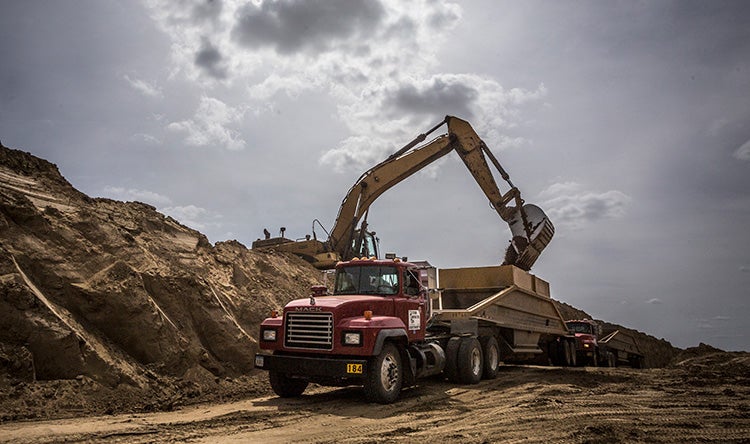
Thinking about projects in this way also forces innovation, and it can save money in the short-term as well. For example, sometimes a big expense with large infrastructure projects is disposing of materials. If you reuse materials on site, you save yourself trucking costs and that's a near-term cost that you don't have to pay. Society may be better off too because fewer truck-miles means fewer emissions and less wear and tear on public roads. But you have to think about that before you contract for a waste hauler. These types of considerations need to happen at the planning and design stage, not after you've come up with the design and are trying to construct it.
Q. What kinds of infrastructure programs need to incorporate resilience/sustainability in the planning stages?
A. All kinds of projects! During the planning stage, trade-offs associated with different alternatives can be understood. Typical questions include: Is there an opportunity to reduce life cycle costs? What is the true value of sustainable and resilient infrastructure alternatives and can these benefits be monetized and compared to the life cycle costs? Are there ways to achieve other-than-mobility-related goals by choosing one alternative over another?
For large networks or systems, dashboards are particularly helpful in helping leaders prioritize their needs. In Hawaii, for instance, HDR is developing a suite of GIS‑based climate risk dashboards and a Resilience Improvement Plan to help the Hawaii Department of Transportation integrate climate considerations early in project development. The dashboards visualize statewide risk from heat, storms, sea‑level rise, flooding and other hazards, enabling planners to anticipate cost, permitting and schedule implications before design begins.
In addition to supporting a more holistic planning process, these assessments are the foundation for establishing sustainable and resilient design goals, such as greenhouse gas minimization, stormwater runoff quantity and energy efficiency. Where possible, resilience should be linked to sustainability so that the resilience we are trying to plan and design for actually helps us move toward a sustainable system in the future. For example, designing a barrier to protect a structure from storm surge may support resilience efforts but is potentially expensive to maintain; in other words, it is not economically sustainable.
Q. Sounds like these decisions are very tied to risk assessments. How is risk management built into these processes?
A. Improved data quality and data availability in recent years have provided an opportunity for better economics risk assessments as well. These assessments contribute to decisions on how robust an infrastructure project should be constructed when facing threats from extreme events. For instance, over-building infrastructure typically diverts funds from other needs while under-building could limit its effectiveness. Risk-informed decision-making methods build on the best available data to assess the likelihoods and consequences of failures.
A key step in risk-based decision-making is estimating the baseline economic impact if a storm, wildfire or other disaster occurred today, given current infrastructure and hazard risks. This “no-action” cost includes repair, economic, societal, and displacement impacts, and can be compared to the cost of infrastructure improvements to guide prioritization and investment decisions.
While the benefits of avoided losses are only experienced if a disaster occurs, risk-reducing projects can also generate co-benefits that occur even if an identified hazard does not come to fruition. Our economics team is experienced in valuing, for example, natural resources benefits associated with nature-based solutions, green infrastructure, and ecosystem and habitat enhancements.
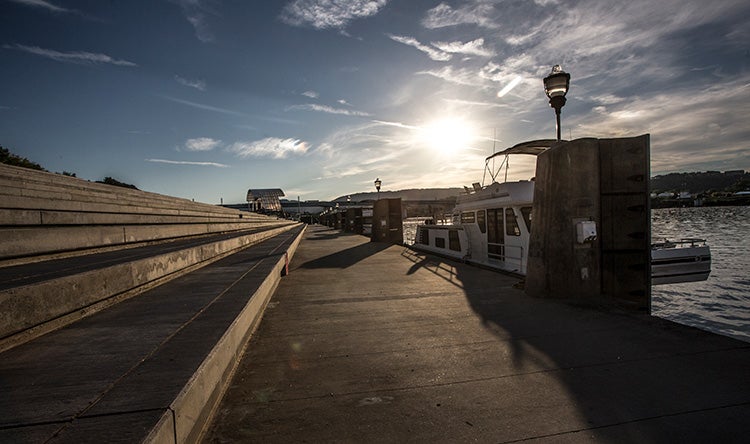
Sometimes an analysis shows it doesn’t make sense to invest more. For a New York port, we considered whether we should design and build a more resilient wharf today, build a more traditional wharf with the ability to be resilience-enhanced, or altogether skip adding anything to address resilience. Turns out, the ability to add resilience features to the wharf at some point in the future was the most cost-effective choice. Near term, the risks of an event occurring were low enough that managing unexpected emergency repairs was more cost-effective. Longer term, however, sea level rise projections and other considerations made the probability of an unexpected event more likely and the impact more significant. We have completed similar analyses for municipalities in Florida, as well as for some of our U.S. and global rail and transit clients — helping them determine which of their assets are most vulnerable and most critical. This information can then help prioritize adaptation projects for near-term investment.
Inspiration and Advice
Q. How did you become interested in resilience and sustainability?
A. I have thought about this since I was a kid! Going to the dump with my dad, thinking that there must be a better way. Playing in a creek and witnessing how quickly water can erode something. Being simultaneously proud and mortified by the way my mom made things stretch to many uses, forced hand-me-downs, repurposed old furniture. Remembering my parents’ decisions about windows and lighting and house orientation when they built their house in the ’70s. And then I grew up and realized that these little things can be applied to very big concepts and scales.
Q. What advice do you have for someone just starting to work in the field?
A. Be pragmatic and persuasive but not overly opinionated. Rome was not built in a day. Oftentimes working in the sustainability realm involves meeting people on their level and explaining the concrete benefits. If you don’t reach people on their level, you lose their interest.
Look for opportunities to help, even on a small scale. Consider bringing up the topics of resilience and sustainability in your office, perhaps via a young professional group. To the extent possible, bring this stuff up whenever you can. Don't be afraid to say things like, “You know, we didn't really talk about whether we should be using permeable pavement.”
More generally, if someone seems to have a job that you think is really cool, give them a call and see if you can learn from them. Get involved in groups, even local groups that are interested in these issues and learn about your own community. Baby steps go a long way. Lots of people doing small things related to resilience and sustainability really can make a big difference and impact in their communities.
Each Experts Talk interview illuminates a different aspect of transportation infrastructure planning, design and delivery. Check back regularly for new insights from the specialized experts and thought leaders behind our award-winning, full service consulting practice.


