

Delivering Critical Water Infrastructure Under Pressure
Modern infrastructure upgrades are rarely isolated engineering challenges. They are complex exercises that need to balance risk management, operational resilience, cross‑disciplinary collaboration and managing community expectations.
A recent water system transformation in the southern British Columbia, Resort Municipality of Whistler (RMOW) illustrates how engineering teams and utilities can successfully deliver complex, essential upgrades during peak demand and under high‑risk seasonal conditions.
From Legacy Constraints to System Resilience
The South Whistler Water Supply project addressed longstanding vulnerabilities in a hybrid water system built of legacy infrastructure and recent expansions completed ahead of the 2010 Winter Olympics. Key risks included water source redundancy, reliance on a single groundwater well with an outdated pressure relief valve (PRV), and elevated manganese and pH variation.
This project improved supply redundancy for thousands of permanent and seasonal residents and over three million annual visitors while maintaining uninterrupted service throughout construction. HDR engineers led the planning, design, and implementation support for the water system transformation, coordinating closely with RMOW operations staff and contractors.
Rather than incremental fixes, we developed an approach that focused on carefully sequenced, systemwide resilience:
- Eliminating high-risk assets (e.g., manganese-impacted wells)
- Introducing redundancy through a new pump station and reconfigured supply network
- Standardizing water quality with pH correction across all sources
- Integrating previously disconnected infrastructure into a cohesive system
Summer in Whistler: Festivals, Fires and High Demand
This upgrade required careful sequencing and planning as it had to be delivered within an operating, high-pressure system during the community’s peak-demand season. Any unplanned disruption during this time could have affected thousands of residents and visitors while limiting firefighting capacity during periods of elevated wildfire risk.
The solution was a carefully orchestrated and sequenced approach that enabled the team to reduce risk at each step of system integration. The emphasis on detailed staging demonstrates a key insight: in high‑risk infrastructure projects, success is determined less by design innovation and more by execution precision.
The Role of 4D Visualization in Collaboration
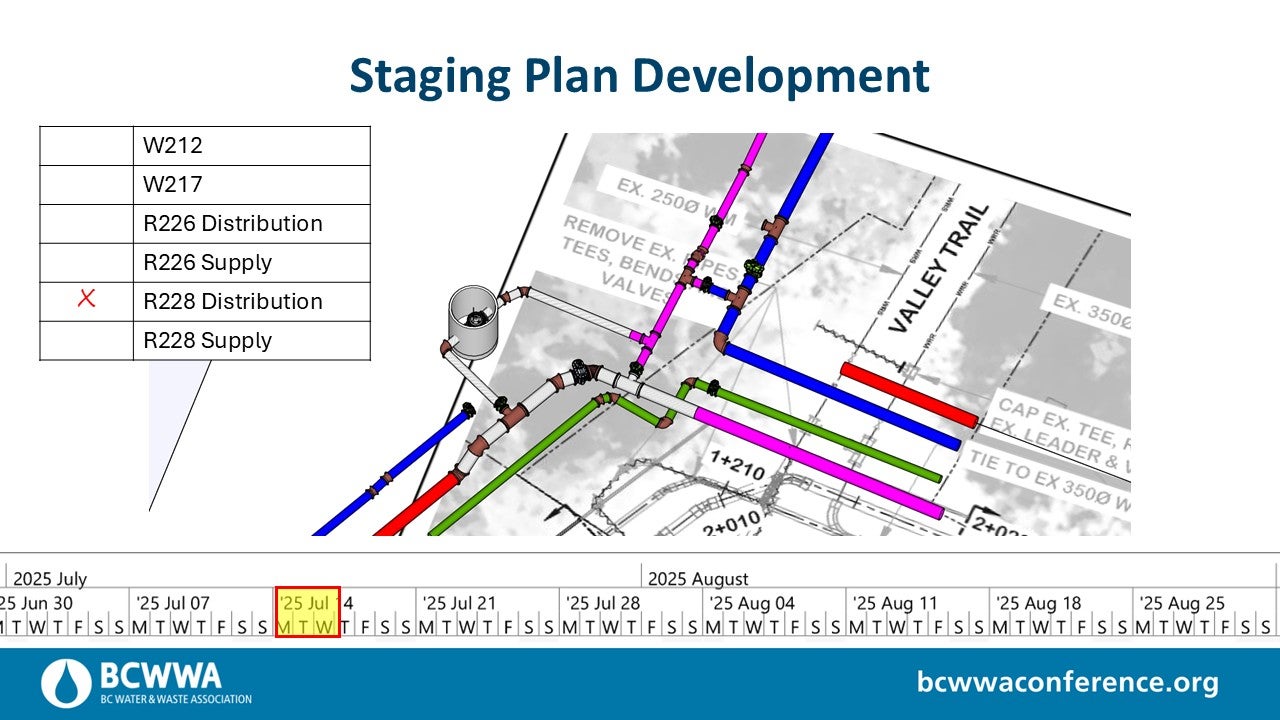
A standout differentiator on this project was the use of 4D visualization. By linking 3D piping models to the construction schedule, our team could visualize each shutdown, bypass, and tie-in before work occurs in the field. This enables operators and contractors to identify potential conflicts early and build confidence in the execution plan. In addition to enhancing coordination between engineers, contractors, and operators, this proved to be an important communication tool for the team, stakeholders and the community, visualizing the system at each stage of construction.
Lessons From a Complex Water System Transformation
Key lessons the team will carry forward into future projects include:
- Maintain strong engagement with operational staff and foster close collaboration with contractors.
- Develop contingency plans for every stage, including backup water supplies, potential water quality variations, spare parts availability, and potential delays.
- Incorporate bypasses and temporary connections to reduce risks to water supply continuity.
- Leverage visualization tools to support planning, communication, and decision-making.
As utilities across North America face aging infrastructure, climate-related risks, and increasing service expectations, this project demonstrates how resilience can be built through integrating engineering excellence with operational insight, collaborative planning, and disciplined execution.
This story is based on a presentation Walt Bayless, our Canada Drinking Water Lead, shared at the BC Water & Waste Association conference in Penticton in April 2026.


