
Carolina Crossroads Corridor Improvements

Carolina Crossroads Corridor Improvements
Environmental and Engineering Work Set Stage for Major Corridor Redevelopment
Located in the heart of South Carolina, the I-20/26/126 corridor is the crossroads of the state economy and the major hub for the Midlands’ commuters, travelers, and commerce. In addition to being a main route in and out of Columbia, I-26 is a thoroughfare for travelers headed to the coast and mountains and a major cargo route between Lowcountry ports and Upstate manufacturers. Last improved in the 1980s, the I-20/26/126 corridor does not meet current traffic demands and had earned the nickname “Malfunction Junction.” Finding a solution has become the state’s top interstate priority.
Beginning in 2015, HDR served as the prime consultant to complete alternatives development, environmental analysis and documentation, public stakeholder engagement, and preliminary design for completion of the Environmental Impact Statement (EIS) and Record of Decision (ROD) in spring of 2019. Following the NEPA stage, we have continued to support overall program delivery strategy, including development of the 2019 plan to deliver the project in five phases. We also provide management, design and implementation to deliver these much-needed and critical infrastructure improvements for the state of South Carolina.
A New Multi-Phased Approach
In October 2023, SCDOT restructured its approach to the remaining project area (previously identified as Phase 3, the largest of the five phases), charging HDR with the task of identifying the most effective means of rephasing the project with the least impacts to cost, schedule or traveling public, while also addressing significant risks associated with critical utility relocations and geotechnical conditions. Our team developed and evaluated multiple rephasing alternatives through active coordination with SCDOT to arrive at a preferred path forward and SCDOT-approved rephasing plan in February 2024. The new plan restructures the delivery of the previous (“Legacy”) Phase 3 area into multiple, smaller phases of construction using a combination of design-build and design-bid-build delivery methods.
Maintaining Momentum
Significant progress has been made across the project and its sections. As of early 2026:
- Phase 1 and Phase 2 of the project have reached substantial completion. These design-build projects consisted of reconstruction of two service road interchanges.
- Phase 3B — clearing and grubbing of the main interchange area — is nearing construction completion.
- Phase 3C — the widening of I-20 — has begun construction.
- Phase 3D — I-26/I-126 reconstruction — is in procurement.
- Phase 3A and Phases 4 and 5 are in the final design stage. These phases will be delivered using design-bid-build and include frontage road and utility relocations (Phase 3A), and additional frontage roads and utility relocations, I-26 widening, and reconstruction of a service road interchange (Phases 4 and 5).
- Phase 3E — I-20/I-26 interchange and two additional service road interchanges — is in conceptual design.
Steady and Ongoing Program Management
Since beginning the project, HDR has provided continued program management services to SCDOT, including support for major project requirements, environmental services, traffic analysis, including Interchange Modification Report updates, utility coordination, ongoing right-of-way plan updates, procurement development, and public involvement services. HDR has also provided design review support for design-build projects and has continued multi-disciplinary final design and plan development activities for Phases 3A, 4 and 5, which are scheduled to begin construction in early 2027.
Community-Focused Benefits
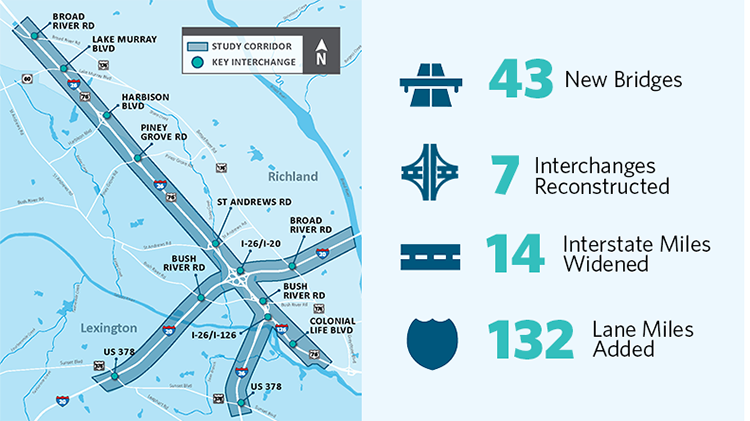
Upon completion, the corridor will have added capacity and upgraded design to meet current standards which will improve the operations and safety of the entire project area. These improvements will be achieved with additional lanes in each direction on I-20, I-26, and I-126 as well as 12-foot inside shoulders to reduce operational impacts from incidents. The reconstruction of seven interchanges in the project area will also deliver these improvements with upgraded designs. Replacing the I-20/I-26 cloverleaf interchange with directional ramps and the implementation of collector-distributor roads will consolidate movements within the project area and improve I-26 and I-20 mainline operations and safety.
When the project is complete, these changes will save each driver an average of 112 hours per year that would have otherwise been spent sitting in traffic. The entire project is anticipated to be complete in 2034.


