
Austin-Bergstrom International Airport

Austin-Bergstrom International Airport
Designing Austin’s First Taxiway Bridges to Support Expansion at Texas Airport
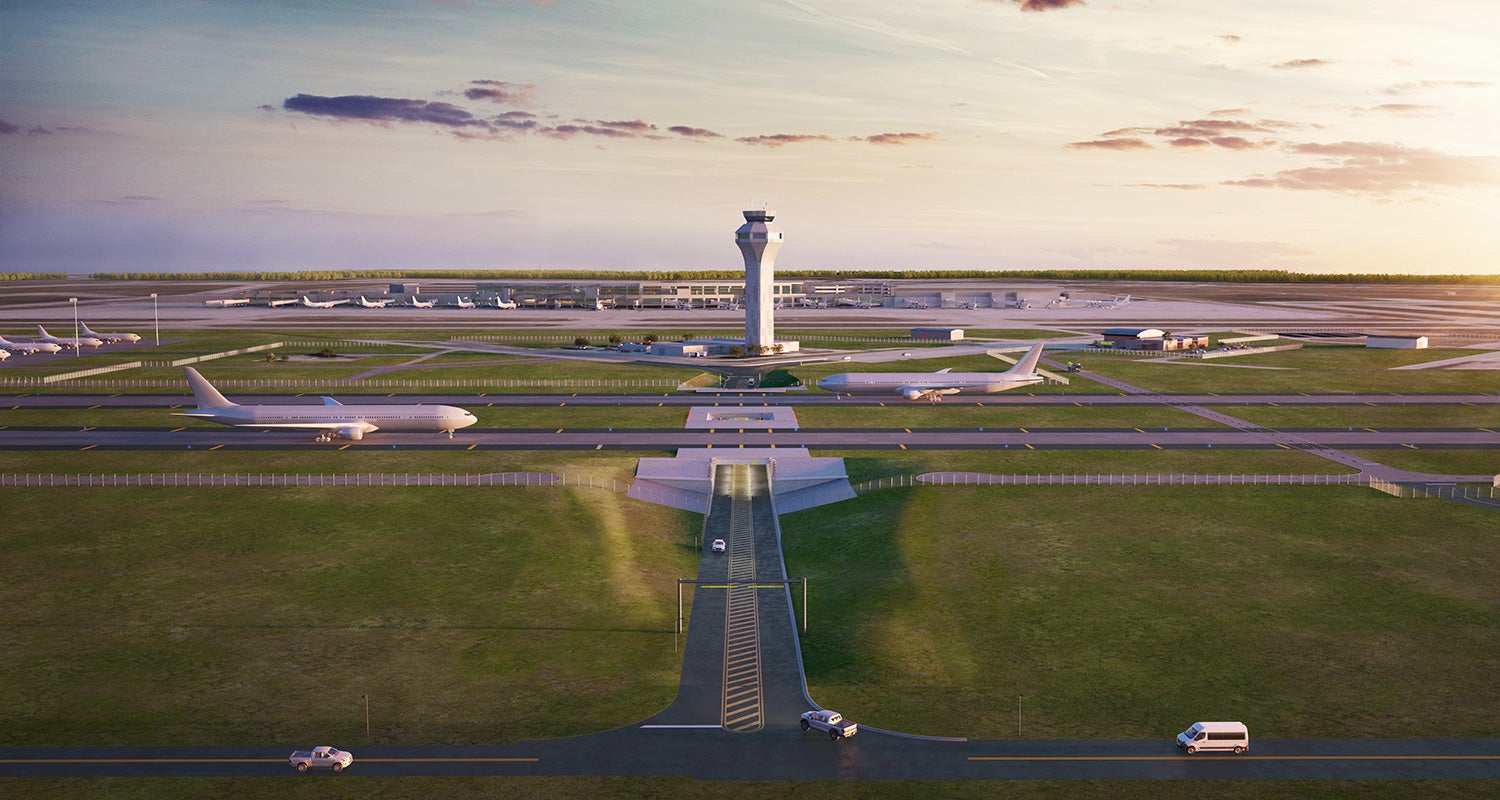
- Two new taxiway bridges spanning active roadways
- Maintain critical emergency and operational access across airfield
- Part of multiyear expansion at the airport
Population growth in Austin, Texas, is creating new demand at Austin-Bergstrom International Airport (AUS). In 2023, more than 22 million passengers arrived and departed from the airport, the busiest year on record for AUS. The airport, designed to process 15 million passengers annually, is now running at almost double its original capacity.
To meet current and future demand, AUS is undergoing a significant multi-year expansion. Known as Journey With AUS, the estimated $5 billion investment is modernizing and expanding the airport. Upgrades include a new arrivals and departures hall, a new concourse and tunnel, 32 additional gates, a 7,000-space parking garage, an updated baggage handling system and supporting infrastructure.
To support the new 26-gate Concourse B, the airport is constructing two miles of parallel concrete midfield taxiways connecting both sides of the airfield. These taxiways would otherwise cut off existing roadway access to essential airfield facilities, including the air traffic control tower, aircraft rescue and firefighter services and service corridors that support terminal deliveries. These routes need to remain open for emergency access, daily logistics and airport operations.
To preserve roadway access, HDR partnered with RS&H to design two new 48-foot-span, 229-foot-wide taxiway bridges that carry aircraft over active roadways. Our team led every phase of bridge design from concept development and preliminary engineering through final design along with ongoing construction support.
Each bridge consists of concrete abutment walls, prestressed girders, drilled shafts and retaining walls. Once complete, they will be the first taxiway bridges in service in Austin.
Addressing Site and Aircraft Load Challenges
Site selection was a critical early step for our team. A preliminary engineering report weighed various challenges at the airport including allowable taxiway grades, drainage grades and major utility conflicts.
The extremely flat site made drainage a challenge. The team had to lower the roadway enough to achieve minimum vertical clearance while still allowing natural drainage and avoiding the need for an expensive pump station.
The wide range of aircraft that would be using the taxiway bridges introduced additional complexity. Unlike highway bridges, taxiway bridges must accommodate a wide range of aircraft with different wheel configurations and load distributions. Our team worked closely with airport officials to establish project-specific design criteria, including fleet mix, main gear configuration and braking forces.
One of the most technically challenging aspects was understanding how aircraft loads distribute across the bridge girders. The team developed detailed analytical models to evaluate how stiffness and spacing affect load sharing. This allowed the design to be refined for both safety and efficiency, balancing structural performance with cost and constructability.
Coordinating Across an Active Airfield
Coordination has been critical throughout the project. The design required close collaboration among multiple subconsultants responsible for utilities, lighting and electrical systems, roadway and taxiway design and geotechnical engineering, as well as the contractor. The team also worked with city departments, including Austin Aviation, Austin Transportation and Public Works, Austin Water, Austin Watershed Protection, and the Quality Management Division, along with a federal partner, the Federal Aviation Administration.
Construction on the taxiway bridges began in mid-2025 as part of the broader airport expansion. Our team continues to support the project through site visits, design clarification and coordination with the contractor to address field conditions and maintain alignment with the design intent.
When complete, the taxiway bridges will allow aircraft, vehicles and operations to safely move through a complex and growing airfield.


