

Experts Talk: Bridge Aesthetics With Michael Fitzpatrick
Experts Talk is an interview series with technical leaders from across our transportation program.
Designing Signature Structures that Communicate Community Identity
A bridge — new or replacement — is an opportunity for a community to express its identity and create a public space that captures the emotions of residents and visitors. It can also connect or strengthen connections to neighborhoods. For an owner, however, finding the consensus that achieves these ends within their schedule and budget can seem intimidating. It doesn’t have to be.
Michael Fitzpatrick, our bridge architecture practice group leader, has a unique approach that weaves aesthetics with community-articulated sensibilities to design signature structures that evoke the character of an area. He finds consensus to shape solutions embraced by owners and stakeholders. In this interview he discusses how he develops the insight into the many points of view in each community to design structures whose form enhances the local environment.
Q. What is the difference between designing a bridge and designing a signature bridge?
A. The main difference between designing a standard bridge and a signature bridge isn’t the cost, it is the user experience. People think that a signature bridge is inherently far more expensive than a baseline structure. The truth is that while costs may increase, they do not need to rise significantly. But the user experience is critical.
Think about designing a bridge in Venice, Italy. The community — both global visitors and Venetians themselves — have very high expectations, yet the majority of Venice’s more than 400 bridges are not extravagant or world-famous designs, they are functional and have been given some thought or “considered.” They meet users’ needs and contribute to the visual quality of the site.
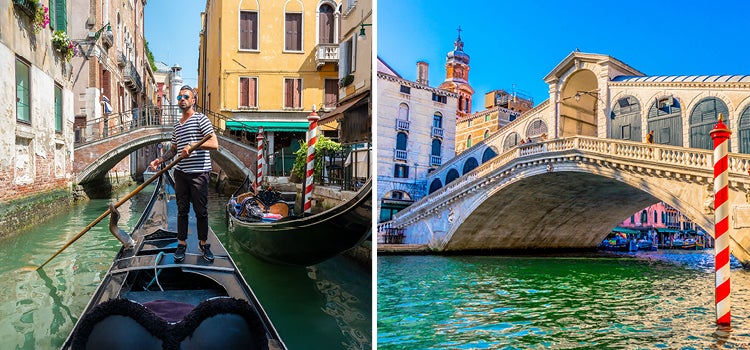
The design criteria for Venetian bridges are straightforward: a gondola must be able to pass underneath, and pedestrian foot traffic needs to be supported above. Even the most famous bridge in Venice, the Ponte di Rialto, is not necessarily an architectural statement. It is covered to protect people from the elements, and the single arch provides the maximum horizontal and vertical clearances.
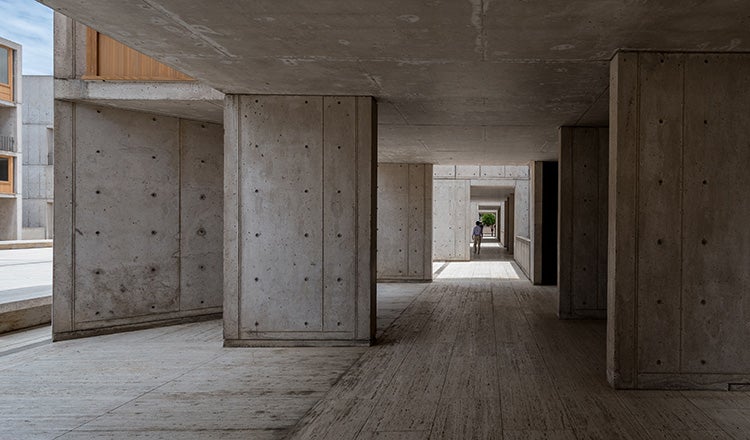
One of my favorite architects, Louis Kahn, taught architecture at Princeton University, and was asked about the most challenging aspect of teaching architecture. His response was that he “does not teach architecture, I teach appropriateness.” Louis Kahn’s buildings are not extravagant. They are simple forms that capture light and make great space. His work evokes poetry and creates an experience.
If creating an appropriate user experience is the most important thing, consider the Burlington Bridge replacement in Iowa City, Iowa. Our initial task was to offer precedent images of bridges at 10%, 20% and 30% above a baseline cost.
When we stepped back and looked at the entirety of the project, including major bridge replacement, pedestrian bridge and ramp replacement, new dam configuration and streetscape modifications, we quickly realized that we could make a more meaningful impact reimagining the pedestrian bridge and ramp system.
The existing vehicle bridge was low to the river and not visible. Any attempt to make it a "signature bridge" would be costly with little improvement in experience. However, the existing pedestrian bridge and ramp was to be the core mode of student movement, connecting the main University of Iowa campus on the west to student housing and functions on the east. With slopes exceeding 13% and icy conditions common during the academic year, the bridge did not function as originally planned and was not a good experience for anyone using the structure.
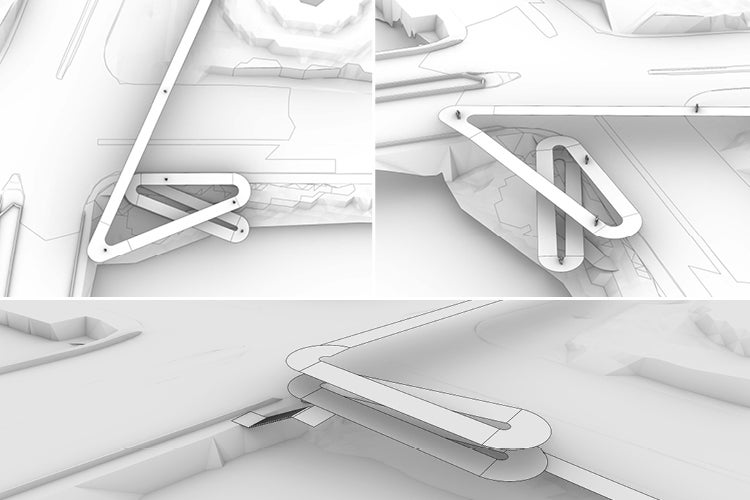
This is where we shifted from designing a typical pedestrian bridge into creating a signature experience. The initial thought was to design a typical switchback ramp with 5% slope — similar to those commonly found at stadiums and rail stations. The problem with traditional switchbacks is that they often feel monotonous and inefficient to users. In response, we developed what we call an offset ramp where the switchbacks are oriented toward different viewpoints in the landscape. This transforms each landing into a purposeful pause point, offering opportunities to look out over the campus, the river and different parts of the city. Although the offset ramp will cost more than a conventional stacked switchback, the enhanced experience has the potential to turn the structure into a community destination rather than merely a circulation path.
Q. How has your design process changed with fewer in-person, onsite client meetings?
A. Before the pandemic, it was common practice to travel to project sites and participate in-person for meetings. Experiencing a site and its community firsthand is essential to developing an appropriate design. For example, while working on the Pittsburgh International Airport project, I intentionally stayed at hotels in different neighborhoods and walked to and from the office so I could observe the city at various times of the day. I photographed morning and evening light and shared the images with Project Designer Jimmy Vincent to help him develop project renderings. Insight from local team members let us know that most travelers would be approaching or departing the airport in the dark for most of the year, which helped our project designer produce renderings that more accurately reflected the true user experience.
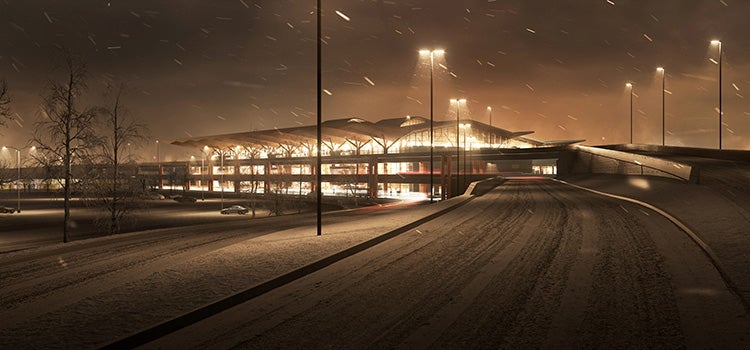
Getting to know a place as well as I knew Pittsburgh without being there in person has been a challenge, but we have adapted new practices to address that. Pre-pandemic stakeholder interactions focused primarily on presenting ideas and getting feedback. Now we also learn about the site through their lived experiences.
Two techniques have proven to be especially effective: assigning stakeholder homework and conducting qualitative surveys. The homework varies by project but generally asks questions such as, “When visitors come to town, where do you take them first and why?” Other questions help identify their most and least favorite aspects of the community. Understanding the “why” behind these answers often reveals the true character of the place. We also ask stakeholders to take photos of the site.
Qualitative surveys further clarify how strongly people feel about certain elements of the built environment. Some questions offer a numerical scale — for example, rate how important it is that the design be “formal” on a scale of 1 to 10. Others use a spectrum; in this example the range would progress from informal to formal.
The concept of “historical” is difficult to interpret in a qualitative survey as the word can be associated with varying time periods by different people. To give context, I show them bridges that were designed ahead of their time and conclude with a bridge originally designed by Leonardo Da Vinci in 1502. People guess the design date to be in the 70s, 80s or 2000s, and they are surprised to learn the actual date. This helps broaden their understanding of what “historical” can mean.
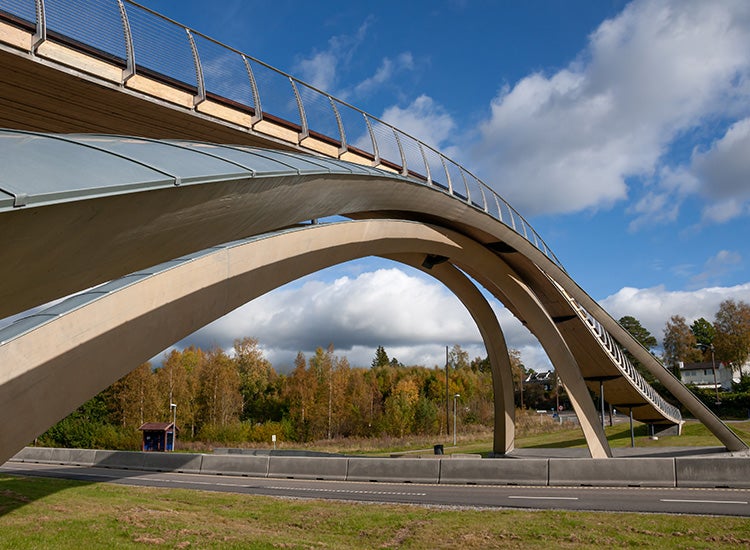
The homework and surveys encourage the stakeholders to see their community with fresh eyes and challenge unconscious biases. The result is more insightful observations and an exciting vision for the future. We used this approach on the Burlington Bridge, and I am confident that simply presenting precedent images and asking for stakeholder preferences would not have led to the selection of the offset ramp. The thoughtful, methodical process encouraged the group to explore both expected and unexpected ideas, consider cost versus the value of having an iconic bridge, and articulate what would meaningfully improve their built environment.
Q. What is the process that you use to help a community select a bridge?
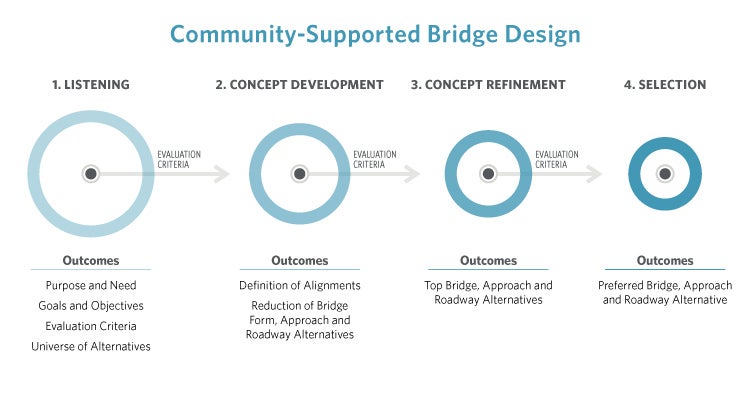
A. We have developed a process that identifies the owner’s and community’s expectations at the beginning of the design process. This needs to be a rigorous requirement from Notice to Proceed. If expectations and selection criteria are not established early, the project becomes significantly more challenging. Our process has four steps and starts with listening to the owner and community. This is also our opportunity to explain the bridge design process and present a clear road map. By the end of Step 1, the team should have established the selection criteria.
In Step 2, the team presents precedent projects and high-level concepts for discussion. It is important to note that concept development includes all disciplines working in collaboration. In the beginning, architecture might lead the conversation with engineering support. As the process develops, engineering becomes the driving factor.
Step 3 leads to concept refinement, where the number of concepts is reduced by eliminating or combining designs that do not meet the selection criteria. The remaining bridge concepts become more complete, incorporating input from the other disciplines and developing preliminary cost ranges.
Selection happens in Step 4. It typically begins with two or three fully developed concepts. This stage is often difficult for the stakeholders as they tend to like all remaining designs, and the differences are subtle.
Q. What is the most challenging project you have worked on and what made it challenging?
A. Any project that has not used our process might present challenges. Most of the projects that I have worked on have had complexities, often stemming from conflicts between permitting agencies or stakeholder groups unwilling to compromise. In those situations, people simply might not understand what a particular design looks like or how the bridge integrates into the surrounding landscape. On the St. Croix Crossing, part of my role was to illustrate how proposed designs fit into the landscape. We found that people’s assumptions were often greater than the realities of the specific conditions. In the end, improved understanding helped people compromise and we delivered a beautiful bridge.
A recent project in Los Angeles posed a different challenge because the client could not articulate the design qualities they wanted. The project involves building new run-through track at Union Station for Metrolink and future high-speed rail over Highway 101. There is very little precedent for building an aesthetic heavy rail bridge in a high seismic zone with poor soil.
The client wanted a non-repetitive design where the form was integral with the structure while also being cost-efficient and contractor friendly. After many design iterations and concepts, we decided to explore the architectural philosophy known as subtractive architecture. Applied to this project, we envisioned a solid pier wall with sections carved out — similar to the separation of tectonic plates.
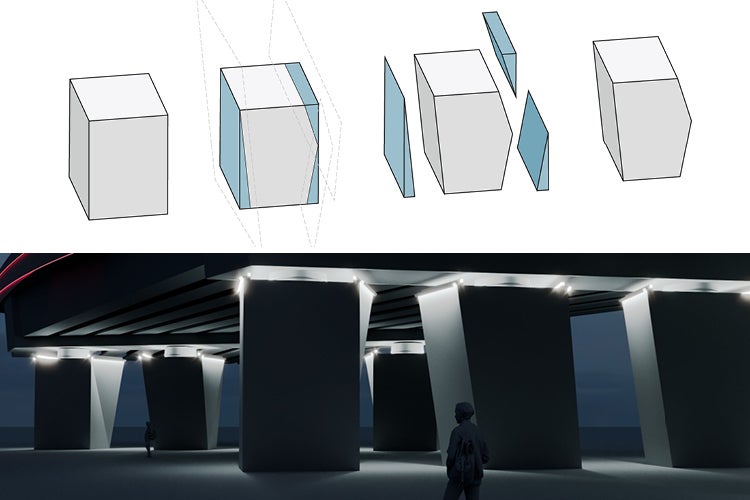
While the project has 39 piers and the client requested a non-repetitive design, it wasn’t efficient for the contractor to create 39 one-off pier shapes. To achieve visual variation while maintaining constructability, we suggested using advanced slip forming techniques and a limited number of variables. Taking advantage of the bridge’s S-curve alignment, where one area spanned highway 101 and the other crossed an industrial district, we created four base configurations and rotated the piers so they would appear to be non-repeating.
We continue to work with the contractor to reduce material quantities while maintaining the design intent and developing a naming nomenclature. Details like aesthetic lighting to highlight the "shift" in the forms and securing the light fixtures remain in development.
Inspiration & Advice
Q. What inspired you to enter the architectural field?
A. When I was young, I drew and painted all the time, winning first prize in an art competition. In high school I decided to become a car designer, but no one knew what that profession was called, so I focused on being an engineer. During the first two years of engineering school, I loved calculus, physics and theory classes but there was no design time. Then I discovered industrial design (automobile designers) and switched to an art school. Two years later I discovered sculpture and switched majors again! My first job was in an original Art Deco and Art Nouveau furniture gallery where we restored pieces and sold them. A co-worker said I should go to school for architecture because I was obviously interested in designing an entire environment.
What launched my career was working for an architecture firm with a 100-year history of collaborating with engineers on the design of bridges. In traditional architecture, programs define space such as a living room and dining room. The expression comes from the relationship between program and activities. Bridge architecture, instead, has no traditional program but is still responsible for creating a quality experience. Also, bridges respond to both an urban and human scale; unlike buildings, they need to work on a macro and micro scale.
Q. Who are the people or things that have influenced you the most?
A. My inspirations include Pier Luigi Nervi, Marcel Duchamp, Robert Maillart, Eastern culture and design, Paul Cezanne, Greene and Greene, Filippo Brunelleschi, Constantin Brancusi, E. E. Cummings, Louis Majorelle, Stephen Berg and photography.
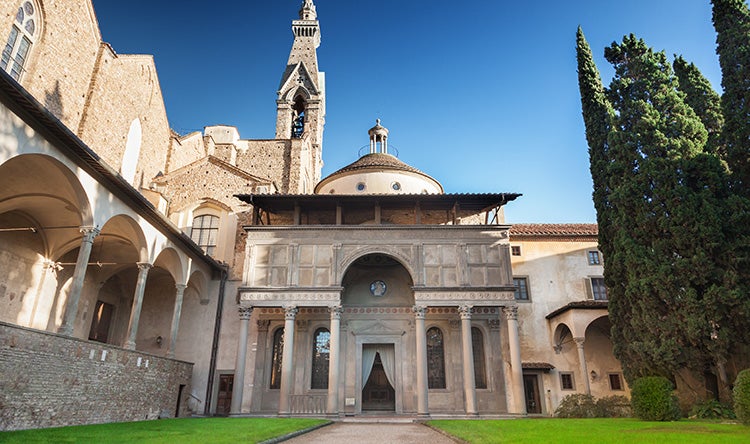
I’ve been fortunate to have many great teachers and professional mentors. Al Holm, a classical architect, had probably the biggest impact on me. He sat me down in his office for two hours one day — classical music was playing, north light through a skylight, plaster Corinthian column cap on the bookshelf — and asked me about my motivation. At one point he asked, “What about beauty? Is there anything wrong with putting a flower in your hair?” I had no idea what he was talking about until I visited Florence, Italy, and stepped through the main door of the Pazzi Chapel. It was like that scene in “The Matrix” when a new experience was added to a character. It opened my eyes to the truth that beauty is achieved through careful planning, design intent and contradiction.
Q. What advice do you have for bridge architects who are new to the profession?
A. I think bridge architecture is a discovered path. To thrive I think one needs to approach design in a new way every day, sharpen your curiosity, question everything — and I do mean everything — and always appreciate and be amazed by beauty.
Each Experts Talk interview illuminates a different aspect of transportation infrastructure planning, design and delivery. Check back regularly for new insights from the specialized experts and thought leaders behind our award-winning, full service consulting practice.


