

Why Tolling Authorities Need a Different Asset Management Playbook
Tolling authorities rely on asset management as much as any transportation agency. But they do not operate like a traditional department of transportation. They have different stakeholders, including boards and governing bodies that are directly accountable for revenue performance, customer experience and public trust. Further, many also operate facilities outside the National Highway System, where federal Transportation Asset Management Plan requirements do not directly apply. Even when NHS rules do reach their roadway, those rules cover pavement and bridges, not the toll collection system itself.
As a result, they make decisions with different factors in mind. While both need to maintain their critical public infrastructure, a toll operator also needs to protect revenue by delivering a high-quality, reliable service that drivers consistently choose over no-cost alternatives. Maintaining that high-quality, reliable service depends on having a real-time and accurate understanding of the complete tolling system. That requires a different asset management mindset.
Authorities often choose to have their toll systems operated and maintained through vendor contracts. This works well, but it can obscure an owner’s understanding of critical assets like component age, support status and transition exposure that could inhibit informed decision making tied to operational and/or organizational risk management. When life cycle decisions do not incorporate this information, choices may be made based on procurement timing rather than a cohesive agency strategy tied to system performance and client satisfaction.
In other words, sometimes the agency owns the risk but not the visibility to effectively manage it. In tolling, the toll system itself is a critical agency asset. It should be visible, governed and planned across its full life cycle, and managed in a way that preserves value, including components that still have useful life when contracts end.
Toll customers want a quicker route to their destination, and expect reliable operations, accurate bills and responsive customer service. When any of those expectations fail, agencies are at risk of immediate revenue loss and reputational harm. This is why tolling authorities need a different asset management playbook: one that integrates the entire toll system into a comprehensive and transparent asset life cycle planning and management process. It needs to align current contracts and timing of capital project decision-making with asset performance and reliability, so that revenue goals and customer expectations can be met.
Risk Is Predictable Across the Life Cycle
Toll systems belong in an asset management program because life cycle risks are often predictable. These risks spike at known points when support ends, when major upgrades happen, or when contracts renew or transition.
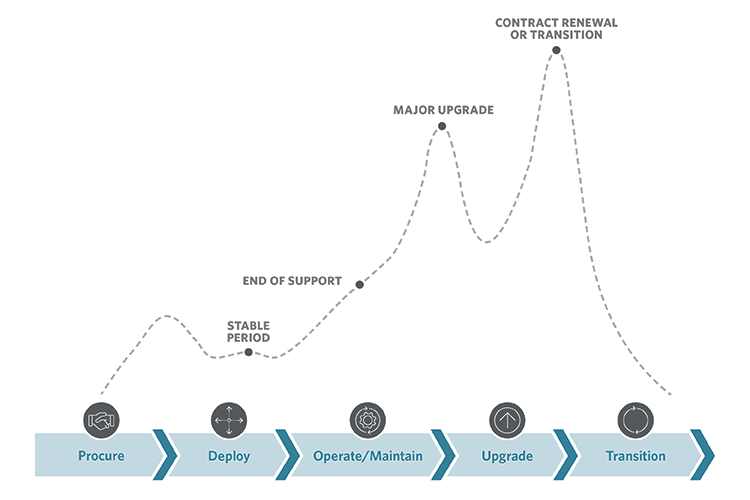
Agencies can act on this pattern if they see it early enough. Holistic asset management aligns maintenance, capital planning and contract strategy before pressure builds. That reduces emergency procurements, limits the number of expensive and time-consuming change orders, and allows the agency to plan based on its needs rather than based on contract timing.
The Building Blocks of Tolling Asset Management
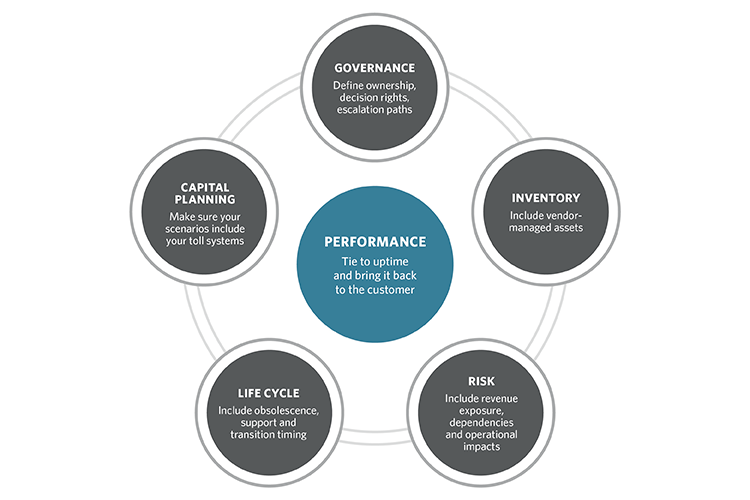
An integrated asset management model is built on the following pillars:
- Governance: Someone must own decisions and a clear escalation path must be defined. In the tolling world, these responsibilities often cross agency departments and vendor boundaries. Without structure, agencies rely on fragmented viewpoints and vendor timing for key decisions.
- Asset Inventory: The asset inventory for a tolling agency should capture data for all assets, even those operated by vendors and enough information to support better decision-making. Useful attributes to capture in your inventory are asset class, ownership, support status, key interfaces and condition. Some of this information may already be available in maintenance or operations management systems, but it must be well integrated to support enterprise-level decision making.
- Risk Management: Common consequences of the failure of a tolling system are revenue exposure, reduced operational uptime, billing issues and customer service impact. Measures such as tag and plate read rates can show where performance is degrading before the issue becomes a larger business problem.
- Life Cycle Planning: Tolling operations may become more vulnerable when equipment approaches obsolescence, when support status ends, major upgrades are needed, and when contracts are up for renewal. A life cycle plan shows when technical, operational and contractual pressure is likely to emerge so that an agency can act before the choices become urgent.
- Capital and Contract Planning: Capital planning helps decide what an authority should fund. Tolling agencies should not let vendor contracts make this choice for them. Instead, major transitions should be planned by looking across the business and factoring in asset condition, support status, operational risks and business priorities. This creates better conditions for negotiation and a managed implementation.
- Performance: Performance lies at the center of these pillars because it indicates whether the asset management efforts you are undertaking are improving the outcomes that matter. Connect your decisions to service and business performance. Include tolling measures (roadside uptime, accuracy, customer issues) alongside infrastructure metrics.
What a Structured Approach Can Do
A recent large-agency harmonization effort performed by HDR shows how a better tolling asset management mindset can produce real business results. In that project, we reviewed contracts, system conditions, design documents, policy and stakeholder needs across two complex tolling environments run by the same organization. We then applied a benefit-cost assessment to quantify costs and savings, and we developed an implementation roadmap. Preliminary findings identified opportunities to save more than 30% in contract value by harmonizing system features across the two environments and creating a unified timeline for implementation that captured operational, capital and contract costs in one place.
This work gave the agency a clear view of where toll system choices, contract timing, life cycle risks and capital planning overlapped. The lesson is that agencies gain value when they assess tolling systems as part of a larger decision framework rather than as isolated contracts or disconnected technical components. That structure helps leaders decide what to fund, when to act and how to reduce risks.
Questions Leaders Can Ask Now
- Do we know which tolling assets are approaching end of support?
- How good is our visibility into vendor-managed assets?
- Who owns life cycle decisions for the toll system?
- Are contract renewals aligned to technical reality or to contract timing?
- Can we quantify the customer and revenue impact of degraded toll system performance?
Thoughtful answers to these questions can help leaders understand where their asset management program stands and what opportunities there are to create near- and long-term value for their organization.
Proactively Manage All Assets
Tolling authorities already understand the importance of managing infrastructure. The next step is to apply that same mindset to the systems that collect revenue, shape customer experience and influence contract strategy. In the tolling world, the asset base is broader than pavement, bridges and facilities. It includes the toll collection ecosystem and the risks that come with it.


