
Wishbone Bridge and Unity Underpass

Wishbone Bridge and Unity Underpass
A Community‑Driven Crossing That Completes Austin’s Signature Trail
- Complex and non-standard three-legged concrete structure
- Prioritized constructability in a downtown area with tight constraints
- Advanced modeling to minimize in-water piers and reduce hydraulic impacts
When the Wishbone Bridge in Austin, Texas, opened to the public in February 2026, the structure’s automated counter registered more than 21,000 users on the first day. The turnout reflected how long the project had been anticipated and how critical the connection is to Austin’s trail network. The three‑legged pedestrian and bicycle bridge spans Lady Bird Lake at the eastern end of the Ann and Roy Butler Hike‑and‑Bike Trail, completing a long‑missing link in one of the most heavily used urban trail corridors in Texas.
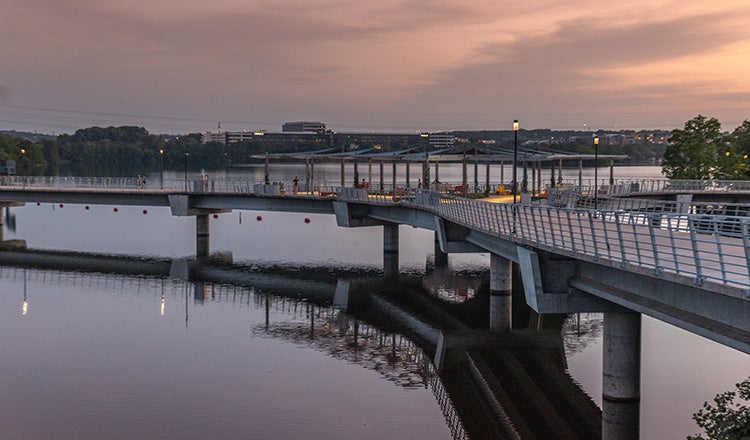
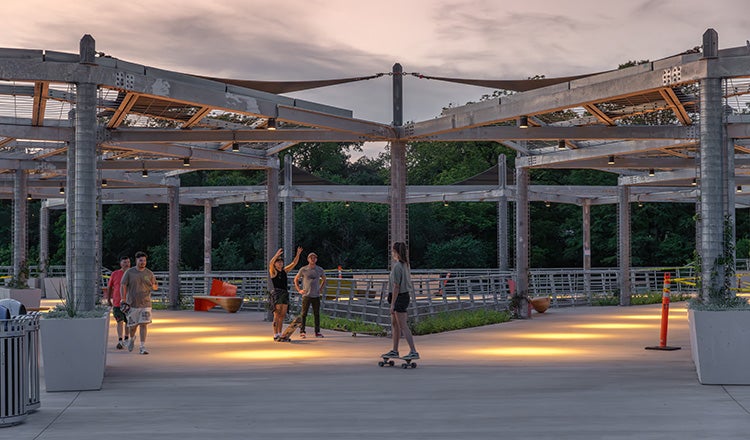
The bridge’s Y‑shaped form connects the north shore, south shore and a narrow peninsula, creating safe access while offering a central plaza designed for gathering, resting and taking in views of the lake and downtown skyline. Paired with the Unity Underpass beneath South Pleasant Valley Road, the project replaces a narrow, uncomfortable route alongside fast‑moving vehicles with a fully separated, accessible facility that enhances safety, comfort and connectivity for millions of annual users.
HDR served as prime consultant for the project, supporting the City of Austin from early planning and environmental analysis through preliminary engineering, final design and construction support. HDR’s multidisciplinary team supported public engagement, evaluated multiple alignment alternatives, developed the preferred bridge configuration and delivered the structural, hydraulic, roadway and constructability solutions required to build in one of the city’s most sensitive and constrained environments.
From Public Vision to Buildable Design
The Wishbone Bridge’s defining shape began as an idea voiced by residents. During the first round of public engagement, community members were invited to sketch alignments they believed would best serve the area. Several independently proposed a wishbone‑shaped bridge that could connect all three shorelines at once. That concept became the most supported alternative and carried through to final design, earning 96% approval at the third public meeting.
The need for the project was clear. Previously, pedestrians and cyclists were forced onto a narrow sidewalk along the Pleasant Valley Road bridge and Longhorn Dam. In places, the route narrowed to just a few feet wide, adjacent to traffic and maintenance gates, creating safety risks and congestion on a trail system that sees more than 5 million users each year.
With the preferred alignment established, our team worked closely with the city to develop a structural approach that balanced cost, constructability and user experience. Public feedback favored a conventional, efficient structure below the deck paired with high‑quality finishes above.
Engineering Within Tight Constraints
Designing the bridge required navigating a series of environmental and technical challenges. The crossing lies within a tightly regulated floodplain on Lady Bird Lake, which operates under a strict no‑rise requirement. Our team minimized the number of in‑water piers and used long spans to limit hydraulic impacts. Advanced modeling demonstrated that the final configuration would not create backwater effects, even during extreme flood events.
Structurally, the three‑legged geometry introduced complexity beyond that of a typical straight crossing. Thermal movement, load paths and girder alignment all required careful analysis. We addressed these challenges through a hybrid system that combined long‑span prestressed concrete girders with cast‑in‑place diaphragms and beams.
Accessibility and user comfort were also central to the design. The three approach legs tie into surrounding trails at different elevations, while the central plaza needed to remain nearly level to function as a gathering space. Our roadway and structural designers coordinated slopes and drainage to meet Americans with Disabilities Act (ADA) requirements without compromising constructability or aesthetics.
Building in the Heart of a Busy City
Construction access was one of the project’s most significant challenges. The site is surrounded by parkland, dense development and water, with limited options for staging equipment. Load restrictions on the nearby dam and geotechnical constraints on the peninsula further inhibited access.
We addressed these issues by prioritizing constructability. Prestressed concrete girders were installed using cranes mounted on barges, reducing the need for extensive falsework in the lake. Once in place, the girders served as work platforms for subsequent cast‑in‑place elements.
Lasting Impact
Today, the Wishbone Bridge and Unity Underpass provide a safe, inviting connection that completes the Ann and Roy Butler Hike‑and‑Bike Trail loop and strengthens east‑west and north‑south mobility in Austin. The project demonstrates how community‑driven vision, efficient structural systems and careful attention to constructability can come together to create infrastructure that functions as both transportation and place.


