

Experts Talk: Parametric Bridge Design with Michael Roberts
Experts Talk is an interview series with technical leaders from across our transportation program.
Signature Bridges Become Digitally Alive with Parametric Design
Parametric bridge design is a fundamental shift from traditional practice — as profoundly different as CAD is from drafting with ink on vellum — and forms the groundwork for digital design’s progression into the Fourth Industrial Revolution. It establishes a living, intelligently centralized workflow that efficiently manages intentional and iterative change, giving designers and owners earlier insight into the broader project context. Through logic based visual programming, parametric design dynamically links design data and geometric relationships, enabling real time adaptation within a project’s spatial environment. In doing so, it reinvigorates the master builder model by centralizing expert driven, context sensitive design to generate engineered proofs of concept earlier in the process.

Our Michael Roberts has been developing and using parametric design tools for roughly half of his 25-year structural engineering career. A bridge engineer with a passion for structural design, Michael has a project resume ranging from Olympic ski jumps to the largest self-anchored suspension bridge in the world and a wide range of conventional and signature bridges pushing and flexing the limits of design innovation. In this interview he explains why a parametric design approach is so important to the bridge industry.
Q. What do you mean when you say a parametric design model is “intelligent”?
A. In the same way that Excel spreadsheets update when input changes, parametric design updates 3D geometry and the supporting engineering analyses, live and in real time. It’s as simple as watching the span of a bridge change before your eyes by adjusting end point coordinates. Yet its power lies in the underlying computational design automation, which is linked to those points and automatically updates geometry within a contextually rich digital environment as spatial relationships are defined or changed.
The structure isn’t simply visualized — it is designed in a fundamentally different manner that connects two points with more than just a geometric line. We don’t just draw a line; we generate living attributes attached to centralized data so when the geometry shifts, the data and its associated digital thread recalculate. This allows us to immediately assess, adapt and update both the design and its workflow in response to changes affecting the structure and its adjacent spatial context.
The degree to which this empowers and streamlines design development and decision-making cannot be overstated since we are working with improved data availability in assessing solution viability in the moment. In an environment where design moves fast, adapting to change and keeping up is critical. Parametric design connects the bridge engineer’s expertise and design intent to a centralized digital representation, which evolves into a shareable proof-of-concept for the team, the owner and stakeholders to support critical design development.
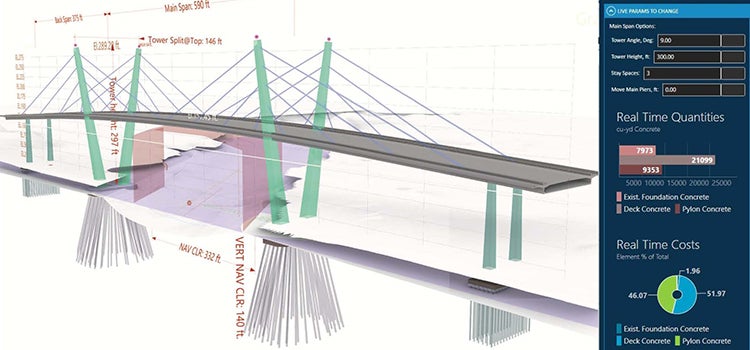
Q. Is this just about using a new, slick piece of software? Isn’t the idea of changing a pier shape having the costs and quantities automatically recalculate too good to be true?
A. This is an understandable concern for any innovative technology, but no different from when we transitioned from manual calculations to spreadsheets. Parametric design tools provide a universal language between designers and their data which streamlines analysis and empowers a design team who’s collaborating with an owner to explore alternatives to articulate a community’s vision for their bridge.
We are using tools that are compatible across analysis and production platforms. They let engineers define a structure parametrically with mathematical rules that act on a parameter to generate the structure’s geometry for an analysis or BIM model. This underlying intelligence means that changes to a parameter automatically recalculate everything from structural support configurations to the quantity of needed rebar. We instantly see implications for constructability, cost and community impacts so an owner can interact with design ideas and decisions interactively and in real time.
The software we use helps us reduce risk, offer earlier insight, and integrate the client and public earlier with visualizations that are technically and contextually correct, and much easier to understand in early stages. What differentiates parametric design is the alignment of computational tools with our structural engineering expertise, facilitating collaborative workflows across disciplines for exploring spatially relevant scenarios and solutions.
Q. What’s the most interesting project where you’ve used a parametric design approach?
A. The Green Street tied arch pedestrian bridge in North Carolina proved parametric design to be pivotal in helping the client deliver a better project. Upfront, it allowed us to feel much more confident that the unique arch form was structurally viable and met the site constraints heading into a contractual design-build agreement. During execution it helped us carry adaptations through the project’s lifecycle — from detailed design and production, to checking field tolerances — creating a precedent-setting workflow that met a limited design and construction budget on an aggressive schedule.
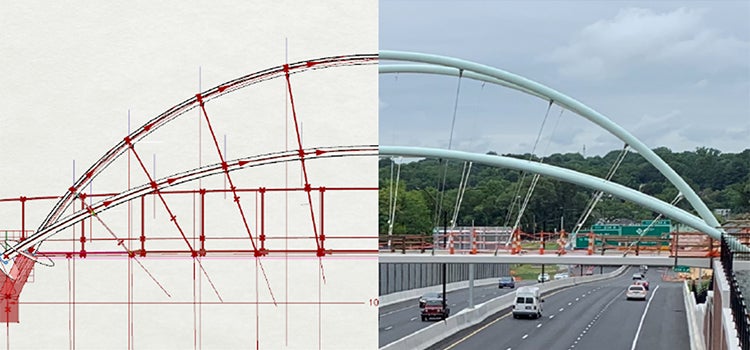
Although final design documents were delivered on paper to the Department of Transportation (not digitally), parametric design was game-changing behind the scenes by enabling a smaller, specialized team to accommodate the complex geometry, changes and unique design challenges efficiently. What was built effectively matched the original procurement phase concept. This demonstrates the proof-of-concepting advantages of parametric design at the earliest stages, when decisions are paramount and have the greatest impact on a project’s cost. In this case, it was the competition/procurement phase. Our approach was key to delivering the client’s and community’s aesthetic vision under challenging constraints, without deviating from the Request for Proposal and while maintaining a predictable outcome for a complex signature bridge.
Q. Does this change how we work with an infrastructure owner or a contractor?
A. It can fundamentally change the usefulness of a discussion with a contractor or owner about how a signature structure might be staged or phased or erected, because seeing is believing. The parametric model allows “what if” discussions during a meeting or a workshop and in front of their eyes. What if you move a foundation element to improve clearance or accommodate an unanticipated subsurface condition? How does that rework the design and the erection scheme, and what are the predicted impacts to the project?
Analyses that sometimes take structural designers weeks to generate, adapt to or calculate may be accomplished through parametric modeling in minutes instead if initially set up for that purpose. This type of dramatic transformation allows a practical conversation between designer and builder to define construction means and methods for a signature structure. The parametric model becomes the central model for downstream digital connections, be it Excel data tables for plan sheets, the structural analysis model or the BIM model generating deliverables.
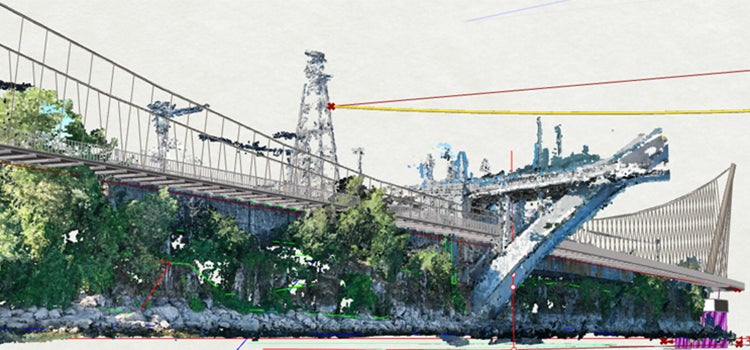
Q. How is this different from more traditional approaches to complex bridge design?
A. Conventional approaches limit the possibilities we can explore cost-effectively in a multidimensional design environment. Parametric design creates opportunities to explore more viable original design concepts while leveraging our expertise and client collaboration capabilities at a different scale, strengthening both design innovation and overall project coordination.
Signature bridges demand a totally different approach to conceptualizing and form-finding compared to simpler bridges, but they are still subject to the same codes and structural engineering rigor. Solving the design puzzle is hard on any budget and scope, and even harder on complex signature bridges where almost everything is unique. Parametric tools provide a platform to solve these challenges more effectively. Exploring options through parametric tools is the first step in visually demonstrating that a design concept will work in the real world. Parametric models typically include topography, bathymetry and other GIS-based data, identifying opportunities and constraints that require creative solutions.
A small pedestrian bridge with a unique shape suited to the neighborhood may have a smaller design budget which requires the efficient modeling and vetting of numerous concepts and alignments over varied topography and site constraints — that’s a perfect application of parametric design. At the other end of the spectrum a signature bridge can be efficiently modeled and envisioned.
The efficiency and technical rigor of a parametric design approach aligned with technical expertise strengthens engineer authored, parametric solution development, where concepts can be actively shaped rather than merely extracted and evaluated. This improves client engagement and opens new design configurations for our bridge experts that may have been challenging or impossible to manage or execute any other way.
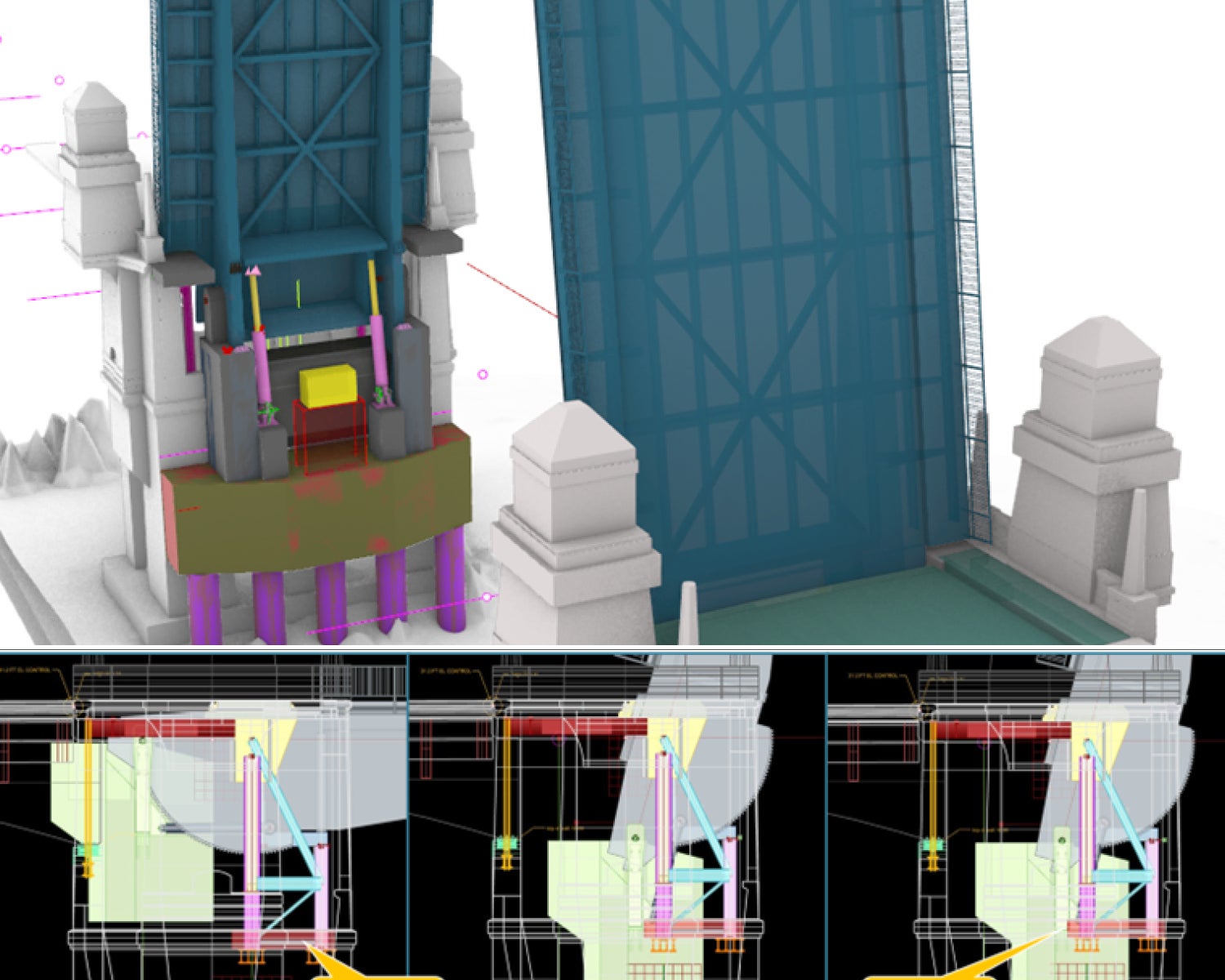
Q. How does parametric design relate to and differ from model-centric design?
Parametric design plays a distinct and essential role in HDR’s digital ecosystem because it begins with engineering intent rather than inherited geometry. In many project environments, especially those driven by roadway or architectural priorities, engineers are tasked to adapt to models created by others. Model‑centric workflows excel in that space — they streamline coordination, improve data extraction and help teams work efficiently with externally provided content. They are invaluable for large, multidisciplinary delivery.
But parametric design is different. It is the workflow the engineering team uses to originate the geometry, not react to it. By encoding structural logic, constructability constraints and performance criteria directly into the model, parametric design becomes the authoritative source of truth from the very beginning. Every downstream representation — analysis, quantities, documentation, visualization — is generated from a single, engineering‑authored 3D model.
This approach is especially powerful on projects where originality, precision and constructability cannot be compromised. It allows engineers to lead the design rather than follow it, so that the final solution is not limited by upstream assumptions or incomplete models. In that sense, parametric design doesn’t replace model‑centric workflows; it elevates them. When the foundational geometry is created parametrically, model‑centric tools become even more effective, because they are working from a clean, intentional, engineering‑driven source.
Parametric design remains the purest expression of engineering authorship in our digital practice — a master‑builder approach that unifies creativity, technical rigor and automation. It is a differentiator for HDR and a critical capability for complex projects where the design must be led, not inherited.
Inspiration and Advice
Q. What got you interested in parametric design?
A. I’ve always been captivated by the application of technology to engineering, be it computer programming or CAD applications. Since learning AutoCAD in eighth grade, it became clear to me how critical our drawing tools are, how they benefit an industry where geometry is the design, and how they improve our ability to understand our design solutions better.
I believe that these tools and way of designing are the most exciting and powerful changes to our industry since CAD took over from vellum. These tools are the key to understanding structural form, function and design possibilities.
Combining these tools with advances in industrial automation and artificial intelligence, I believe that parametric design is a doorway to the Fourth Industrial Revolution. Designers in other industries are stepping over the threshold and it’s up to structural engineers to capitalize on our expertise and knowledge to invigorate our role to lead bridge design into this next digital revolution with these innovative tools as well.
Q. What advice do you have for new transportation professionals who are interested in parametric design?
A. If you’ve been introduced to parametric design and want to apply it as you build your career, ask current or prospective employers how they’re using these tools to see where your interests align. Parametric design varies across companies and projects, but opportunities to learn and apply it exist at every level, especially when design iteration, optimization and adaptability are critical to project success.
Each Experts Talk interview illuminates a different aspect of transportation infrastructure planning, design and delivery. Check back regularly for new insights from the specialized experts and thought leaders behind our award-winning, full service consulting practice.


