
Tennessee Department of Health R.S. Gass State Lab

Tennessee Department of Health R.S. Gass State Lab
A Public Health Lab Designed for Resilience and Responsiveness
Nestled within a densely wooded site, the Public Health and Environmental Laboratory for the State of Tennessee is embedded in nature and designed to embody the principles of health and human wellness. Replacing an aging and inadequate public health lab, the facility addresses stringent site constraints and conditions while supporting a flexible, resilient environment for critical public health functions.
BSL3 laboratories support emergency preparedness by enabling the safe processing of high-risk biological agents, while training labs, sample accessioning, and specialty laboratories support antibiotic resistance testing, newborn screening, bacteriology, wastewater surveillance, environmental chemistry, aquatic biology, the work of the CDC’s Antibiotic Resistance Laboratory Network and more.
Bridging Public Health and Environmental Stewardship
Drawing inspiration from Tennessee’s natural limestone formations, the building’s horizontal expression is punctuated with distinct elements that echo the character and imperfections of stone. Using the site's topography that cascades down to the stream, the building steps down across the site, creating terraces for staff to engage with nature. To preserve creeks and habitat for the endangered streamside salamander, vehicular and pedestrian bridges connect the building access over preserved natural areas, reinforcing both wayfinding and environmental stewardship.
Modular, Human-Centered Public Health Lab Design for Evolving Scientific Needs
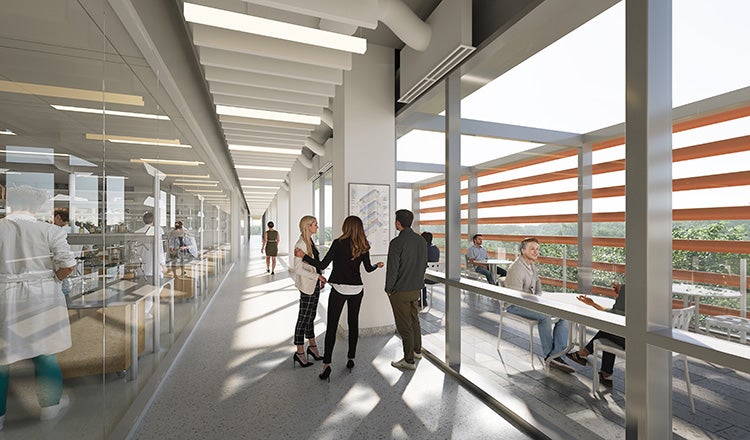
The modular, human-centered environment adapts to evolving scientific and operational needs, with a building layout that maximizes daylight and views while supporting efficient workflows. An open lab concept minimizing full-height walls enhances flexibility, allowing systems to integrate without disrupting operations. Designed to process thousands of specimens annually, the facility conducts disease-screening, surveillance and response to biological and chemical threats.
The resulting blend of natural site integration and intuitive solutions to complex programmatic requirements advances public health and workplace wellness, supports advanced research and strengthens statewide emergency response.
Designed in partnership with ESa — Earl Swensson Associates.


