

The Power of Computational Fluid Dynamics in Infrastructure Decision-Making
With CFD, Complex Hydraulic Behavior Is No Longer Invisible
Every engineer is likely familiar with fluid dynamics. Fluid mechanics is listed as a course in every engineering college catalog. Questions about fluid dynamics are on the engineer-in-training test and the professional engineer exam. The physical principles of fluids govern the water industry.
Before robust computer models were developed, the practical applications of fluid dynamics were limited to what could be observed and measured materially. Sets of static calculations were visible only after construction/application.
What is CFD?
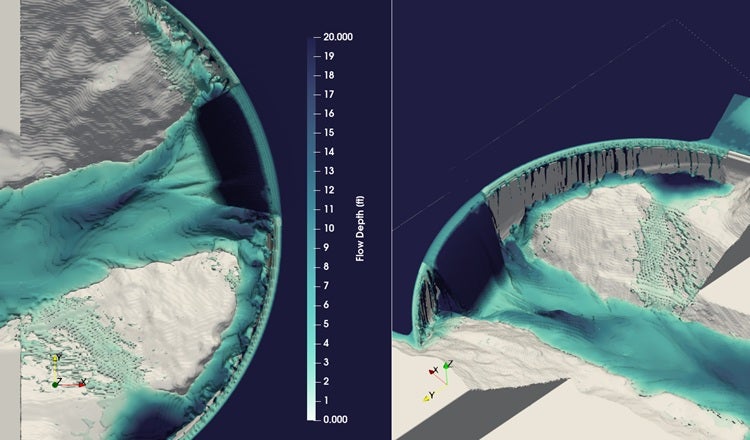
Computational fluid dynamics, commonly called CFD, creates physics-based three-dimensional digital representations of flow through a hydraulic system. With CFD, governing equations of fluid motion can be solved, creating a reasonable virtual twin of a physical system. Velocity, pressure, turbulence, air-water interaction, mixing and other physical behavior can be examined at the desk, instead of in the field, where locations may be difficult or unsafe to measure. This virtual lab calculates and displays the results of multiple project options and parameters, facilitating feasibility evaluation.
CFD provides water system decision-makers with coherent information to make defensible decisions. Because these models are sophisticated and adjustable, the information they provide can help teams identify risks earlier, compare alternatives before construction, focus physical model testing where it matters most and communicate complex findings in a visual form that decision-makers and regulators can understand. When used at the right stage with the appropriate level of detail, CFD helps manage the uncertainty within infrastructure design, construction and operation.
Factors That Increase Hydraulic Uncertainty
All the following conditions create greater risks for construction and operation:
- Aging assets – replacing or modifying existing infrastructure is never “by the book”
- Climate uncertainty – increasing variability and magnitude of flows
- Regulatory pressure – for example, a particular kind of fish species may have new or developing specific hydraulic requirements
- Capital program constraints – overbuilding vs right-size building
Tradeoffs That Impact Decision-Making
CFD can evaluate what-if scenarios that may occur prior to construction such as:
- In a conveyance channel, a shorter transition may save concrete but increase channel exposure to erosive flow conditions.
- In a treatment plant, a baffle may improve flow distribution but create a debris issue and other maintenance concerns.
- A larger structure (dam spillway, stormwater tunnel) may provide greater hydraulic margin but add excessive cost in both construction and schedule risk.
CFD models won’t rank options, but they will give an interdisciplinary team quantitative evidence to evaluate trade-offs that support decisions.
How CFD Informs Risk and Cost on Dam Rehabilitation
Use cases for CFD studies span the water industry. One example of its value to a dam owner is where HDR used CFD to evaluate modifications to a spillway where concentrated high-velocity flow created concern about downstream erosion. The team compared a range of flip-bucket configurations to understand how differences in geometry affected jet trajectory, near-bed velocity and hydraulic loading downstream. Rather than simply advancing the largest structural solution with the most hydraulic margin, the analysis helped the project team identify an alternative that reduced concentrated hydraulic loading while also considering constructability and the amount of new concrete required. The study helped the dam owner determine the balance between erosion reduction, project risk and construction cost before committing to a final design.
Where CFD Delivers Value
- During planning, it can help an owner avoid advancing a concept with hidden limitations.
- During design, it can reduce rework by identifying concerns before details are fixed.
- During procurement and construction, it can support clearer performance requirements and reduce the likelihood of field changes. It can also be used to understand the often short-lived but complex hydraulic implications of temporary construction works (scaffolding, platforms, and cofferdams).
- During commissioning, the model can help teams interpret observed behavior and refine operating procedures.
- During long-term asset management, the CFD model can be reused to evaluate new operating conditions or future modifications.
How to Decide if You Need a CFD Study
First, determine what you need to know. Precise study objectives will sharpen the model’s focus to produce clear evidence for your project or expenditure. Invite diverse input when deciding what you need to discover. CFD is most effective when the broader project team can contribute instead of treating the study as a discrete modeling task. Civil, mechanical, structural, geotechnical, environmental, construction and operations perspectives help define the right questions, establish realistic constraints and determine whether a hydraulically favorable alternative is practical.
This early collaboration to decide what’s most important to know is critical because the best hydraulic result may not be the best overall project solution. For example:
- A feature that improves flow distribution may add structural complexity and cost.
- A larger structure may provide additional hydraulic margin but increase excavation, concrete quantities, construction duration or outage requirements.
- An operating strategy that performs well in the model may create maintenance or access concerns.
- A lower-cost modification may not reduce the governing hydraulic risk sufficiently.
Questions to Ask in a Hydraulic Study
A CFD study can measure how a hydraulic system performs under different conditions and assess risks related to:
- Inefficiency - flow separations and eddies in undesirable locations
- Energy loss - head loss improvements
- Cavitation potential
- Erosion potential
- Contaminant or temperature discharge dilution confirmation
- Rehabilitation vs new build
In addition to performance, consider:
- How study findings could inform design changes, operational guidance or investment decisions.
- Which operating scenarios should be considered.
- Are there adequate existing field data, drawings or previous studies to establish an initial model?
- How the cost of CFD compare with unresolved uncertainty, construction budget, and future operation and maintenance.
- Cost savings of CFD information across the project lifecycle.
- The value of the component being designed in relation to the system value to which it belongs. What is the cost of a system interruption?
Collaborate Early and Often with Internal Stakeholders
If you decide to move forward with a CFD study, continue to keep the perspectives of internal stakeholders in mind. Regular coordination with the project team allows for consideration of potential trade-offs while the design is still flexible. This elevates the purpose of CFD into a decision-support process that connects fluid behavior with the broader project. Integrating the knowledge of the team prevents a CFD study from becoming a late-stage verification exercise when there may be little opportunity to improve the design without causing rework.
How to Choose a CFD Study Provider
Look for a disciplined modeling approach that connects analysis to project objectives. A focused model with clear assumptions may be more useful than a highly detailed model that is difficult to validate or interpret. The model should be verified in proportion to the criticality of the decisions you are making.
Establish expectations for a CFD study provider. The team selected should explain:
- The model's limits and how recommendations may be affected
- The connection between model development, model output and design criteria
- How the model may be used to meet regulatory criteria
- How the model will be checked
Decide what study deliverables you need. They could include:
- Technical documentation
- Project and model decision documentation
- Executive summary
- An alternative matrix
- Animations for technical review, executive briefings, regulator discussions and public communication that present the underlying facts of the model
- Model files that are organized for future access
What Happens in a CFD Study
An effective CFD study provides answers to specific questions to help owners decide what is best for their customers, constituents and/or rate payers. Deciding first what is important and unknown is essential to commissioning a study that supports direction instead of conducting a broad investigation that produces large amounts of data.
Examples of questions whose answers can advance a project or solution:
- Can a proposed water intake operate across a range of river stages?
- Is a conveyance transition likely to have turbulent flow separation that reduces hydraulic capacity?
- Will increasing climate variability-induced dam spillway design flows result in a change to spillway pressures or downstream erosion potential?
- Does a diffuser configuration provide adequate mixing to the surrounding water body?
Benefits of a Staged CFD Study Approach
Primary questions like those above are the first step in a staged work plan. An initial model can screen concepts and test whether the suspected hydraulic mechanism is important. If the results show meaningful sensitivity, the model can be refined to evaluate the preferred alternatives in greater detail. A staged approach gives owners decision points throughout the study. They can stop when the question has been answered, refine only the portion that affects the recommendation or add a companion physical model study if uncertainty remains high.
Refining the CFD model as the study progresses is often more cost-effective than committing immediately to the most complex possible analysis. After the simplest model has been selected to investigate the hydraulic mechanism, the domain, scenarios, model fidelity and verification effort can be determined.
Now that the virtual lab has been selected, the next steps in a CFD study are to:
- Make the model a compatible tool to be used in concert with design standards and applicable regulations.
- Evaluate options based on established performance criteria.
- Continue collaborating with the broader project team as CFD results emerge to adjust alternatives and test changes within the model.
- Use findings to recommend what is necessary for design, operation or regulatory compliance to move forward.
- Retain the model, a reusable digital asset, to inform future decisions when operating conditions change or facilities are modified.
FAQs for CFD
Does CFD replace physical modeling?
No, they complement one another. CFD can screen alternatives and identify the conditions or locations that deserve focused physical testing. Field observations can then help validate key assumptions, and CFD can extend the evaluation to additional scenarios. Used together, they can create a more efficient testing program and a more complete understanding of performance, especially when the construction costs and consequences of failure in terms of human life and environmental losses are significant.
What are some use cases for CFD?
- A water utility may be considering a new intake or a major pump station upgrade.
- A wastewater plant owner needs to troubleshoot asymmetrical flow distribution.
- A dam owner may need to prioritize rehabilitation work across several aging structures or upgrade a facility due to increasing design flows.
- A transportation agency may be evaluating whether a deep drainage shaft can safely convey extreme storm flows.
- An environmental manager may need to demonstrate that an outfall or diffuser will meet water quality objectives under a range of receiving water conditions.
What are some limitations of traditional management that don’t exist for CFD?
- Water moving through an enclosed wet well that cannot be fully observed during operation.
- Incidents that occur far away from accessible instrumentation.
- Rare maximum level events or fluctuations that are hard to measure.
- Performance and challenges that may vary widely due to conditions such as debris buildup.
- Mechanisms that control performance which can’t be seen at work but must be purchased without testing.
What are some consequences of overestimating hydraulic risk?
- Oversized structures
- Unnecessary equipment
- Excessive excavation
- Rehabilitation that fails to deliver value proportional to cost


