

Convergence & The Lab of the Future
Design for the Age of Convergence
The recent merger of biology and digital technology, known as convergence, is revolutionizing biology and healthcare. Today, transdisciplinary collaborations are shaped by the integration of AI, machine learning, and new technologies in all sciences, accelerating breakthroughs that will eventually impact all aspects of life. While leading institutions around the world are embracing convergence as the future of science, existing research space does not adequately address the needs of this deeply collaborative, focused and widely variable work.
How does the laboratory need to evolve for the age of convergence?
In 2024, a multi-disciplinary team explored this question through an HDR Fellowship led by Somayeh Mousazadeh. This research informed the development of a prototype addressing the spatial and infrastructure needs of convergence facilities and provided insights into the design principles and considerations for planning them.
The Convergence Prototype
The convergence prototype considers the influence of rapidly advancing technologies in biological research and healthcare. It is designed in response to two needs: facilitating cross-disciplinary collaborations and accommodating flexibility and rapid change.
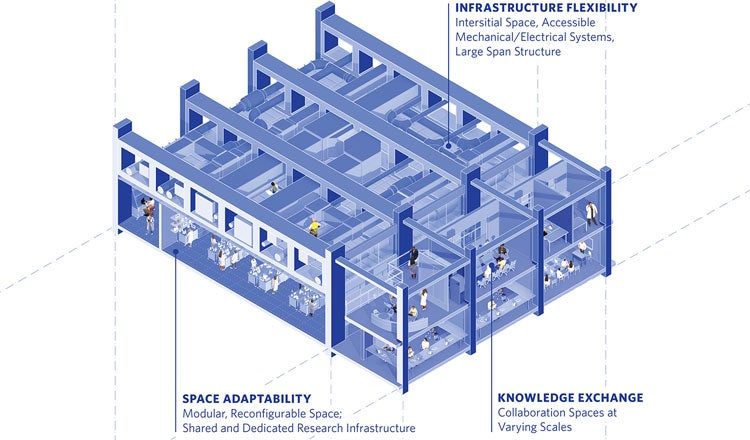
Building systems are decoupled and accessible for maintenance and upgrades as needed. The interstitial space in the loft-like hollow created by the Vierendeel truss, a type of structural frame that allows for more flexibility, offers a long span and service accessibility. Similar to a chassis for car parts, building system solutions can be easily swapped in and out without compromising the whole.
Accessible infrastructure, further supported by mobile laboratory furnishings, allows for faster adaptability — a key aspect of convergence research. Providing core facilities to exchange knowledge and share equipment prevents over-customization or duplication while still maintaining research quality.
Shared core facilities are also key to creating a sense of collegiality and encouraging collaboration, while supporting the optimization of lab and office space. The prototype allows for different scales of collaboration — maximizing the exposure and collision between the different disciplines without interrupting individual researchers’ focus.
Convergence Fellowship Research Team


When it comes to innovative workplace design, laboratories are not often the first places we think of. And yet, laboratories are places that foster the discoveries solving big challenges of our time. They deserve our full attention. The convergence prototype puts science architecture on the map, as evidenced by its selection as the Editor’s Choice for “The Future of Work” in Architizer’ s 2025 Vision Awards — a discipline agnostic category focusing on what future workplaces will look like.

Strategically located within the heart of Discovery Square — a dynamic, 16-block innovation district in downtown Rochester — the Kellen Building extends Mayo Clinic’s research presence into a thriving ecosystem of life sciences, technology and entrepreneurship. This highly connected urban hub fosters collaboration between agile startups and global industry leaders, all within a walkable neighborhood enriched by housing, cultural institutions, dining and entertainment.


Interested in learning more about the HDR Fellowship on convergence and its impact on lab design?