
Complex Engineering Decisions on a Three-Legged Pedestrian Bridge
Austin’s Wishbone Bridge Featured in Aspire Magazine
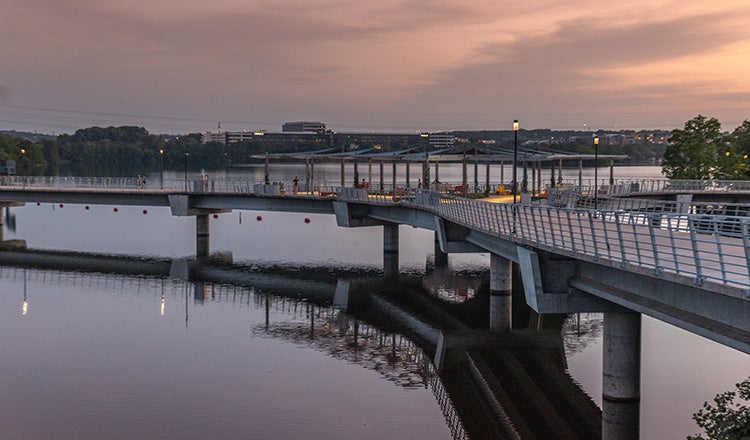
Austin’s Wishbone pedestrian bridge completes a long-missing link in the city’s loop trail system. The Y-shaped structure’s legs converge at a central plaza, connecting three shorelines at the east end of Lady Bird Lake. Since opening in early 2026, the new structure has been embraced by the community and a welcome addition to the city’s urban trail corridor. It also required complex engineering and constructability expertise.
Bridge engineer Lee Frieberg led the project’s design for HDR and wrote about the project in a recent issue of Aspire magazine. Frieberg has spent three decades providing civil engineering and project management throughout Texas as well as elsewhere in the U.S. Writing about the Wishbone bridge, Frieberg explained how the bridge’s unique three-legged design introduced much more structural complexity than typical bridges.
“From an engineering perspective, the wishbone geometry introduced challenges well beyond those of a straight crossing,” Frieberg wrote. “In a conventional bridge, thermal movement can be predicted along a single axis, with expansion and contraction occurring symmetrically. In a three-legged configuration, movement is constrained in multiple directions, creating complex stress paths that must be carefully managed.”
Frieberg also discussed challenges the team encountered working in a managed floodplain, the work done to minimize piers in the water, and strategies employed to improve constructability.
Read the full article, “Wishbone Bridge Connects Austin Through Precast Concrete Innovation,” in the Fall 2026 issue of Aspire magazine, published by the Precast/Prestressed Concrete Institute.


