
Pier B On-Dock Rail Support Facility

Pier B On-Dock Rail Support Facility
Reducing Congestion, Improving Sustainability, Advancing Small Businesses at the Second-Busiest Container Seaport in the United States
- Enhance on-dock rail capacity at the Port of Long Beach’s shipping terminals, speeding deliveries across the entire national supply chain, easing congestion and lessening environmental impacts
- More than triple the volume of on-dock rail cargo the Port can handle annually, from 1.5 million twenty-foot equivalent units (TEUs) to 4.7 million TEUs
- The $1.815 billion program is being delivered in phases
The Port of Long Beach is the second busiest port in the United States handling trade valued at more than $300 billion annually. As a gateway for global commerce, the port facilitates the arrival and departure of goods from around the world. Incoming goods are transported by truck or rail to their destinations across the United States. To improve efficiency and reduce emissions throughout Southern California, the Port of Long Beach has been working for decades to modernize its on-dock rail support infrastructure. HDR has been assisting the port with those efforts since the late 1990s.
Currently, HDR is providing final engineering design services for the Port’s Pier B On-Dock Rail Support Facility Program. Previously, the team provided preliminary engineering services and environmental support. The final design includes site investigations, utility potholing, waste characterization, rail simulation and modeling, traffic studies, structural analyses, hydraulic study, lighting analyses, utility and drainage design, roadway and site design, railroad and track design, Envision sustainability design and pump station design.
The $1.815 billion program has been organized into 10 construction projects. Construction began in August 2024 and is expected to be completed in 2032. When complete, the new facility will double the size of the existing Pier B rail yard from 82 acres to 171 acres.
Key components of the program include:
- Realignment of the existing Pier B Street and Pico Avenue
- Altering the embankment of State Route 710 for additional tracks along Pico Corridor and construction of a retaining wall and a tie-back wall to accommodate a total of eight railroad tracks
- Closure of the Ninth Street at-grade crossing
- Reconfigure existing tracks and add additional tracks to allow five arrival/departure tracks up to 10,000 feet long with direct connection to the on-dock rail facilities and the Alameda Corridor railway totaling 52,000 additional track-feet
- Relocation of existing mainline tracks into the North Harbor area
- Expansion of inbound-outbound staging tracks to accommodate up to five 10,000-foot trains
- Expansion of existing railcar storage and staging with 38 storage tracks totaling 93,000 track-feet
- A new locomotive staging and re-fueling facility with capacity for 30 locomotives
- Removal of the Shoemaker Bridge ramps and other streets between 9th Street and 12th Street
- Provide crash walls to protect existing State Route 103 (SR-103) (Terminal Island Freeway) and Anaheim Street overcrossing bridge columns
- Modify existing Berth 54 Crescent Warehouse to accommodate Pico Avenue realignment
- Construct a storm drain and sewer lift station
- Demolish the existing Los Angeles County LA-04 Pump Station and construct a pump station at a new location
- Coordinate third-party utility relocations outside of the rail corridors. Relocate public utilities outside of the rail corridors
- Relocate the existing 16 active oil-production-associated wells outside of the rail corridors
- Widening of the Dominguez Channel Bridge to accommodate an additional track
HDR is teaming with 35 subconsultants to undertake the site investigation, utility potholing, rail modeling, and the final design on the Pier B program.
Easing Port Congestion
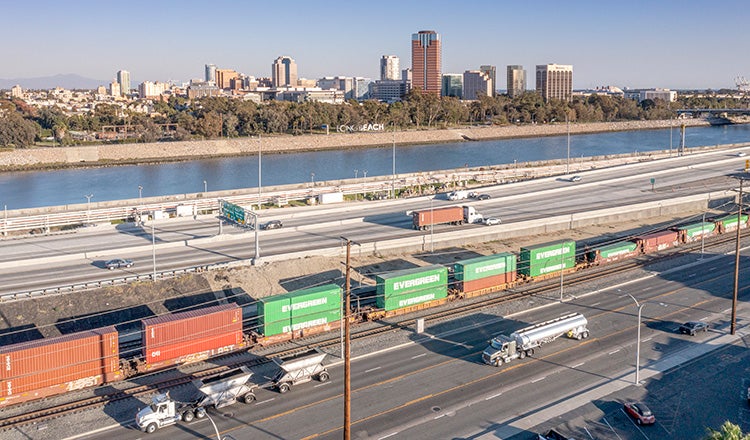
On-dock rail helps reduce traffic congestion by taking trucks off the road. One 10,000-foot-long double-stacked intermodal train can eliminate up to 750 local truck trips, and trains are up to four times more fuel efficient. Good for the environment as well as business, this program will enhance capacity, velocity and safety, increasing the number of containers shipped by rail from the port.
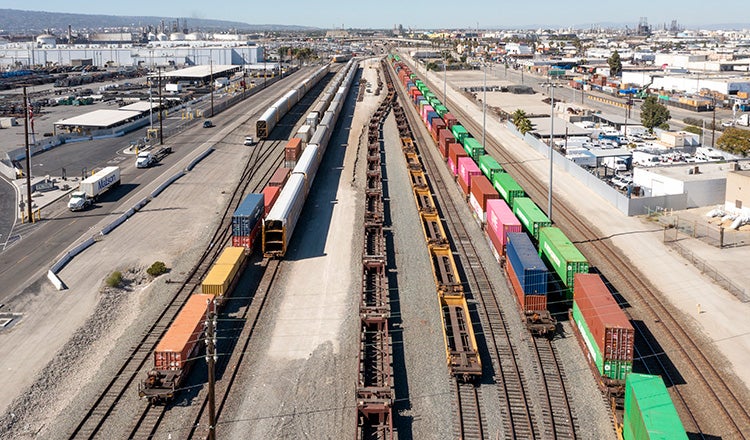
Containers will be unloaded from ships and immediately transported to the Pier B rail yard, where they will be sorted. This will relieve congestion on the dock, which has smaller capacity.
The new rail yard — the inland heart of the port — will move freight much more efficiently, including receiving and departing multiple 10,000-foot trains. The new rail yard design includes an additional 33 miles of rail and 166 turnouts.
Mapping Utilities for the Century-Old Port
The Port of Long Beach has been operating for more than 100 years. Throughout its history, utilities, including oil pipelines, were installed and some were not well-documented or were abandoned. Within the program area, a stormwater pump station must be relocated. There are also two operating oil fields. Additionally, the Port of Long Beach receives offshore oil and has shipping lines that take the oil to refineries north of the project footprint.
We are coordinating the design of utility relocations, working closely with the Port of Long Beach and the cities of Long Beach and Los Angeles. Our team is working with more than 40 utility owners and agencies on relocating or removing more than 1,000 utility lines. Our comprehensive utility approach incorporates subsurface and potholing investigations, including ground penetrating radar surveys across more than 50 acres.
Improving Sustainability
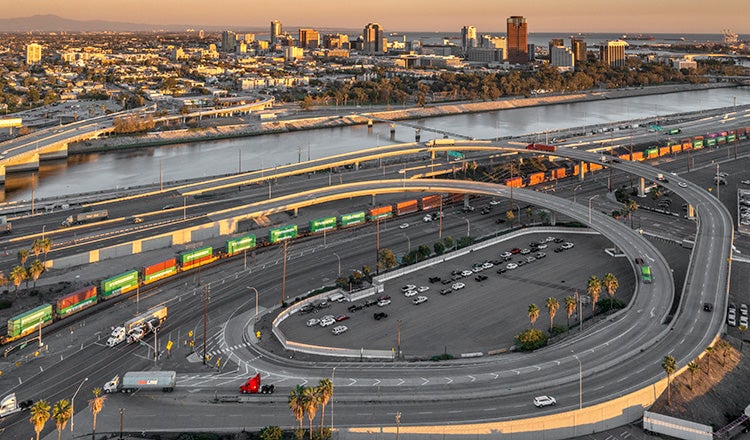
In support of the Port’s Green Port Policy, HDR is also performing support work with the goal that the new facility is sustainably designed and constructed to maximize on-dock rail use and efficiency.
With the assistance of HDR and subconsultants, the port is pursuing a Gold Envision rating. Our sustainability experts have been working to set up a potentially groundbreaking strategy to identify, plan for, collect credit documentation, and eventually submit for verification to the Institute for Sustainable Infrastructure.
Working Closely with Small Businesses
Our team in California has a robust mentor program, and we put it into practice with our small business subconsultants on this program.
The mentorship is a year-long program for protégés that is tailored to address their core needs for growth. Each program is unique, customized to the needs of the small business. Typical topics include strategic planning, business development, technical skills and either accounting or quality processes. Experts from around HDR hold rigorous training sessions, including homework and quarterly check-ins. In addition, small businesses have the opportunity to join HDR’s community outreach efforts. This demonstrates a true partnership that creates meaningful impact for both the businesses and the communities they serve. At the end of these activities, the protégé business is equipped with tools and tailored templates necessary to support growth and to bid on future contracts.


